A resource to support teachers and support staff in identifying key elements that would support pupils with greater depth in writing at KS2.
A number of focus sessions are included that could be used individually or as part of a targeted intervention.
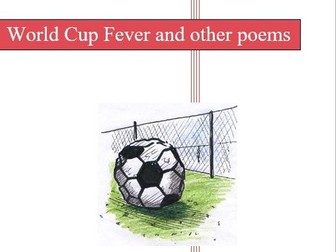
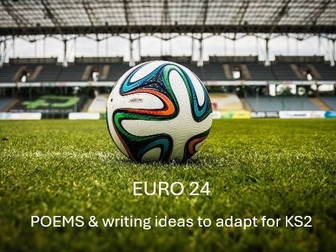
A collection of six football themed poems that could be used for reading, performance or as models for children to write their own World Cup themed poems.
An audit document to support English subject leaders and early reading leads review their provision and approaches to early reading and phonics, particularly in view of the emphasis on Early Reading within Ofsted’s EIF.
Key elements from recent research findings about the accuracy of phonetically decodable books are also included.
A brief prompt sheet for hearing readers to see how well they apply their phonics knowledge is also included.
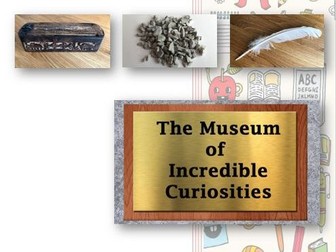
Based around a drama/ speaking and listening game, the resource enables pupils to work as 'experts' in their field.
The resource provides resources (images), a clear outline and guidance as well as links to two films on Vimeo for pupils to give their 'expert' opinions on a number of unidentified objects for The Museum of Incredible Curiosities.
Dr Al introduces the films (KS1 and 2 and expert opinions are modelled by Dr Kendra Robinson.
Additional images are included as well as examples of museum artefact card writing, including greater depth examples for year 6.
This document uses the reading strands for the end of year key stage assessment (KS1 and 2) and considers possible questions that could support both guided reading and independent activities.
A blank column is left for teachers to add additional ideas, questions or approaches that would support the development of reading comprehension in the primary school.
The questions are based on the idea of a progression in difficulty or complexity for the development of reading comprehension in the primary school.
They are broadly based on Bloom’s taxonomy but also include other aspects of comprehension that it could be argued a ‘good reader’ needs be able to use at different stages.
The questions may also prove useful with the current approach of whole class reading or a single text, that many schools seem to have implemented recently: the ‘ACE’ (Apprentice, Competent, Expert) structure thereby allowing some level of differentiation.
The ‘Depth’ element is designed to be particularly challenging for pupils and a level of support may need to be provided in order that pupils are able to understand the focus of some of the questions.
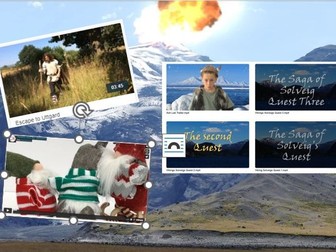
A range of winter themed resources for EYFS (links with the Tomtes (Gonks) video clips on Vimeo), KS1 The Ash Lad, KS2 Quests and sagas.
Vimeo links to all the clips on Vimeo which can be downloaded.
EYFS / KS1
Tomte Tales, Tomtes and the Sledge
How to make a Tomte - instructions
KS1 - The Ash Lad, The Mastermaid (traditional Nordic tales)
KS2 Notes for video and guidance for Solveig’s Quests (3 of them) - to support narrative retelling and writing
Solveig’s Quest – transcript and plan
Solveig’s Quest – photo resources
Text features - Myths and Legends
Stories: The Tale of The Ash Lad (Askeladden) and the Troll
The Mastermaid
Notes for video – KS2
Brynolf’s Quest (Escape to Uttgard) - KS2 story writing
Runes
In the Shadow of the Fire Mountain - drama outline for improvisation, developing a community, exploring scenarios
Character profile sheets - to support drama, character and writing
Adaptable ideas and poems based around the theme of football and the Euros.
The resource includes poems and suggestions of models to support pupils in creating their own poems.
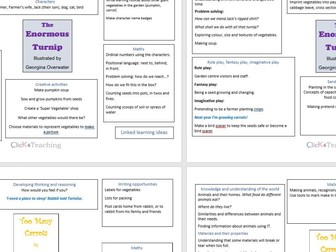
Planning maps for early Years using the following texts:
Blast Off - Malachy Doyle and Gill McClean
Who’s bad and who’s good, Little Miss Riding Hood
Too Many Carrots - Katy Hudson
The Enormous Turnip - Illustrated by Georgina Overwater
Additional role play scenarios for Blast Off
A resource for year 2 or 3 pupils who are sometimes using conjunctions but are not sure what difference they make to the writing.
What advice would they give to Dr Al as he tries to master joining clauses?
A brief document to support English subject leaders consider the implications for their school data in preparation for prioritising and action planning in the next academic year.
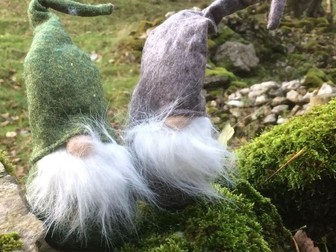
A short sequence of slides that introduce the idea of Tomtes (pronounced Tom - tees) and their life in the snowy north.
The resources can be used to develop speaking and listening (Tell me what you see…Tell me what they are doing/ thinking / saying etc).
With simple resources (natural - pine cones, acorn cups, sticks, twigs, leaves etc) it is possible to create small world play bags for young children to take inside and out, to create their own environments. A few soft Tomtes available in winter also provide a context for play and developing environments.
The slides could be used also with other presentations to introduce young children to possibilities for creative play and thinking.
Other Powerpoints include: The Tomtes and the Gingerbread House, The Tomtes and the Jumpers, The Tomtes and the Postbox, The Tomtes and the Snowman, The Tomtes and the Tree, The Tomtes go sledging.


 Quick View