Count On from Any Number — Year 1Quick View
dobrawa_czeska

Count On from Any Number — Year 1

(0)
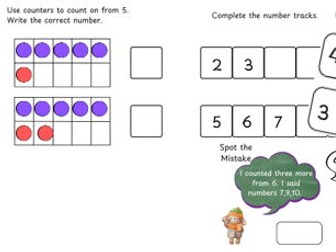
This Year 1 maths resource supports the White Rose Maths scheme by helping pupils practise counting on from any given number within 10. It includes number tracks, counting activities with counters, “spot the mistake” challenges, and simple addition tasks to build number fluency and confidence in sequential counting.
Counting from a larger groupQuick View
dobrawa_czeska

Counting from a larger group

(0)
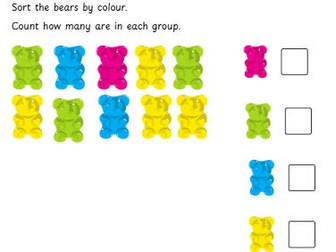
This task helps children practise counting and sorting objects from a larger group. Pupils identify and circle or colour a given number of items (e.g. “Circle 7 pears” or “Colour 5 pinecones”), then sort bears by colour and count how many are in each group. They also answer “how many are left” questions and solve simple problems using visual objects (like flowers or chocolate chips), building understanding of counting, grouping, and subtraction within 10.
Represent objects within 10 and 20Quick View
dobrawa_czeska

Represent objects within 10 and 20

(0)
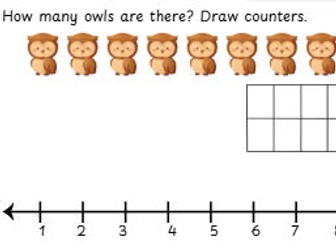
Worksheet set focused on helping children represent quantities using counters and ten frames. Pupils count different objects (like leaves, acorns, squirrels, or pumpkins) and draw the corresponding number of counters to show their understanding. They also match groups of objects to ten frames and identify sets that do or do not match, developing early skills in counting, representing numbers, and recognising quantities up to 20.
Recognise numbers as wordQuick View
dobrawa_czeska

Recognise numbers as word

(0)
This five-page worksheet helps children recognise and connect number words with numerals. Activities include matching numbers to their written words, writing numerals for given words, and representing numbers by drawing counters or circling objects. It also includes “spot the mistake” tasks to check understanding. The focus is on building confidence in reading, writing, and representing numbers from 0 to 10.
Understanding numbers 11, 12 and 13Quick View
dobrawa_czeska

Understanding numbers 11, 12 and 13

(0)
This resource includes a PowerPoint presentation and accompanying worksheet designed to support the teaching and learning of ‘teen’ numbers — specifically 11, 12, and 13. It provides visual models, base ten representations, and reasoning activities to help pupils develop a clear understanding of the structure of teen numbers and confidently apply this knowledge in practical contexts.
Understanding numbers 14,15 and 16Quick View
dobrawa_czeska

Understanding numbers 14,15 and 16

(0)
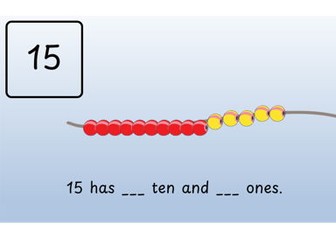
This resource includes a PowerPoint presentation and accompanying worksheet designed to support the teaching and learning of ‘teen’ numbers — specifically 14, 15, and 16. It provides visual models, base ten representations, and reasoning activities to help pupils develop a clear understanding of the structure of teen numbers and confidently apply this knowledge in practical contexts.
Understanding  numbers 18, 18 and 19Quick View
dobrawa_czeska

Understanding numbers 18, 18 and 19

(0)
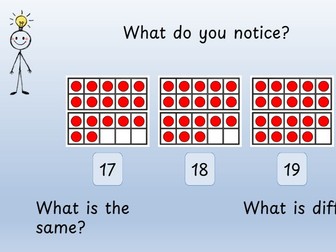
This resource includes a PowerPoint presentation and accompanying worksheet designed to support the teaching and learning of ‘teen’ numbers — specifically 17, 18, and 19. It provides visual models, base ten representations, and reasoning activities to help pupils develop a clear understanding of the structure of teen numbers and confidently apply this knowledge in practical contexts.
Who was Florence NightingaleQuick View
dobrawa_czeska

Who was Florence Nightingale

(0)
In this engaging lesson, children are introduced to Florence Nightingale, the inspirational “Lady with the Lamp,” who transformed nursing and healthcare. The lesson begins with a video of the PowerPoint, where Florence herself speaks directly to the children, bringing history to life through storytelling and vivid visuals. Afterwards, pupils take part in a timeline activity, using timeline cards to order key events from Florence’s remarkable life — from her early years to her work during the Crimean War. This interactive session helps children understand her lasting impact on medicine and society in a fun and memorable way. Enjoy!
Understanding number 20Quick View
dobrawa_czeska

Understanding number 20

(0)
This lesson helps children develop a deep understanding of the number 20. Through an engaging PowerPoint presentation and accompanying worksheet, pupils explore different ways to make 20 using tens and ones, number sentences, and visual representations such as ten frames and base ten blocks. The activities support reasoning and fluency, helping learners recognise 20 as two tens and build confidence in composing and decomposing numbers within 20.
Number to 20Quick View
dobrawa_czeska

Number to 20

(0)
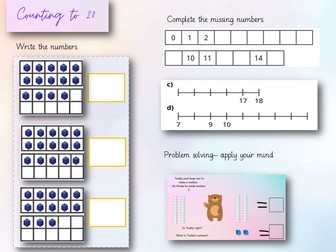
This worksheet helps children practise recognising, ordering, and identifying numbers up to 20. Pupils complete number lines, identify the numbers shown by arrows, and apply their understanding through short problem-solving questions. It supports early number sense and sequencing skills in a fun, visual way.
Numbers to 20 Year 1/2 worksheet + PPTQuick View
dobrawa_czeska

Numbers to 20 Year 1/2 worksheet + PPT

(0)
Recap numbers to 20. Engaging worksheet and power point. Task 1, Task 2 and apply your mind (problem solving). National Curriculum links • Read and write numbers from 1 to 20 in numerals and words (Y1) • Read and write numbers to at least 100 in numerals and in words
Counting objects within 10 and 20 + reasoning questionsQuick View
dobrawa_czeska

Counting objects within 10 and 20 + reasoning questions

(0)
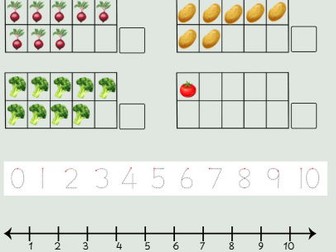
This 7-page worksheet pack provides engaging practice for early learners to develop their counting, number sense, and number formation skills using ten frames. Each page features clear visual representations to help children count objects up to ten, understand quantity, and build confidence in writing numerals correctly. Designed to support White Rose Maths resources, this pack aligns with key early learning objectives and reinforces concepts taught in the classroom.
Counting objects PPTQuick View
dobrawa_czeska

Counting objects PPT

(0)
The presentation helps children apply the five key counting principles through visual examples and interactive questions: One-to-one principle: Saying one number name for each object. Stable-order principle: Using number names in the correct order. Cardinal principle: Understanding that the last number said represents the total number counted. Abstraction principle: Recognizing that anything can be counted, including sounds and movements. Order-irrelevance principle: Knowing that objects can be counted in any order and the total remains the same.