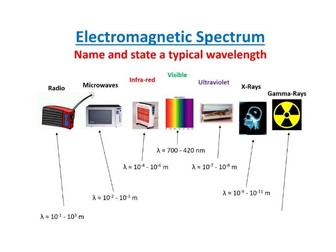
This short resource in power point using pop-ups leads students to an understanding of the parts of the electromagnetic spectrum, including the names and the wavelength of the bands.
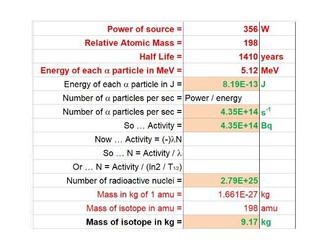
This resource is to calculate the Power from a Radioactive Source in a Space Probe.
A radioactive source is used to supply energy to a space probe.
Given the Power of the source, the Relative Atomic Mass of the isotope,
the Half Life of the source and the Energy of each Alpha Particle,
calculate the minimum Mass of the isotope required
to supply enough power for the space probe.
There are a series of four (4) examples with answers, followed by a template to make your own.
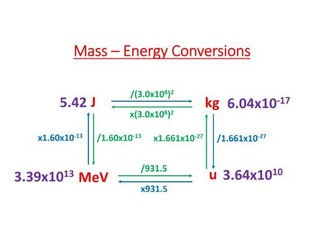
This short resource using power point featuring pop-ups, links ideas of Joules (J) and Mega Electron Volts (MeV) with kilogrames (kg) and Atomic Mass Units (u) in a simple but effective manner. It can use it as a starter, plenary or assessment during the main part of the lesson. It provides immediate checking of understanding.
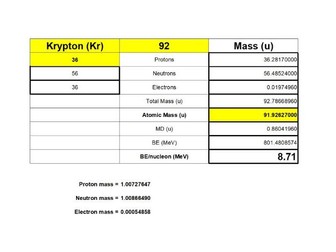
This excellent resource will help with the study of Mass Defect (MD), Binding Energy (BE) and Binding Energy per Nucleon calculations.
There are eight (8) examples in total, each with a question sheet along with the solutions. Students are able to immediately check their final answer for Binding Energy/Nucleon and see exactly where a mistake has been made, if this should apply.
The examples are: Gold 197, Helium 4, Krypton 92, Barium 141, Hafnium 180, Radon 212, Uranium 235 and Germanium 76. Additionally, as the spreadsheets are in Excel, it becomes very easy to add other isotopes to the list yourself if required.
After the students have calculated the examples, it becomes a very easy task to get them to plot a graph of BE/Nucleon against Mass Number A to obtain the expected simplified graph. A great lesson!
A blank sheet for your own examples is included at the end.
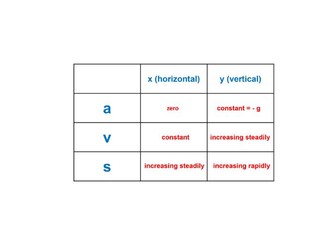
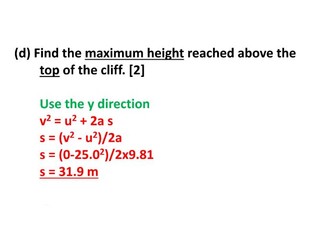
A very simple yet effective power point resource with pop-ups to get students to analyse the motion of projectiles in the x and y directions. The resource can be used as AFL during a lesson, as a starter or as a plenary. Although very brief, it is extremely instructive.
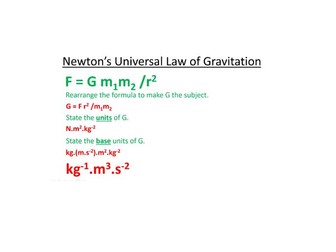
This short power point with pop-ups for Derived Units and Base Units for Big G can be used for teaching or assessment, as a starter or as a plenary. The pop-ups can be stepped through, with suggestions from the students. A useful resource for the study of units. Although a very brief resource, it is extremely educational for the teaching of units.
Two Projectile Motion AfL Examples in power point including the solutions with step-by-step pop-ups for easy use with students. Suitable for examples, tests, starters or plenaries, etc. Blanks with headings are good for printing out for student use. All the easy steps which lead through the main parts of understanding Projectile Motion questions. Each of the two examples contain eleven calculations, all with pop-up solutions provided.
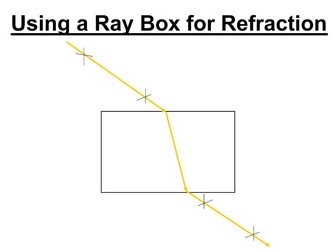
This resource is for using a ray box for reflection and refraction is a power point with pop-ups that demonstrates all the steps involved in experimenting with Reflection and Refraction in the science lab. Use the power point to explain how to draw the ray diagrams before experimentation, during and/or finally as a plenary after completion.
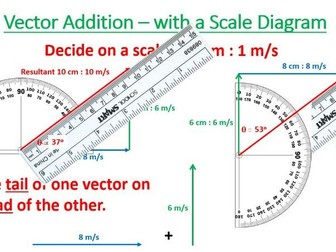
This is a Power Point on the Addition of Vectors which explains the process of Vector addition in a step by step way. We start with a very short video link as a plane lands in strong cross winds. The process of adding vectors is then explored using calculations and then scale diagrams for right angle triangles. Acute and obtuse angle triangles are then finally investigated. Lesson objectives are included.
Analysis of electrical circuits is used to calculate the resistance, potential difference, current and power for different parts of the arrangement. Three examples are provided each with increasing level of difficulty. The power point pop-ups show the questions and the solutions at each stage of the analysis. Can be teacher demonstrated and/or student investigation. The last example involves a battery of two cells with their poles reversed.
A great resource for combining uncertainties when adding, subtracting, multiplying and dividing. Can be used as an explanation, a starter test or a plenary. The power point pop-ups provide the solutions at each stage.
Using Conservation of Momentum diagrams, a vector equation is applied to an explosion using power point. Vector subtraction and vector addition are demonstrated. This is resource 5 in a series of examples on vector equations.
This is a Power Point on the Subtraction of Vectors which explains the process of Vector Subtraction in a step-by-step way. An introductory video link shows the near absence of relative velocity when two panes are approaching parallel runways. The process of subtracting vectors is explored using a right-angle triangle. Acute and obtuse angle triangles are then investigated. Six multiple choice examples are included throughout the package.
Using Conservation of Momentum diagrams, a vector equation is applied to a collision using power point. Vector subtraction and vector addition are demonstrated. This is resource 1 in a series of examples on vector equations.
A great resource for combining uncertainties when adding, subtracting, multiplying and dividing. Can be used as an explanation, a starter test or a plenary. The power point pop-ups provide the solutions at each stage.
Students are invited to read off values from a straight line graph in order to state and calculate the intercept and gradient and to estimate their uncertainties.
Using Conservation of Momentum diagrams, a vector equation is applied to a collision using power point. Vector subtraction and vector addition are demonstrated. This is resource 2 in a series of examples on vector equations.
Using Conservation of Momentum diagrams, a vector equation is applied to an explosion. Vector subtraction and vector addition are demonstrated. This is resource 4 in a series of examples on vector equations.
Students are invited to read off values from a straight line graph in order to state and calculate the intercept and gradient and to estimate their uncertainties.
This is a very useful set of 5 examples for calculating and combining uncertainties. The differentiated questions can be easily printed along with the solution pages when required. The uncertainty examples become more challenging as the students progress through the list: Area and Force (multiply), Velocity and Pressure (divide) and Resistivity (multiply and divide).