Targeted practice with the cardiac output = stroke volume x heart rate equation, including unit conversions and exam-style rearrangements.
Visit advisoryscience.com for more science teaching resources.
Practice calculating SA:V ratios for different cell shapes and organisms, linking results to diffusion efficiency and organism size.
Visit advisoryscience.com for more science teaching resources.
Structured practice calculating percentage change in mass during osmosis required practicals, including negative values and interpretation.
Visit advisoryscience.com for more science teaching resources.
Drill calculating rate of reaction from enzyme experiment data, including interpreting graphs and using the rate = 1/time formula.
Visit advisoryscience.com for more science teaching resources.
Focused practice using the magnification triangle to calculate magnification, image size, and actual size from microscopy diagrams and data.
Visit advisoryscience.com for more science teaching resources.
This workbook covers both pressure = force/area and p = h rho g for fluid pressure. Students practise substitution, rearrangement, and unit conversion across a range of Edexcel GCSE Physics contexts. Full worked answers included. Print-ready for particle model topics or revision.
Visit advisoryscience.com for more science teaching resources.
Students build fluency with s = d/t in all its rearrangements, with questions covering a range of real-world scenarios. This is often the first Physics equation students meet and they need solid practice. Designed for Edexcel GCSE Physics with full worked answers. Print-ready for lessons or revision.
Visit advisoryscience.com for more science teaching resources.
Students practise the transformer equation Vs/Vp = Ns/Np alongside power conservation calculations for step-up and step-down transformers. Covers the Edexcel GCSE Physics specification requirements. Full worked answers included. Print-ready and useful for magnetism and electromagnetism revision.
Visit advisoryscience.com for more science teaching resources.
This workbook gives students repeated practice applying v = f lambda to calculate wave speed, frequency, and wavelength. Questions cover sound waves, light, and water waves in Edexcel GCSE Physics contexts. Full worked answers included. Print-ready for waves topics or exam revision.
Visit advisoryscience.com for more science teaching resources.
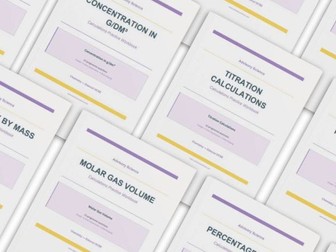
14 print-ready Chemistry calculation workbooks targeting every quantitative chemistry skill on the Edexcel GCSE specification. Each workbook isolates a single calculation type so students build genuine fluency before moving on. Full worked answers are included in every book.
Topics covered: relative formula mass, moles, conservation of mass, concentration in g/dm3, concentration in mol/dm3, atom economy, percentage yield, percentage by mass, empirical formula, reacting masses, molar gas volume, titrations, energy change Q=mcDeltaT, and bond energies. The heavy hitters are all here.
Visit advisoryscience.com for more science teaching resources.
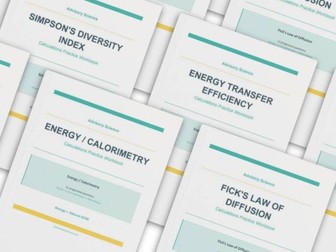
16 print-ready Biology calculation workbooks covering every required maths skill for Edexcel GCSE. Each book targets one calculation type so students get focused, repeated practice without cognitive overload. Full worked answers are included in every workbook.
Topics covered: magnification, BMI, cardiac output, percentage change, rate of enzyme reaction, rate of transpiration, capture-recapture, energy calorimetry, energy transfer efficiency, Fick’s law, inverse square law, area of clear zone, population density, rate of decomposition, rate of reaction, and Simpson’s diversity index. Use them for lesson starters, homework, revision, or intervention.
Visit advisoryscience.com for more science teaching resources.
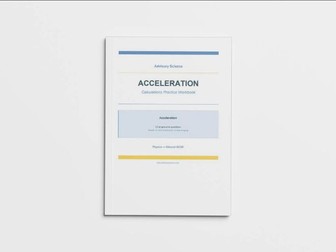
Plenty of practice calculating acceleration using a = (v-u)/t, including deceleration questions and rearranging for other variables. Covers the formula as it appears in Edexcel GCSE Physics exams. Full worked answers are included throughout. Print-ready for classwork, homework, or revision.
Visit advisoryscience.com for more science teaching resources.
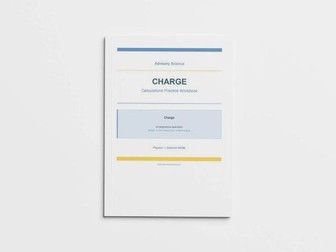
Focused practice calculating charge transferred using Q = It, including rearranging for current and time. Questions are based on the Edexcel GCSE Physics specification with realistic circuit scenarios. Full worked answers included. Print-ready and suitable for electricity topics or revision.
Visit advisoryscience.com for more science teaching resources.
This workbook gives students practice calculating efficiency as both a decimal and a percentage. Questions cover energy transfers and power in real-world contexts for Edexcel GCSE Physics. Full worked answers included throughout. Print-ready for lessons, homework, or exam preparation.
Visit advisoryscience.com for more science teaching resources.
Focused drill on calculating electrical power using P = IV and P = I squared R. Students work through circuit problems with increasing complexity. Designed for Edexcel GCSE Physics with full worked answers. Print-ready and ideal for electricity topics or targeted revision.
Visit advisoryscience.com for more science teaching resources.
Students use E = QV and E = Pt to calculate energy transferred in electrical circuits. Covers kilowatt hour calculations and unit conversions as required by Edexcel GCSE Physics. Full worked answers included. Print-ready for classwork, homework, or revision sessions.
Visit advisoryscience.com for more science teaching resources.
Repeated practice with Newton’s second law F = ma, including rearranging for mass and acceleration. Questions cover resultant forces and real-world contexts. Written for Edexcel GCSE Physics with full worked answers. Print-ready and perfect for forces topics or exam revision.
Visit advisoryscience.com for more science teaching resources.
This workbook covers calculating the force on a current-carrying conductor in a magnetic field using F = BIl. Students practise substitution and rearrangement in motor effect contexts. Designed for Edexcel GCSE Physics with full worked answers. Print-ready for magnetism topics or revision.
Visit advisoryscience.com for more science teaching resources.
Students build fluency with KE = half mv squared through repeated, structured practice. Questions include rearranging for mass and velocity, which students often find tricky. Written for Edexcel GCSE Physics with full worked answers. Print-ready for energy topics, revision, or intervention.
Visit advisoryscience.com for more science teaching resources.
This workbook covers calculating momentum and applying conservation of momentum to collision and explosion problems. Students practise p = mv alongside two-body calculations. Designed for Edexcel GCSE Physics with full worked answers. Print-ready and useful for forces topics or exam preparation.
Visit advisoryscience.com for more science teaching resources.
Focused practice with GPE = mgh, including rearranging for mass, height, and gravitational field strength. Covers the calculation as tested in Edexcel GCSE Physics exams. Full worked answers are included throughout. Print-ready and ideal for energy topics or revision sessions.
Visit advisoryscience.com for more science teaching resources.