In this lesson: Measuring and representing motion
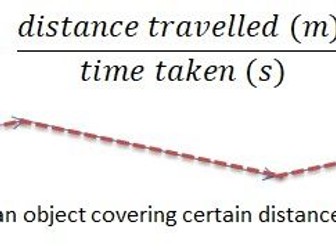
Describe motion - speed and distance
Vector quantities
Equations of motions (for constant acceleration)
Motion in 2D
Measuring motion
Examples and Exam questions
The lessons are based on AQA curriculum:
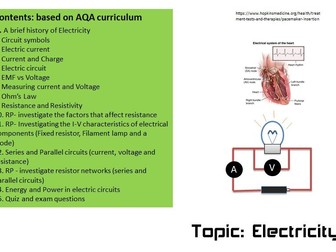
A brief history of Electricity
Circuit symbols
Electric current
Current and Charge
Electric circuit
EMF vs Voltage
Measuring current and Voltage
Ohm’s Law
Resistance and Resistivity
RP- investigate the factors that affect resistance
RP- Investigating the I-V characteristics of electrical components (Fixed resistor, Filament lamp and a diode)
Series and Parallel circuits (current, voltage and resistance)
RP - investigate resistor networks (series and parallel circuits)
Energy and Power in electric circuits
Quiz and exam questions
A fully simplified lesson on phase and path difference. The lesson cover:
Path Difference: A measure of how far ahead a wave is compared to another wave, usually expressed in terms of the wavelength.
Phase Difference: The difference in phase between two points on a wave. It is usually expressed in radians.
Lesson objectives:
Define and describe: Power and resistance
Calculate Power, resistance and energy transfer
Describe Ohm’s law
Describe and explain different types of conductors: Ohmic vs non-Ohmic
Key points:
All organisms in an ecosystem depend on each other.
Food chains show the flow of energy from one organism to another.
Food chains show the feeding relationships between organisms.
Food webs show how all the food chains in an ecosystem interact.
It is a complete lesson with quiz and questions.
Key points:
Different elements are present in different parts of the Earth’s structure.
The crust is made from enormous plates which move very slowly due to movements of the mantle below.
The rocks on Earth are constantly changing due to many different processes.
There are three main types of rock, with rocks changing between each type over millions of years.
This rock recycling is a process called the rock cycle.
Lesson objectives:
I can describe the role of the human skeleton in support, protection and making blood cells.
I can describe what muscles are made of and how they move.
I can explain how muscles work together to move bones at joints.
Students will be able to:
understand that the moment of force is a measure of its tendency to cause a body to rotate about a specific point,
understand that if the line of action of a force passes through a point, the force does not give rise to a moment about that point,
calculate the moment of a force about a point,
calculate the moment of the sum of a system of forces about a point,
understand that the counter clockwise direction is defined as positive for moments.
Lesson objective: you are able to
set-up a practical using various components, including a filament lamp, a diode and a resistor at a fix temperature.
collect data to draw conclusion I-V characteristics of various components.
A simplified lesson to focus on pupils understanding:
what specific heat capacity (SHC) is.
calculate: energy transfer, change in temperature and specific heat capacity of different substances.
Lesson objective: you are able to
set-up a basic circuit
set-up series and parallel circuits using resistors (i.e. lamps)
understand and explain why the current, resistance and voltage vary in series and parallel circuits.
answers exam-style questions
I prepared the lesson step by step as this is a difficult concept. Pupils should know:
that the latent heat of fusion: temperature remains constant when solid turns to liquid
that the latent heat of vaporisation: temperature remains constant when liquid turns into gas
how to use E=ml to calculate energy transfer
(for higher or A- level) Questions that involve both SHC and SLH
A well explained lesson with lots of animation will certainly help pupils.
Lesson Objectives:
Know and able to use formulas to calculate different energy stores of objects.
Be able to make calculations of energy transfer between stores.
Know that a stretched (or compressed) spring has elastic potential energy stores.
Be able to calculate elastic potential energy stores, spring constant and extension using formula.
This lesson is useful for both GCSE and A-level maths students.
understand and recall the factor theorem
-use the factor theorem to verify that a linear expression is a factor of a polynomial
-find unknowns in a polynomial expression given a linear factor by using the factor theorem
The lesson covers: (very simplified)
Newland’s periodic table with errors
Mendeleev’s table with errors
The modern periodic table: electronic configuration, non-metals and metals…
Exam style questions on Periodic table.