 Quick View
Snap Match educational card game for ESL learners
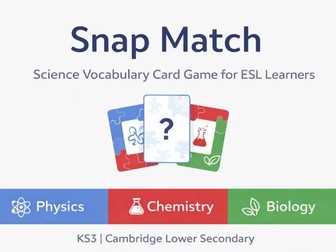
Snap Match is a KS3 / Cambridge Lower Secondary Science vocabulary card game designed to support ESL learners in building confidence with key scientific words, meanings and examples.
This resource uses a simple matching format to help students learn and retain essential science terminology through active, competitive practice. Each set focuses on one topic at a time and is colour-coded by subject: Physics (blue), Chemistry (red) and Biology (green).
Students match:
the key word
the easy meaning
the example
For Chemistry ions, students match:
the ion name
the charge
the formula
The resource is designed to help learners:
understand scientific vocabulary more easily
improve reading and comprehension of science questions
use key terms more accurately in speaking and writing
strengthen recall through repetition and retrieval practice
improve confidence in Cambridge Lower Secondary / KS3 Science
Included are printable PDF card packs that can be laminated and reused for pair work, small-group competition, starter activities, revision games and intervention support for weaker ESL learners.
Topics currently include:
Energy stores
Forces
Cells
Cell adaptations
Organisation in living things
Digestive system
Respiratory system
Circulatory system
Y9 Physics thermal transfer and expansion
GCSE Chemistry ions and charges
This resource is ideal for teachers looking for a practical, low-prep way to make science vocabulary more accessible, especially for students who struggle with scientific language but can understand the concepts when terms are simplified and practised regularly.