Spanish GCSE Reports Comments - Ready to Use and AdaptableQuick View
amossoni

Spanish GCSE Reports Comments - Ready to Use and Adaptable

(0)
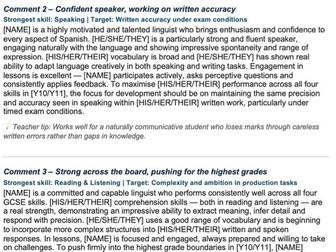
This pack contains 20 fully written Spanish GCSE subject report comments, organised into three ability tiers. Each comment covers the key GCSE skills — reading, writing, listening and speaking — and addresses vocabulary range, use of complex structures, confidence in speaking, engagement in lessons, strongest skill, and a clear target for improvement. Simply replace the placeholders with the appropriate details for each student:   [NAME] → student’s name or pronoun   [HE/SHE/THEY] → appropriate pronoun   [HIS/HER/THEIR] → possessive pronoun   [Y10/Y11] → year group   [TOPIC/SKILL] → optional specific detail The three tiers are: High Ability – Students performing confidently at Grade 7–9 Mid Ability – Students working at Grade 4–6 with clear targets Foundation/Support – Students requiring additional support, working toward Grade 1–4 All comments are written to work for both Year 10 and Year 11 — simply swap [Y10/Y11] as appropriate. Comments can be used as-is or lightly personalised with specific topics, exam details or individual achievements.
KS3 Adaptable Form Tutor Report Comments.Quick View
amossoni

KS3 Adaptable Form Tutor Report Comments.

(0)
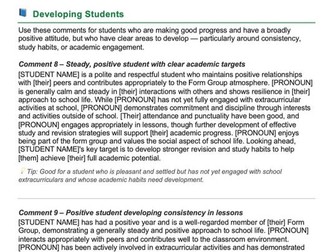
This pack contains 20+ fully written form tutor report comments, organised into three student profiles. Simply replace [STUDENT NAME] or [PRONOUN] with the appropriate name or pronoun for each student. The three categories are: Thriving Student – strong engagement, leadership, and academic commitment Developing Student – positive attitude with clear targets to build on Student Requiring Support – constructive, target-focused language for students needing redirection Comments can be used as-is or lightly adapted to reflect individual students’ subjects, activities, or achievements.
Y8 Spanish Holiday Brochure Project – End of YearQuick View
amossoni

Y8 Spanish Holiday Brochure Project – End of Year

(0)
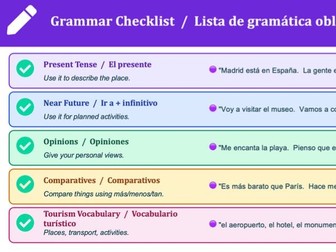
A fun, engaging end-of-year project that challenges Year 8 Spanish students to create their own holiday brochure for a Spanish-speaking destination — entirely in Spanish. What’s included: A fully bilingual PowerPoint presentation (10 slides) guiding students step by step through every section of the project, complete with example sentences, vocabulary banks, grammar prompts, and a model role-play dialogue. Students also receive a clear brief outlining exactly what their brochure must contain. A helpsheet with key vocabulary, structures and hints for each specific section of the project What students produce: A minimum 2-page holiday brochure covering a description of their chosen place, transport, accommodation, things to do, personal recommendations, and a short role-play conversation — all written in Spanish. This project is designed to consolidate key Y8 skills in one creative task. Students practise the present tense, near future (ir a + infinitive), opinion phrases, comparatives, and essential tourism vocabulary — all in a real-world context that feels meaningful rather than like a test. It’s an ideal low-stress end-of-year assessment that still demands genuine language production across multiple skill areas.
Year 9 Spanish End-of-Year ProjectQuick View
amossoni

Year 9 Spanish End-of-Year Project

(0)
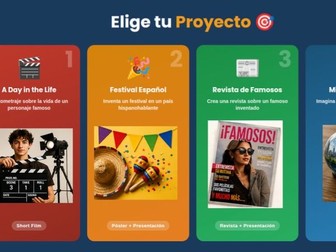
A creative and engaging Spanish project designed for Year 9 students to consolidate and showcase their language skills at the end of the academic year. Students can choose from four different project options, allowing them to personalise their work while practising key GCSE-style language skills, including descriptions, opinions, tenses, cultural knowledge, and future aspirations: A Day in the Life Create a Spanish Festival Celebrity Magazine My Future Self The project encourages independent learning, creativity, and the use of a wide range of vocabulary and grammatical structures. The resource includes: Clear project instructions Four project pathways to suit different interests Success criteria and expectations Opportunities to develop speaking, writing, reading, and cultural understanding Suitable for mixed-ability classes and independent completion Ideal as an end-of-year assessment, enrichment activity, homework project, or transition task.
AQA GCSE Spanish (2026) HIGHER Speaking Practice BookletQuick View
amossoni

AQA GCSE Spanish (2026) HIGHER Speaking Practice Booklet

(0)
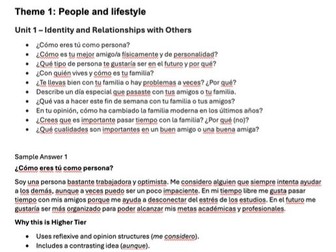
Higher Tier speaking practice booklet. Designed around all 9 units across the 3 themes of the AQA GCSE Spanish (first assessment 2026) specification, this resource provides model answers that demonstrate the language and skills required to access the top mark bands. It includes: Speaking questions covering all themes and units. Two Higher Tier model answers for each unit. Examiner-style explanations highlighting why each answer is successful. Examples of complex grammar, varied tenses, opinions, justifications, and high-level vocabulary. How can it help students? Builds confidence for the speaking examination. Develops students’ ability to give extended answers. Provides models of Grade 7–9 language. Encourages the use of a wider range of structures and vocabulary. Helps students understand what examiners are looking for in higher-level responses. Ideal for classroom use, independent revision, speaking homework, intervention sessions, and targeted GCSE exam preparation.
Y7 - Spanish Project - TV ShowQuick View
amossoni

Y7 - Spanish Project - TV Show

(0)
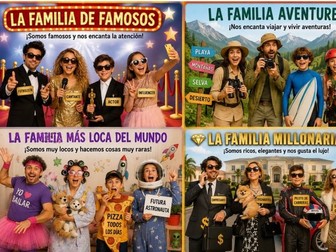
¡Familias de España! - Year 7 Spanish TV Show Project This end-of-year speaking project allows students to consolidate and apply the Spanish they have learned throughout Year 7 in a creative and collaborative context. Working in groups, students create a fictional family and take part in a TV-style interview conducted in Spanish. The project revisits the key topics covered during the year, including personal information, family relationships, physical and personality descriptions, hobbies and free-time activities, school life, pets, opinions, and future aspirations. Students use familiar vocabulary and structures to create detailed characters and respond to interview questions. Through planning, writing, rehearsing, and performing, students reinforce their speaking, listening, reading, and writing skills while developing confidence, fluency, pronunciation, and spontaneous communication. The project encourages creativity, teamwork, and the practical use of language in an engaging and meaningful setting.
Year 9 - Food & Healthy Lifestyle - WorksheetQuick View
amossoni

Year 9 - Food & Healthy Lifestyle - Worksheet

(0)
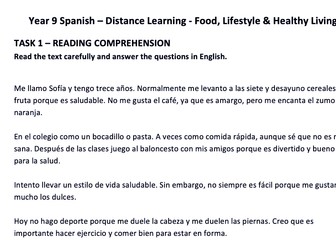
This worksheet focuses on food, meals, opinions with reasons, daily routine, sport, healthy living and “me duele / me duelen” structures. Includes: Reading comprehension text with questions in English Grammar practice (opinions + reasons, body parts, daily routine sequencing) 80–100 word structured writing task with clear success criteria Independent research task on a Spanish-speaking country Can be used for homework, independent learning or cover.
Year 8 – Food & Ordering in a Café/RestaurantQuick View
amossoni

Year 8 – Food & Ordering in a Café/Restaurant

(0)
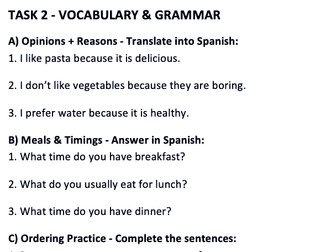
This worksheet focuses on practical communication skills: ordering food, meals, timings, preferences and giving opinions with reasons. Includes: Restaurant dialogue reading comprehension Translation and vocabulary practice Ordering sentence completion activities 90-word dialogue writing task (restaurant role-play style) Independent research task on a traditional dish Can be used for homework, independent work, cover.
Y11 - GCSE Unit 9 - Independent Learning RevisionQuick View
amossoni

Y11 - GCSE Unit 9 - Independent Learning Revision

(0)
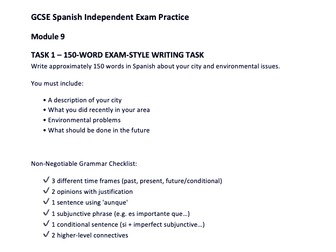
This GCSE Spanish worksheet is designed for Year 11 students preparing for their final exams, focusing on Module 9 (AQA). It promotes independent, high-level exam practice and deeper grammatical control. What’s included: • A 150-word GCSE exam-style writing task with a rigorous grammar checklist • A high-level model paragraph to guide structure and vocabulary • A challenging reading comprehension text with questions • Grammar manipulation exercises (present to past and future transformations) • An exam-style translation task (English into Spanish) • A Grade 9 Upgrade Challenge requiring verb sophistication, idiomatic language and imperfect subjunctive use Students must incorporate multiple time frames, justified opinions, advanced connectives, conditional sentences and subjunctive structures - making it ideal for securing top grades (8–9). This resource is ideal for independent revision, mock exam preparation, intervention sessions or homework.
Spanish AQA GCSE - Unit 3 - Revision Activities for Independent LearningQuick View
amossoni

Spanish AQA GCSE - Unit 3 - Revision Activities for Independent Learning

(0)
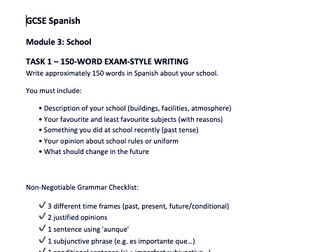
This GCSE Spanish worksheet is designed for Year 10 students studying the topic of School (Module 3). It provides structured, exam-style practice covering four key skills: writing, reading, translation and speaking. What’s included: • A 150-word exam-style writing task with a clear structure and detailed grammar checklist • A challenging reading text with comprehension questions (answers in English) • Grammar manipulation exercises (tense changes: past and future) • An exam-style translation task (English into Spanish) • A Grade 8–9 “Upgrade Challenge” to stretch higher-ability students • A structured 90-second speaking preparation task with specific tense and grammar requirements Students are required to use three time frames, justified opinions, higher-level connectives, the subjunctive and conditional structures - making this an ideal resource for developing Grade 7-9 responses. Good for cover lessons, revision, homework, or independent exam preparation.
Extending and improving writing - Year 7Quick View
amossoni

Extending and improving writing - Year 7

(0)
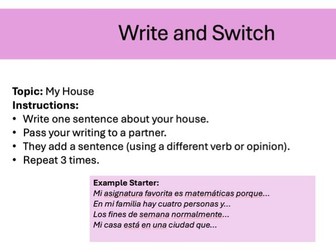
The resource contains a series of tasks for the students to complete as part of a revisions session or in preparation for assessments. These can be done as a class too or in smaller groups. Sentence Builder Activity Improve This Sentence Picture Prompt Activity Write and Switch Parallel Writing Task Connective Insertion
A Level Spanish Step-by--Step Spanish to English Translation GuideQuick View
amossoni

A Level Spanish Step-by--Step Spanish to English Translation Guide

(0)
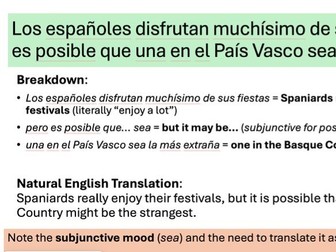
This PowerPoint file contains a step by step guide on startegies to follow to succeed in the Spa to Eng translation of Paper 1. It includes: steps to follow while completing the task two translation tasks from past papers a completed translation: sentence by sentence with analysis, suggestions and breakdown as in the picture attached.
Spanish/French - Food Tech Cross Curricular PresentationsQuick View
amossoni

Spanish/French - Food Tech Cross Curricular Presentations

(0)
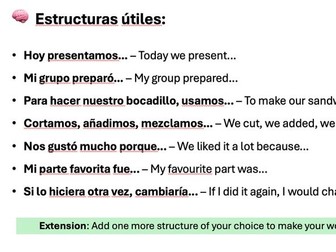
This PowerPoint contains a whole preparation lesson for a cooking session with Y8 students. It includes: Rules for Food Tech room Key vobulary/verbs Past tense gap fill task Key structures/frame for a presentation in Spanish/French an example of a presentation The presentation contains the lesson in Spanish and French - You will need to delete the slides that are not relevant to you.
Y11 Report Comment BankQuick View
amossoni

Y11 Report Comment Bank

(1)
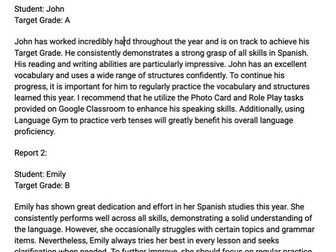
20 reports for MFL GCSE students. They include information about work ethic, target grade, skills and revision suggestions. The document is available in pdf and word format and contains a balance of Target A, B, C and D students.
¿Quién soy? Headbanz Game – End of Year Spanish Speaking Game (Year 8 & 9)Quick View
amossoni

¿Quién soy? Headbanz Game – End of Year Spanish Speaking Game (Year 8 & 9)

(0)
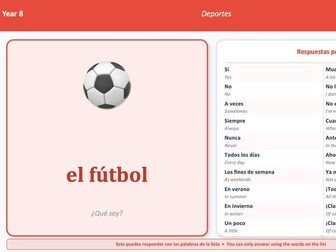
Fun, low-prep speaking activity your students will actually want to play! Based on the classic Headbanz game, students must guess the Spanish word on the slide behind them by asking yes/no questions - entirely in Spanish. This resource includes two ready files: 30 PowerPoint game cards covering topics such as food, animals, travel, jobs, and Spanish culture. Each card features the target word, an illustration, and a full list of possible answers in Spanish and English for the class. A bilingual Question Mat (Word document, A4) with 25 ready-to-display starter questions organised by category - perfect for projecting on the board or printing as a desk mat and support the student guessing the word. Perfect for: KS3 and KS4 Spanish lessons, end-of-term activities or form time. Suitable for Years 8 and 9 but easily adapted for other year groups by swapping in your own vocabulary.
Spanish & French Phonics Bundle | PowerPoint (classroom displays) + Read Aloud Texts (y7-11)Quick View
amossoni

Spanish & French Phonics Bundle | PowerPoint (classroom displays) + Read Aloud Texts (y7-11)

(0)
This resource pairs a vibrant, colour-coded Phonics PowerPoint that can be printed and used as classroom display with a set of 10 progressive Read Aloud practice texts (that can also be printed as displays), giving students both the theory (how each sound works) and the practice (real texts to apply it). What’s included — Phonics PowerPoint A fully-illustrated, KS3-ready slide deck covering every key sound in Spanish and French: Every vowel sound, with mouth-shape tips and example words Tricky consonants (Spanish: Ñ, RR/R, J/G, C/Z, QU, LL, H, B/V | French: nasal vowels, OU, EU/ŒU, R, GN) Silent final letters and the liaison rule for French One bold, colour-coded slide per sound — visible from the back of the classroom A quick-recap “memory tricks” summary slide What’s included — Read Aloud Practice Texts 10 original ~150-word passages (5 Spanish, 5 French), one for every year group from 7 to 11: Vocabulary and grammar pitched to each year group, building from present tense through to conditional/subjunctive structures Topics that grow with the curriculum: family & school, weekend & town, holidays, technology & environment, social issues & aspirations A “Phonics & Sounds to Practise” breakdown under every text, linking straight back to the sounds taught in the PowerPoint A guidance page with classroom ideas (paired reading, teacher modelling, recorded self-assessment, GCSE warm-up drills) Teach the sound → show students the rule → give them a real text to practise it on.