

 Quick View
IGCSE/GCSE Economics: Basic Economic Problem
Master the foundational concept of Economics with this complete, engaging lesson on ‘The Economic Problem’ - the conflict between finite resources and unlimited wants. Designed specifically for IGCSE and GCSE Economics students.
This all-in-one lesson package introduces students to the core problem of scarcity and its consequences. Through a clear PowerPoint presentation, students will define key terminology, apply concepts to relatable scenarios, and analyse a government-level case study.
What’s Included:
A fully editable PowerPoint (.ppt) file containing the entire lesson sequence.
Clear Lesson Objectives to frame the learning.
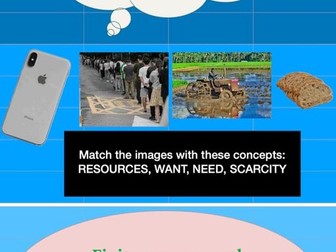
Starter Activity: An engaging image-based matching task to hook students.
Key Concept Definitions: A structured table for students to learn and record essential terms (e.g., Scarcity, Choice, Opportunity Cost).
Individual Student Task: A relatable family scenario to apply the economic problem in a real-world context.
Think-Pair-Share Case Study: A government-level dilemma to encourage discussion and deepen understanding.
Plenary: Three multiple-choice questions to assess immediate comprehension.
Lesson Summary & Homework Slide: To consolidate learning and extend it beyond the classroom.
All Answers Included: Full answers for all activities are embedded within the PowerPoint for easy review and self-assessment.
Key Features & Benefits:
Exam-Board Aligned: Perfect for Edexcel IGCSE and CIE IGCSE specifications, as well as AQA GCSE and OCR GCSE Economics courses.
Scaffolded Learning: Progresses from simple definitions to complex application, catering to a range of learner abilities.
Varied Activities: Incorporates individual, paired, and whole-class tasks to maintain engagement.
Ready-to-Teach: No preparation needed! Simply download and deliver the lesson.
Keywords/Tags:
IGCSE Economics, GCSE Economics, The Economic Problem, Scarcity, Finite Resources, Unlimited Wants, Opportunity Cost, Choice, Factors of Production, Lesson Plan, PowerPoint, Starter, Plenary, Case Study.