Understanding the Mole ConceptQuick View
RAAMH

Understanding the Mole Concept

(0)
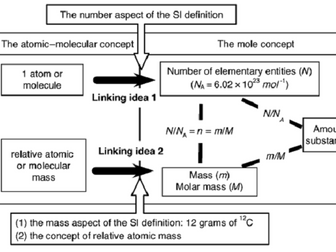
The difficulties that students and educators have in understanding the mole concept are well documented. A key difficulty, the origin of Avogadro’s number is addressed.A number of activities (inspired by the philosophy of guided inquiry) represents the idea of aggregating, or accumulating entities of a substance to give one mole of that substance. The connection between relative atomic mass and molar mass, requiring students to understand the idea that on a macroscopic scale (grams), so long as the numbers of particles of two different substances are the same, their relative mass ratio will be the same as the ratio of their relative atomic masses is also incorporated within the activities. If students can understand this, then they should understand why we use Avogadro’s number, and what motivated its discovery.
Understanding the Integral ConceptQuick View
RAAMH

Understanding the Integral Concept

(0)
Many students do not have a deep understanding of the integral concept. This resource addresses a number of challenges when introducing the integral: 1) choosing an appropriate, intuitive context which gives meaning to the symbols in the integral expression; 2) aiding the transfer of the integral expression to different contexts via using the Riemann sum in an informal way so that students can see and interpret the rectangles which are inherent in this sum; and 3) the gradual formalizing of the Riemann sum and its linkage with the Fundamental Theorem of Calculus.
Understanding the Slope and Rate of Change ConceptQuick View
RAAMH

Understanding the Slope and Rate of Change Concept

(1)
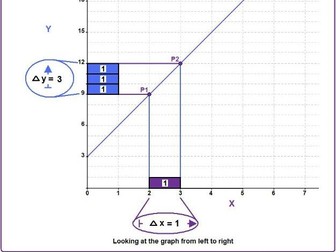
Many students do not have a deep understanding of slope or rate of change. Various factors help explain why such a deep understanding is difficult to acquire. These factors include the following: the different representations for slope; graphical understanding; ratio and rate; and proportional reasoning. These factors have informed the design of a mathematical resource to help give students a deep understanding of slope and rate of change.