A set of Weather Flashcards designed to support vocabulary building, retrieval practice and confident speaking in the classroom.
These bright, accessible cards cover key weather terms and phrases, making them ideal for KS2–KS3 language lessons, Spanish Language support, topic work, or quick starter activities.
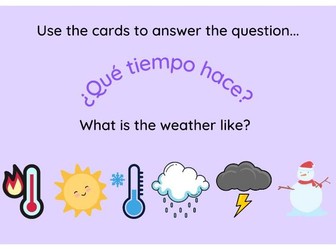
High‑quality flashcards featuring common weather conditions
Clear visuals to support learners of all abilities
Vocabulary suitable for primary and lower‑secondary learners
Printable format for classroom displays, games, or revision packs
Perfect for:
Introducing new topic vocabulary
Retrieval practice and low‑stakes quizzing
Pair work, matching games and speaking prompts
Spanish learners who benefit from strong visual support
The cards are simple, versatile and ready to use: ideal for busy teachers who want engaging, no‑prep resources that slot easily into any scheme of work.
**POWERPOINT LESSON + LINK TO GOOGLE SLIDES VERSION.
This comprehensive teaching pack explores Andalusian architecture through accessible Spanish‑language explanations, cultural context, and structured classroom activities. Designed for A‑Level Spanish, GCSE Spanish, and IB Spanish, it supports teachers delivering cultural content, preparing students for speaking exams, and developing comprehension skills.
The resource introduces students to three of the most iconic monuments in southern Spain: La Mezquita de Córdoba, La Alhambra de Granada, and La Giralda de Sevilla. Each section includes maps, visuals, and clear Spanish descriptions to help learners understand the historical and geographical context of Andalucía.
Students also explore the Islamic and Mudéjar influence on Spanish architecture. The resource explains key features such as horseshoe arches, domes, muqarnas (stalactite vaulting), decorated walls, ornamental mosaics, with a matching activity and answer key. This makes it ideal for teachers wanting to integrate authentic cultural knowledge into their A‑Level Spanish curriculum.
A detailed section on La Alhambra covers the Alcazaba, the Nasrid Palaces, and the unique artistic style of the period. Students answer comprehension questions in Spanish and are then shown the answers. The pack also includes a complete section on the Real Alcázar de Sevilla, its historical development, and its blend of Islamic, Gothic, and Mudéjar elements. A video‑based listening activity reinforces understanding, with answers provided.
To support speaking and spontaneous language production, the resource ends with discussion questions and debate prompts, encouraging students to express opinions about architecture, art, and cultural heritage in fluent Spanish.
This pack is ideal for:
A‑Level/AS-Level Spanish cultural lessons
A‑Level Paper 3 (Speaking) preparation
GCSE Spanish cultural enrichment (Advanced students)
Cover lessons (with Spanish-speaking staff) and independent study
Teachers seeking ready‑to‑use Spanish resources with answer keys
Clear and visually supported, this resource helps students deepen their understanding of Spanish history, Islamic Spain, and Andalusian culture, while strengthening their reading, listening, and speaking skills.**
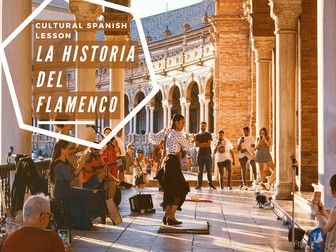
This powerpoint lesson aims to improve comprehension whilst exposing students to cultural aspects of Spain. This can be used n conjunction with the A-Level curriculum in the UK (Linked to El Patrimonio Cultural). It explores not only the art form itself but also alludes to parts of Spanish history relating to La Convivencia (co-existence). This can also be used with younger students who are more advanced, especially as a bridging activity. It mostly focuses on speaking and reading skills.
It includes:
An initial guessing activity to help students understand what Flamenco is.
A reading activity explaining the different aspects of flamenco.
Comprehension questions.
A brief match-up activity to help consolidate niche vocab.
Two video links with supplementary questions that could be used for speaking or writing activities.
A discussion question to help generate interest in the topic.
Vocabulary list-making activity to help expand knowledge on adjectives.
Mind-map creation over why flamenco is important culturally.
This resource is a complete A‑Level Spanish Speaking Cards support pack, designed to help students develop high‑level, exam‑ready responses for Paper 3 (Speaking). It provides students with the structures, phrases, and model answers they need to speak confidently, accurately and spontaneously.
What the resource includes
A comprehensive bank of high‑level speaking phrases
The first section offers a wide range of expressions for giving opinions, reacting emotionally, and using advanced grammar. These include:
Emotional reactions such as “me llama la atención que + subjuntivo” and “me sorprende que + subjuntivo”
Useful opinion structures like “A mi juicio” and “A mi modo de ver”
Subjunctive triggers, contrast markers, and connectors for structuring long answers
This section acts as a toolkit students can use with any speaking card.
Grammar support for high‑level accuracy
The resource includes clear lists of:
Imperfect subjunctive stems (si tuviera, si fuera, si pudiera…)
Passive‑avoidance structures with se (se puede, se debe, se dice…)
Alternatives to porque (e.g., puesto que, dado que, debido a…)
These are essential for achieving the top bands in AO2 and AO3.
A fully modelled speaking‑card example
The second half of the resource provides a complete model answer for a speaking card about el papel de los abuelos en España. It includes:
A reaction to the information on the card
An explanation of why grandparents have an increasingly important role
A discussion of wider social changes in the Hispanic world
It also discusses historical context, such as the permiso marital and changes in family structures since the Franco era.
This model shows students exactly how to structure a high‑scoring response.
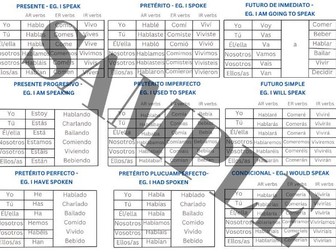
This GCSE Spanish Tense Mat includes European Spanish conjugations of AR, ER and IR verbs in the following tenses:
Present
Preterite
Immediate Future
Present Progressive
Imperfect
Simple Future
Perfect
Past Perfect
Conditional
These printable sheets come with two options: one with the DM Serif Display font and a sandy background and one using a more accesible Sans font on a lighter background.
This has been useful for my students as they have stuck it in the back of their books and used it as reference for homeworks and assignments where they are allowed additional support.
These are printable mats in pdf format. Each page contains the same content but different formatting.
A revision resource that is specifically useful for A-Level/AS-Level Spanish students who are studying Pedro Almodóvar’s film Volver.
This is specifically for Paper 2 revision. This resource breaks down every major character: Raimunda, Sole, Paula, Irene, Agustina, Paco y la tía Paula. Each character is given clear bullet‑point summaries of personality, role and development (personalidad, papel y desarrollo).
Perfect for revision, essay preparation and classroom teaching, the slides help students understand character motivations, relationships, and narrative significance in a concise, accessible format. Ideal for teachers looking to support high‑level analysis by building a solid foundation of character understanding/inter-personal relationships and for students aiming for top‑band essays.
This PowerPoint (.pptx) resource offers in-depth redactions and thematic essays on El Laberinto del Fauno, ideal for A-Level or advanced Spanish learners. It covers major topics such as the use of violence, representations of good and evil, gender roles, symbolism, and the fantasy vs. reality dichotomy. Each slide includes analytical points, examples, and explanations aligned with exam specifications (e.g AQA). Perfect for classroom use, revision, or independent study, this resource helps students develop critical thinking and essay-writing skills in Spanish. Keywords: Pan’s Labyrinth, El Laberinto del Fauno, Spanish A-Level, film analysis, Guillermo del Toro, symbolism, fantasy, fascism, gender roles, PowerPoint, redacciones.
Exact list of topics:
The use of violence in the film and whether it is necessary.
Whether the Pale Man scene reflects the main themes of the film.
Women not being portrayed as the weaker sex and the danger of ignoring them.
The representation of good and bad in the real and fantasy worlds.
Symbolism used to reflect Vidal’s personality.
Techniques used by the director to explore Ofelia’s fantasy world.
Carmen’s behaviour towards Vidal and Ofelia.
The relationship between Ofelia and Mercedes.
Whether the film can be considered a fairy tale.
This resource contains written exemplar responses to the three written questions on 35 different AQA stimulus cards for AS and A-Level pupils. There is at least one card for all of the following themes:
Los valores tradicionales y modernos.
El ciberespacio.
La igualdad de los sexos.
La inmigración.
El racismo.
La convivencia.
La influencia de los ídolos.
La identidad regional en España.
El patrimonio cultural.
Jóvenes de hoy, ciudadanos de mañana.
Monarquías y dictaduras.
Movimientos populares
As a Spanish Language Assistant, I focused heavily on the speaking card section of the exam for this year’s A2 students, as well as the entire speaking exam for the AS students. This meant that every week we would do a “debate club” in which the students would prepare the card beforehand and come to the club to share their own opinion. Afterwards, I would then show them my exemplar answers, which are all found on the presentation that I have uploaded. This is one way the resource can be used, but in reality it could be the basis of so many other classes as well and of course, be useful to a lot of language assistants.
There are more cards that are found in both the AS and A2 exams, as I wanted the Year 12 and 13 students to benefit from the debate classes equally, but I still did make sure to include many cards on solely A2 topics as well.
The exemplar answers contain lots of high-level grammatical structures, opinion phrases, interesting reasonings and more up-to-date statistics/examples that the students can use to justify their opinions.
The cards are not organised by topic.


 Quick View