GlobalisationQuick View
Aelgin19

Globalisation

(0)
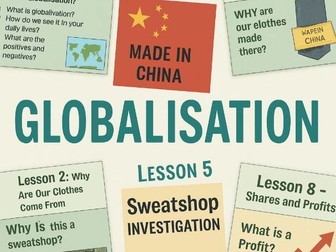
This fully resourced scheme of work explores the complex relationship between globalisation, production chains, and the clothing industry. Designed for KS3 Geography (adaptable for KS4), the pack provides everything you need to teach students about where their clothes come from, the impacts of consumer choices, and the realities of global trade. What’s Included? Eight complete, ready-to-teach PowerPoint lessons with engaging activities, case studies, and assessments: Globalisation Introduction – What is globalisation? Positives and negatives in our daily lives. Where Our Clothes Come From – Exploring the origins of clothing and mapping global trade links. Why Are Our Clothes Made in…? – Investigating why production is concentrated in countries like China and Bangladesh. Sweatshops – Understanding working conditions and ethical concerns in the garment industry. Sweatshop Investigation – In-depth case study with evidence analysis and critical thinking tasks. Made in China – Focusing on China’s role in the global clothing industry and its economic impact. Production Chains – Tracing the journey of a t-shirt from raw material to shop floor. Shares and Profits – Examining who benefits most from global clothing production. Learning Objectives & Skills Define and explain globalisation with real-world examples. Analyse the geography of production chains and global trade flows. Explore ethical issues in clothing manufacture, including sweatshops and fair trade. Develop critical thinking and empathy through case studies (e.g., China, Bangladesh). Strengthen map, data interpretation, and enquiry skills. Teaching Features Engaging starters & plenaries to spark discussion. Differentiated activities for all ability levels (worksheets, debates, fact files, role-play). Assessment opportunities built into each lesson. Cross-curricular links with Economics, Business Studies, and Citizenship. Encourages reflection on ethical consumerism and students’ own choices. Perfect For: KS3 Geography schemes of work. Adaptation into KS4/GCSE Globalisation units. Covering cross-curricular PSHE and Citizenship topics.
Climate ChangeQuick View
Aelgin19

Climate Change

(0)
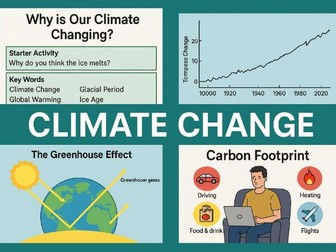
ring climate change to life in your classroom with this five-lesson, fully resourced teaching pack. Each PowerPoint is carefully designed with clear learning objectives, success criteria, engaging activities, and built-in opportunities for assessment. Perfect for KS3 and adaptable for KS4, these lessons cover the essential building blocks of climate change education while encouraging critical thinking and concern for society. What’s Included: Lesson 1 – Why is Our Climate Changing? Introduces the difference between weather and climate. Explains natural and historical climate changes (ice ages, medieval warm period). Activities on temperature cycles and graph interpretation Lesson 2 – Evidence of Climate Change Uses fossils, ice cores, and tree rings to show how scientists measure past climates. Explains greenhouse gases and the greenhouse effect with student-friendly diagrams. Includes challenge questions and activities to deepen understanding Lesson 3 – Carbon Footprint Defines what a carbon footprint is and how daily life contributes to it. Interactive quizzes and reflection tasks to calculate personal footprints. Encourages learners to suggest realistic ways to reduce emissions Lesson 4 – Impacts of Climate Change Covers global impacts including stronger hurricanes, melting glaciers, rising sea levels, and biodiversity loss. Real-world case studies (e.g., Arctic species, Bangladesh, Maldives). Task-based learning with opportunities for group discussion and independent fact-files Lesson 5 – Impacts of Rising Sea Levels Focus on sea level change over time, with clear data interpretation tasks. Case study: Kiribati – one of the first nations threatened with becoming uninhabitable. Students explore social, economic, and environmental consequences of flooding Features: ✔ Ready-to-teach PowerPoint slides (no additional planning required). ✔ Clear Learning Objectives and Success Criteria for every lesson. ✔ Activities ranging from starter quizzes and case studies to plenaries and fact-files. ✔ Stretch and challenge opportunities for higher ability students. ✔ Fully linked to geographical concepts such as climate cycles, human impacts, and societal consequences. Who is it for? KS3 Geography (Years 7–9) – ideal for introducing climate change. KS4 Geography – adaptable for GCSE courses as foundation material. Cross-curricular links with science and citizenship.
Extreme EnvironmentsQuick View
Aelgin19

Extreme Environments

(0)
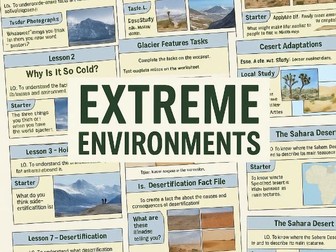
This fully resourced 11-lesson scheme of work explores some of the most fascinating and challenging environments on Earth. Designed for KS3 Geography but easily adaptable for KS4, the pack includes high-quality, ready-to-teach PowerPoints with activities, visuals, and assessments that build knowledge and skills progressively. Lesson Breakdown Introduction to Extreme Environments – What makes an environment “extreme”? Explore examples around the world. Why Is It So Cold? – Investigating polar climates, temperature patterns, and the science behind extreme cold. Glaciers – How glaciers form, move, and shape the landscape. The Coldest Place on Earth – A case study on Antarctica and its unique challenges. Hot Deserts – Characteristics, climate, and adaptations in some of the hottest places on Earth. Desert Adaptations – How plants, animals, and people survive in desert climates. Desertification – Understanding the causes and consequences of desertification. Desertification Fact File – Guided research and consolidation task to apply learning. Desertification Fill-in-the-Blanks Task – Literacy and retrieval practice for reinforcement. Glacier Features Tasks – Activities and diagrams to explore glacial landforms. The Sahara Desert – A detailed case study of the largest hot desert in the world. Features of the Pack Engaging starter and plenary tasks in every lesson. Case studies (Antarctica, Sahara Desert) to bring topics to life. Fully differentiated with scaffolds and extension tasks. Variety of activities: retrieval practice, literacy support, diagram annotation, research, and exam-style questions. Designed with assessment for learning (AfL) opportunities throughout. Who Is It For? Perfect for KS3 Geography classes (Years 7–9), with clear links to GCSE/IGCSE topics such as cold environments, hot deserts, and global climate systems.