GCSE Science Paper 1 Revision ChecklistQuick View
bennealmearse

GCSE Science Paper 1 Revision Checklist

(0)
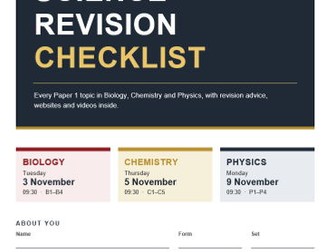
Paper 1 revision checklist booklet for Year 11 mock exams, covering all topics for Biology (B1-B4), Chemistry (C1-C5), and Physics (P1-P4). I put this together to give students a clear idea of exactly what they need to know. It’s set up to work for the whole cohort, with clear labels for Combined or Triple science, as well as Foundation or Higher tier content. Students just skip the parts that don’t apply to their specific exam. Inside the booklet: RAG checklists: Every single spec point has a red, amber, or green tracker so students can prioritise their independent study. Maths skills checklists: There is a dedicated maths skills checklist for each science so they know exactly which equations, unit conversions, and calculations they need to practise. Required Practicals: All RPs are explicitly flagged as a reminder to learn the methods, variables, and risks. Key words and common mistakes: Each section has ‘Watch Out’ boxes to tackle common misconceptions (like reminding them that antibiotics don’t kill viruses) alongside a list of essential vocabulary. How to revise: The front pages include practical advice on active revision (like self-quizzing and flashcards) rather than just re-reading notes, which we all know they do. Exam technique: Quick tips on pacing (1 minute per mark), tackling 6-markers, and picking up marks for showing working. Useful links: A handy list of free resources they can use at home, including Bitesize, Freesciencelessons, Cognito, and Physics & Maths Tutor. It works really well printed as a little A5 booklet to hand out in class for homework or form time revision in the run-up to the mocks. Put in your own dates!
Nuclear Decay (Alpha, Beta and Gamma)Quick View
bennealmearse

Nuclear Decay (Alpha, Beta and Gamma)

(0)
Complete powerpoint lesson for Nuclear Decay Students should learn the differences between Alpha, Beta and Gamma, what ionisation is and why it can be a problem. Starts with retrieval task. Suitable for triple or combined. Adaptable questions for Grades 9-1. INCLUDES ALL ANSWERS Red box = write down
Power GCSE AQAQuick View
bennealmearse

Power GCSE AQA

(0)
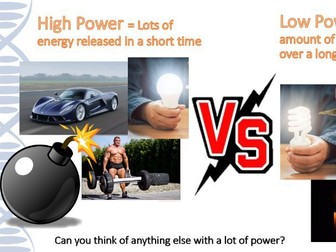
Complete powerpoint lesson for Power. Everything they need to know for power (Including electrical). There is a printable slide for a worksheet (optional) Suitable for triple or combined. Adaptable questions for Grades 9-1. INCLUDES ALL ANSWERS
Atoms and Isotopes LessonQuick View
bennealmearse

Atoms and Isotopes Lesson

(0)
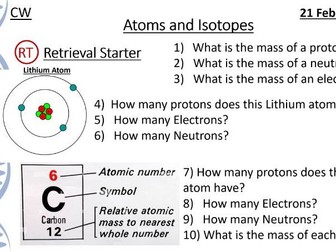
Complete powerpoint lesson for Atoms and Isotopes. Students should learn the difference between atoms, isotopes and ions. They should learn the size of an atom/nucleus as per the spec. Is meant as a Physics lesson but can be used as Chemistry lesson. (AQA spec but should be suitable for most exam boards) Excellent for revision or as a grounding before Nuclear Model (Radioactivity) topic in Physics. Suitable for triple or combined. Adaptable questions for Grades 9-1. Starts with History of Atom Recap INCLUDES ALL ANSWERS Red box = write down True or false plenary which can be thumbs up thumbs down or fold front cover of book over and use that to show answer to teacher.
Large GCSE Periodic Table Wall Poster – Clear From the Back of the RoomQuick View
bennealmearse

Large GCSE Periodic Table Wall Poster – Clear From the Back of the Room

(0)
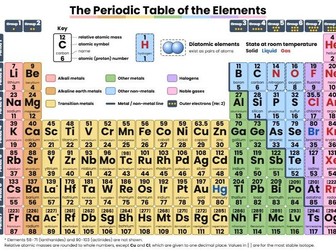
I was fed up with no periodic tables matching the GCSE periodic table and being clear from across the classroom so I made my own! A bold, colour-coded periodic table poster designed for GCSE Chemistry and readable from the back of the room. It uses the same layout and data as the GCSE exam data sheet, so students get used to the table they’ll see in their exams. Every box shows the relative atomic mass, symbol, name and atomic number, and the lanthanides and actinides are left out. Features What’s on the poster • Large, bold symbols and numbers: symbols are 1.8 cm tall at A1 • Colour-coded families: alkali metals, alkaline earth metals, transition metals, other metals, other non-metals, halogens and noble gases • Symbols coloured by state at room temperature: solid (black), liquid (blue) and gas (red) • Outer-shell electrons shown as dots on each group label • Clear Group 1–7 and 0 labels, and Period 1–7 labels • Metal / non-metal dividing line • Diatomic elements outlined, with a simple two-atom diagram • Labelled key showing how to read each element box • Up-to-date element names, including nihonium, moscovium, tennessine and oganesson What’s included • A4 PDF – for handouts, desk copies or exercise books • A1 PDF (841 × 594 mm) and A0 PDF (1189 × 841 mm), print-ready at full size • Blank version with no support for tests (exam style • Step-by-step instructions for printing at A1 or A0 on a normal school printer, in pieces on A4 or A3, then joined together Vector files, so the poster stays sharp at any size. **Instructions for Printing ** Open the file in Adobe Acrobat Reader and go to File → Print. Choose a colour printer and A4 or A3 paper. (A3 easier) Click Poster, set Tile scale: 100% and Overlap: 10 mm, and tick Cut marks and Labels. Print. Lay the sheets out using their labels and trim along the cut marks. Overlap the sheets so the design lines up and tape them together from the back. You can glue if you don’t trim the borders.