C.4.1.1—Arousal refers to the level of physical and psychological activation. This impacts on sport performance in the way that individuals attempt to manage their levels of intensity.
C.4.1.2—When anxiety is low, individuals experience positive emotions, such as excitement, desire and elation. High levels of anxiety induce negative emotions such as fear, worry and despondency.
C.4.2.1—A stressor causes psychological strain. This can be positive, such as looking forward to an opportunity, or negative, such as fearing an outcome.
C.4.2.2—Stressors can be considered as either controllable or uncontrollable.
C.4.2.3—Many coping strategies have been shown to be effective for athletes, although the effectiveness of each is specific to the individual and the situation.
3.1.3.2.1 Sociological theory applied to equal opportunities
Chapter 3.2
Use of Boost/Hodder Education A-Level Textbook (Carl Atherton, Ross Howitt & Sue Young)
Underrepresented groups in sport.
Disability.
Ethnic group.
Gender.
Disadvantaged.
Understanding the key terms relating to equal opportunities.
Discrimination
Stereotyping
Prejudice
C.5.1.1—Goal setting directs attention to a specific task. It is regularly used to enhance motivation in sport, exercise and health.
C.5.1.2—The goal-setting paradox explains that elite athletes often feel less satisfied when a higher goal is achieved than an easier goal. This is thought to be the result of feelings of deflation after success.
C.5.2.1—Imagery is an experience that mimics real experience. It involves using a combination of different sensory modalities in the absence of actual perception.
3.2.4.7 Impact of commercialisation on physical activity and sport and the relationship between sport and the media
Chapter 13.7
The positive and negative impact of commercialisation, sponsorship and the media.
Performer.
Coach.
Official.
Audience.
Sport.
Use of Boost/Hodder A-Level Textbook (Carth Atherton, Ross Howitt & Sue Young)
Chapters 7.1 and 13.8
3.2.4.8 The role of technology in physical activity and sport
Use of Boost/Hodder Education A-Level Textbook (Carl Atherton, Ross Howitt & Sue Young)
Content
Understanding of technology for sports analytics.
Use of technology in data collection (quantitative and qualitative, objective and subjective, validity and reliability of data).
Video and analysis programmes.
Testing and recording equipment (metabolic cart for indirect calorimetry).
Use of GPS and motion tracking software and hardware.
Maintaining data integrity.
Functions of sports analytics.
Monitor fitness for performance.
Skill and technique development.
Injury prevention.
Game analysis.
Talent ID/scouting.
The development of equipment and facilities in physical activity and sport, and their impact on participation and performance.
Impact of material technology on equipment – adapted (disability, age).
Facilities – Olympic legacy, (surfaces, multi-use).
The role of technology in sport and its positive and negative impacts.
3.1.3.2 The impact of sport on society and of society on sport
This section introduces some of the key terms, key concepts and benefits of physical activity to both the individual and society.
3.1.3.2.1 Sociological theory applied to equal opportunities
Understanding of the key terms relating to the study of sport and their impact on equal opportunities in sport and society.
Society.
Socialisation (primary and secondary).
Social processes (social control and social change).
Social issues (causes and consequences of inequality).
Social structures/stratification (eg schools/sports clubs).
Understanding social action theory in relation to social issues in physical activity and sport.
Impact of sport on society and of society on sport.
Underrepresented groups in sport.
Disability.
Ethnic group.
Gender.
Disadvantaged.
Understanding the key terms relating to equal opportunities.
Discrimination
Stereotyping
Prejudice
The barriers to participation in sport and physical activity and possible solutions to overcome them for under represented groups in sport.
Benefits of raising participation.
Health benefits.
Fitness benefits.
Social benefits.
Use of Boost/Hodder Education A-Level Textbook (Carl Atherton, Ross Howitt & Sue Young)
C.1.1.1—Personality refers to individual differences in characteristic patterns of thinking, feeling and behaving. Personality is typically understood to be an interaction between genetic traits and the environment.
C.1.1.2—Social learning theory is a situational approach to understanding behaviour.
C.1.1.3—Personality can change over a long period of time.
C.1.2.1—Mental toughness is an aspect of personality that partly explains how individuals manage challenging and pressurized situations.
C.1.2.2—The theory of the “self-fulfilling prophecy” in sporting success suggests that a sportsperson’s perceived self-confidence results in greater persistence and effort, leading to an increased probability of eventual success.
C.1.2.3—Mental toughness is positively associated with better health outcomes, including fewer depressive symptoms, fewer burnout symptoms and improved sleep quality.
C.1.2.4—Attribution theory illustrates how the locus of control and stability can impact subsequent confidence.
C.3.1.1—Need achievement theory posits that personality and situational factors interact to produce resultant factors, which create emotional factors, which drive behavioural factors.
C.3.1.2—Goal orientation theory assumes that individuals strive to feel successful.
C.3.1.3 - High ego orientation can be problematic if task orientation is low.
C.3.2.1—Self-determination theory hypothesizes that humans strive to satisfy needs of autonomy, competence and relatedness.
C.3.2.2—Motivation can be placed along a continuum from amotivation to controlled motivation to autonomous motivation.
C.3.2.3—Self-determination theory is a meta-theory comprising six mini-theories, each explaining a facet of individual motivation.
C.3.3.1—Motivational climate describes the psychological environment that the coach creates by designing sessions that provide instructions and feedback, which will help to motivate the athletes in training or competition.
Sport and Exercise Health Science (SEHS) International Baccalaureate
2024 Spec
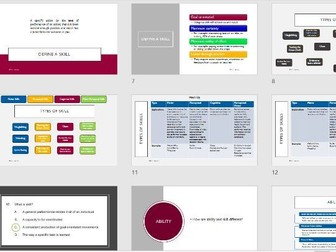
Part C - Pyschology C.2 (including Higher content) Poweroint
Motor Learning
Attentional Control
167 Slides
Made using the 2024 Course Companion Book
Slides with TOK/NOS/Linking questions etc are signposted
Tasks Included:
* Videos
* Match Ups
* Application to ‘your sport’


 Quick View