Islamic Golden Age: introductionQuick View
CitizenTeach

Islamic Golden Age: introduction

(0)
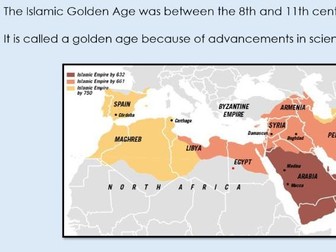
This lesson provides KS3 students with an overview of the Islamic Golden Age! This works perfectly as an introductory lesson to global medieval history. As with all Citizen_Teach resources, the lesson is accessible to all learners in this age range (Key Stage 3, ages 11-14). Resources: x1 PowerPoint (including question sheet) x1 YouTube link in the notes section of slide 8 Learning Aims: Define the term ‘golden age’. Identify key events of the Islamic Golden Age. Reflect on the importance of looking beyond English and European history. Second Order Concepts: significance, chronology, similarity and difference. Overview: Slide 1: knowledge retrieval from prior topics and opportunities for further formative assessment. Slide 2: overview of Scheme of Work (if using). Slide 3: reflection of the importance of English history (teacher-talk with opportunities for extended questioning). Slide 4: geographical location of the Middle East (teacher-talk with opportunities for extended questioning). Slide 5: reflection of the significance of Middle Eastern history (high level questioning). Slide 6: focus on archaeological evidence - an astrolabe (high level questioning and/or student-driven source enquiry). Slide 7: chronological question sheet using video, followed by coding the new historical information (challenging questions, use of classroom visualiser recommended). Slide 8: reflection questions (opportunity for these to be an extended writing task).
Oliver Cromwell: overview of the English Civil War and RevolutionQuick View
CitizenTeach

Oliver Cromwell: overview of the English Civil War and Revolution

(0)
This lesson provides KS3 students with and overview of the English Civil War and Revolution through the story of Oliver Cromwell’s head! This works perfectly as an introductory lesson or an end of topic consolidation lesson. As with all Citizen_Teach resources, the lesson is accessible to all learners in this age range (Key Stage 3, ages 11-14). Resources: x1 PowerPoint x1 PDF worksheet x1 YouTube link in the notes section of slide 3 Learning Aims: Connect key terminology to Cromwell’s head. Analyse the chronology (big picture) of the English Civil War and Revolution. Make a link between the Reformation and the English Civil War. Second Order Concepts: chronology, cause and consequence Overview: Slide 1: key terminology check and opportunities for further formative assessment. Slide 2: overview of Scheme of Work (if using). Slide 3: introduction to Oliver Cromwell (teacher-talk). Slide 4: timeline activity. Instructions are clear, enabling the teacher to help individual students and formatively assess using preferred strategies. Slide 5: higher-level thinking question.
Causes of the English Civil War and RevolutionQuick View
CitizenTeach

Causes of the English Civil War and Revolution

(0)
This KS3 lesson covers the complex causes of the English Civil War in a concise and effective method. Recall, reading comprehension, and analysis provides students with what they need. As with all Citizen_Teach resources, this lesson is accessible to all learners in this age range (KS3, ages 11-14). Resources: x1 PowerPoint x1 double-sided reading Lesson Aims: Reflect on the chronology of the English Civil War. Identify the short, medium, and long-term causes of the English Civil War. Analyse the role of individuals in causing the English Civil War. Second order concepts: cause and consequence, chronology, interpretations Structure: Slide 1: recall and opportunities for preferred formative assessment strategies. Slide 2: overview of the Scheme of Work (if using). Slide 3: teacher-talk / setting the concept of interpretation. Slide 4: guided reading comprehension activity. Slide 5: causation analysis activity. Slide 6: higher-level causation analysis activity which brings the lesson back to the point raised in slide 3 about historical interpretation.
How was the English Civil War fought (including women at war)Quick View
CitizenTeach

How was the English Civil War fought (including women at war)

(0)
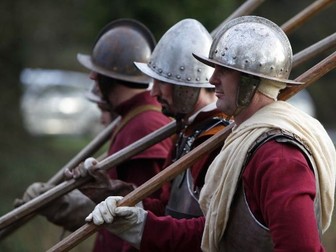
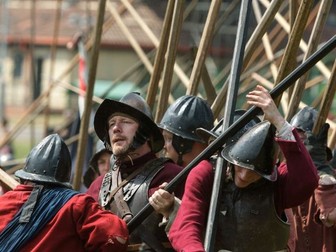
This KS3 lesson covers the soldiers of the English Civil War, including women. The lesson takes students through the dramatic changes in military thinking, as well as changes in historical thinking around the role of women. As with all Citizen_Teach resources, this lesson is accessible to all learners in this age range (KS3, ages 11-14). Resources: x1 PowerPoint x1 women at war table resource x2 videos (embedded in the notes section on slides 3 and 6) Lesson Aims: Describe how soldiers appeared in 1642. Identify the roles women played in the English Civil War. Explain why the New Model Army was significant in changing warfare. Second order concepts: change and continuity, significance, interpretations. Structure: Slide 1: recall and opportunities for preferred formative assessment strategies. Slide 2: overview of the Scheme of Work (if using). Slide 3: film clip and discussion of how soldiers appeared. Slide 4: using evidence of women at war to challenge traditional views of history. Slide 5: teacher-talk to introduce concept of change and continuity in military history. Slide 6: video and questions to develop understanding of change and continuity. Slide 7: write up and peer assessment of change and continuity.