Mastery / Complete Pack / Teacher & StudentQuick View
janley2

Mastery / Complete Pack / Teacher & Student

2 Resources
Analytical Writing Mastery bundle combining the full Teacher and Student Booklets. Structured lessons, model responses, and scaffolded tasks for confident, high‑level writing. Transform analytical writing across your classroom with this complete Analytical Writing Mastery Bundle, combining both the Teacher Booklet and Student Booklet into one cohesive, expertly scaffolded package. Designed for GCSE and A‑Level style analytical writing, this bundle delivers a full 13‑lesson sequence (Lessons 0–12) that builds skills progressively—from foundational grammar and vocabulary to sophisticated paragraph construction, evaluation, and extended essay responses. The Teacher Booklet provides fully modelled answers, exemplar paragraphs, step‑by‑step teaching guidance, and ready‑to‑use explanations that support confident delivery, even for non‑specialists. The Student Booklet mirrors the structure but removes answers, offering clean, distraction‑free pages ideal for classwork, homework, intervention, or revision. Every lesson includes structured tasks, sentence‑level scaffolds, tiered vocabulary, and clear success criteria to support mixed‑ability learners. The sequence is intentionally designed to close gaps, strengthen writing stamina, and develop the precision, clarity, and analytical depth required for top‑band responses. Perfect for English departments, tutors, and intervention teams seeking a consistent, high‑quality approach to analytical writing that students can genuinely master.
Analytical Writing Mastery Pack StudentQuick View
janley2

Analytical Writing Mastery Pack Student

(0)
A complete 12‑lesson student workbook designed to build high‑level analytical writing skills for A‑Level English Literature. Fully scaffolded, beautifully structured, and classroom‑ready. This premium 12‑lesson Student Booklet develops the full range of analytical writing skills needed for top‑band A‑Level essays. Each lesson is structured, concise, and accessible, guiding students through grammar, vocabulary, quotation integration, cohesion, tone, evaluative writing, and full essay construction. Perfect for: whole‑class teaching intervention revision homework independent study Includes: 12 fully structured lessons clear explanations high‑level vocabulary scaffolded tasks no answers (teacher‑safe) premium Abacus² formatting
Analytical Writing Mastery Pack TeacherQuick View
janley2

Analytical Writing Mastery Pack Teacher

(0)
Complete A‑Level English teacher guide with models, answers, and full lesson support for the Language & Analytical Writing Mastery Pack (Lessons 0–12). This comprehensive Teacher Guide provides everything needed to deliver the full 12‑lesson Language & Analytical Writing Mastery Pack with confidence and precision. Designed for A‑Level English departments, it includes complete answers, model paragraphs, exemplar essays, and clear explanations that save hours of planning time. This guide ensures consistency, clarity, and high‑quality modelling across every lesson. Perfect for: whole‑class teaching intervention and revision modelling high‑level analytical writing supply cover and non‑specialist support department‑wide standardisation What This Teacher Guide Includes Each lesson contains: full answers to every task model analytical sentences and paragraphs exemplar essays for key skills clear explanations of grammar, structure, and technique guidance on how to teach each concept premium formatting for easy classroom use This guide aligns exactly with the Student Workbook, making it ideal for paired or departmental use. CONTENTS (Lessons 0–12) Lesson 0 — Grammar & Vocabulary Foundations Teacher explanations, model sentences, and full answer key. Lesson 1 — Academic Register & Formality Models of formal phrasing, tone correction, and analytical rewriting. Lesson 2 — Punctuation for Precision Worked examples of colons, semicolons, comma control, and quotation punctuation. Lesson 3 — Comparative & Superlative Structures Model comparative sentences and evaluative phrasing. Lesson 4 — Metaphorical & Symbolic Language Teacher‑led interpretations and exemplar analytical responses. Lesson 5 — Transcendental & Abstract Vocabulary High‑level vocabulary lists with model usage. Lesson 6 — Word Choice & Etymology Root‑based explanations and model analytical applications. Lesson 7 — Structuring Analytical Paragraphs (PEACE) Full model PEACE paragraphs and structural guidance. Lesson 8 — Cohesion & Flow Model cohesive sentences and paragraph rewrites. Lesson 9 — Quotation Integration Embedded quotation models and improved integration examples. Lesson 10 — Tone, Voice & Critical Style High‑level critical voice models and tone transformations. Lesson 11 — Evaluative Writing & Comparative Judgement Top‑band evaluative phrasing and comparative thesis models. Lesson 12 — Full Essay Structure + Timed Essay Practice Model introductions, PEACE paragraphs, and full exemplar essays. Why Teachers Love This Guide saves significant planning time provides consistent, high‑quality modelling supports mixed‑ability teaching strengthens departmental writing standards pairs seamlessly with the Student Workbook Ideal For A‑Level English Literature A‑Level English Language & Literature High‑ability GCSE bridging Writing intervention programmes Departmental CPD and standardisation
A‑Level Gothic: 10‑Trope Lesson PackQuick View
janley2

A‑Level Gothic: 10‑Trope Lesson Pack

(0)
A‑Level Gothic pack with a 10‑trope checklist, three unseen‑analysis lessons, worksheets and contextual guidance to boost high‑level exam responses. This A‑Level Gothic resource provides a complete three‑lesson sequence designed to build confident, high‑level unseen analysis using a clear, student‑friendly 10‑Trope Gothic Checklist. Perfect for AQA, Edexcel and OCR specifications, it supports conceptual thinking, intertextual links, and examiner‑style responses. The pack includes a fully structured set of lessons covering Gothic origins, trope identification, fin de siècle anxieties, duality, psychological Gothic, and the evolution of the genre from the 18th century to modern texts. Each lesson contains a starter, teacher input, main analytical task, plenary, and homework, ensuring strong pacing and curriculum alignment. Students learn to recognise and apply key Gothic tropes such as the sublime, the uncanny, transgression, madness, decay, the doppelgänger, and fear of the Other. The checklist helps them move quickly from surface‑level description to conceptual interpretation — ideal for unseen extracts and comparative writing. A full worksheet pack is included, featuring scaffolded templates, unseen extracts for annotation, trope‑matching tasks, self‑assessment checklists, and extension materials such as a Gothic vocabulary bank and curated quotations from key writers. The resource also provides comparative tasks using Jekyll and Hyde and The Picture of Dorian Gray, supporting fin de siècle contextual knowledge and duality‑focused analysis. This bundle is ideal for introducing the Gothic, revising key concepts, or preparing students for unseen exam components. It is designed for high challenge, clear structure, and maximum student independence. What’s Included; Three fully planned A‑Level Gothic lessons focused on unseen analysis 10‑Trope Gothic Checklist with definitions, examples, and key texts Starter activities for trope identification and duality symbolism 6 worksheets, 2 for each lesson plan Mini‑lectures on Gothic origins, psychological Gothic, and fin de siècle anxieties Unseen annotation tasks using high‑quality extracts Comparative analysis task using Jekyll & Hyde and Dorian Gray Full worksheet pack with scaffolded templates and annotation sheets Self‑assessment checklist for independent improvement Extension materials including vocabulary bank, quotations, and creative writing tasks Exam‑aligned structure supporting conceptual thinking and intertextual links Plenaries and homework tasks for each lesson to reinforce learning
Year 8 Guide to Victorian Ship BrokingQuick View
janley2

Year 8 Guide to Victorian Ship Broking

(0)
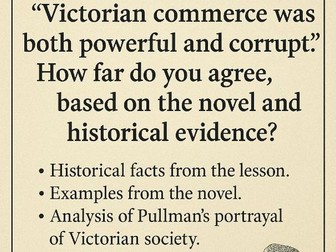
Explore Victorian ship broking and trade in Philip Pullman’s “The Ruby in the Smoke.” Analyse historical context, mystery, and tension with engaging activities and insights. Explore the fascinating world of Victorian ship broking and trade through the lens of Philip Pullman’s novel, “The Ruby in the Smoke.” This comprehensive lesson delves into the historical context of Victorian commerce, highlighting the significance of the shipping industry, the opium trade, and financial intrigue in 19th-century London. Students will analyse how Pullman uses these elements to build mystery and tension in the novel, drawing connections between historical facts and literary themes. Keywords: • Victorian ship broking • The Ruby in the Smoke • Philip Pullman • Victorian commerce • Victorian trade • Victorian London • Year 8 English lesson • Victorian era education • Victorian mystery novels • Victorian shipping industry • Victorian opium trade • Victorian financial intrigue • Victorian docks • Victorian merchants • Victorian historical context • Victorian literature analysis • Victorian society • Victorian era vocabulary • Victorian era worksheets • Victorian era teaching resources
Things Fall Apart: Context & Culture PackQuick View
janley2

Things Fall Apart: Context & Culture Pack

(0)
Complete ICE/IGCSE lesson pack on Things Fall Apart, covering Igbo culture, context, Achebe’s purpose, worksheets, answers and differentiated tasks. Complete ICE/IGCSE lesson pack on Things Fall Apart, designed to build secure understanding of Igbo culture, historical context, and Achebe’s purpose. Includes a full lesson plan, teacher‑annotated version, differentiated worksheets, structured notes, challenge tasks, extract summary, homework sheet, model answers, assessment criteria, and a student self‑assessment rubric. Ideal for mixed‑ability classes and for establishing cultural understanding before reading the novel. Fully editable and classroom‑ready.
A‑Level Gothic Literature: 5 LessonsQuick View
janley2

A‑Level Gothic Literature: 5 Lessons

(0)
A‑Level Gothic Literature OCR pack with 5 detailed lessons, extracts, model essays, critical theory, and differentiated tasks to build top‑grade exam skills. This comprehensive A‑Level Gothic Literature (OCR) lesson pack contains five fully‑resourced, extract‑based lessons covering the core Gothic concepts, themes, and exam skills required for top‑band responses. Designed by Janneta Stoddern (ABACUS²), this pack blends examiner‑level insight, critical theory, and mixed‑ability scaffolding to support every learner from Grade C to A*. Across the five lessons, students explore the uncanny, Gothic settings, gender and transgression, narrative unreliability, and comparative Gothic themes, using extracts from Frankenstein, Dracula, The Bloody Chamber, The Monk, The Picture of Dorian Gray, Wuthering Heights, and The Turn of the Screw. Each lesson includes three extract options (canonical, modern, high‑challenge) so teachers can tailor content to their class or syllabus. Every lesson features: Clear learning focus linked to AO1–AO5 Differentiated tasks with scaffolds, sentence starters, and challenge extensions Annotation guides for language, structure, symbolism, and critical ideas Model Band 5 paragraphs and conceptual theses Critical theory integration (Freud, Botting, Todorov, Gilbert & Gubar, Creed, Punter, Mulvey) Exam‑focused writing frames for micro‑analysis and comparative essays Active learning tasks including starters, annotation activities, and plenaries The pack culminates in a comparative transgression lesson aligned with OCR expectations, complete with extract pairings, a Band 5 paragraph scaffold, and a 50‑word evaluative conclusion task. Perfect for teachers seeking high‑quality, ready‑to‑teach Gothic lessons that combine academic rigour with accessibility. Ideal for OCR but easily adaptable for AQA, Edexcel, WJEC, and CCEA.
Things Fall Apart: Study Revision PackQuick View
janley2

Things Fall Apart: Study Revision Pack

(0)
Complete Things Fall Apart revision guide with key themes, characters, context, quotes, and exam practice to support GCSE and A‑Level student success. This comprehensive Things Fall Apart Revision Booklet provides everything students need to understand, analyse, and write confidently about Chinua Achebe’s landmark novel. Designed for GCSE and A‑Level learners, it offers clear explanations, structured revision tasks, and examiner‑style guidance to support top‑grade outcomes. The booklet covers all major areas of study, including themes, characters, context, narrative methods, key quotations, and exam‑focused analysis. Each section is written with clarity and precision, making it ideal for independent revision, class study, homework, or targeted intervention. What’s Included Detailed chapter summaries to reinforce understanding Key themes (tradition vs change, masculinity, colonialism, fate, identity) Character breakdowns with analytical insights Historical and cultural context (Igbo society, colonial rule, Achebe’s purpose) High‑value quotations with concise commentary Exam‑style questions for practice and assessment Model analysis frames to support structured writing Vocabulary and terminology support for developing academic expression Why This Booklet Works Clear, accessible explanations for mixed‑ability groups Strong focus on exam preparation and analytical writing Ideal for revision sessions, homework, or flipped learning Suitable for AQA, Edexcel, OCR, WJEC, CCEA, and international curricula Designed to save teachers hours of planning while giving students a reliable, high‑quality study companion Perfect for teachers seeking a complete, ready‑to‑use revision resource that builds confidence, deepens understanding, and supports strong exam performance.
Mandela–Woolf Comparative Authority PackQuick View
janley2

Mandela–Woolf Comparative Authority Pack

(0)
A‑Level comparison of Mandela and Woolf exploring how each constructs moral authority through rhetoric, oppression, leadership and contextual power. This comprehensive resource gives students a clear, exam‑focused understanding of how two influential figures—one political, one literary—build credibility, challenge oppression and shape public consciousness through language. The pack breaks down Mandela’s political struggle, anti‑apartheid activism and moral leadership alongside Woolf’s intellectual authority, feminist critique and rhetorical strategies in A Room of One’s Own and Three Guineas. Students gain secure AO2, AO3 and AO4 knowledge through accessible explanations, comparative frameworks and high‑quality academic commentary. Designed for mixed‑ability A‑Level groups, the resource includes comparative essay scaffolds, PEEL paragraph templates, contextual timelines, rhetorical technique guides, model paragraphs, and a printable quote bank. Visual learners benefit from comparison tables, thematic maps and clear side‑by‑side analysis of how each writer constructs moral authority in different genres and historical contexts. This pack is ideal for teachers delivering comparison units, students preparing for exam essays, and classes studying rhetoric, protest writing, leadership, feminism, justice and power. It supports A‑Level English Literature, A‑Level English Language, and A‑Level Combined Language & Literature. Created by Janneta Stoddern.
Moral Authority:Woolf & Mandela PackQuick View
janley2

Moral Authority:Woolf & Mandela Pack

(0)
A complete A‑Level comparison pack on how Virginia Woolf and Nelson Mandela construct moral authority, with essays, scaffolds, flashcards and revision aids. A complete A‑Level comparison pack on how Virginia Woolf and Nelson Mandela construct moral authority, with essays, scaffolds, flashcards and revision aids. This premium resource gives students everything they need to master AO2, AO3 and AO4 when comparing Woolf and Mandela, including annotated model essays, planning tools, exam practice, and visual revision materials. Includes Essential facts; Nelson Mandela and Virginia Woolf. Designed for high‑attaining students and mixed‑ability groups alike, the pack includes a full essay planning scaffold, PEEL paragraph templates, sentence starters, embedded quotation planners, and a comprehensive set of flashcards covering rhetorical techniques, contextual anchors, comparative threads and evaluation prompts. Students can practise with five exam‑style questions, model Band 5 and Band 3 paragraphs, and a peer‑review checklist that supports independent improvement. Visual learners benefit from timeline infographics, rhetorical technique posters, AO4 comparison tables and a printable quote bank. What’s Included ✔ Model Essays (A, B, C)* Fully annotated with AO1–AO5 commentary Examiner‑style insights and improvement notes Comparative analysis throughout ✔ Essay Planning Tools Student‑friendly essay scaffold PEEL paragraph planner with AO prompts Comparison, analysis & evaluation sentence starters Embedded quotation planner (technique + effect + AO3 + AO4) ✔ Flashcards for Rapid Revision AO2 rhetorical techniques AO3 contextual anchors AO4 comparative threads AO5 evaluation prompts ✔ Exam Practice Section Five exam‑style questions Student‑friendly peer review checklist Mark scheme breakdown (AO1–AO5) ✔ Visual Revision Aids Woolf vs Mandela timeline infographic Rhetorical technique poster AO4 comparison table Printable quote bank ✔ TES‑Optimised Publishing Assets SEO title & description High‑conversion tags Thumbnail text ✔ Extension & Enrichment Tasks Creative writing: “Claiming Moral Authority” Debate prompt: lived experience vs intellectual argument Comparative extension: MLK, Gandhi, Orwell Why This Pack Works Designed for mixed‑ability A‑Level groups Supports independent revision and classroom teaching Clear AO signposting throughout High‑quality academic design
Woolf: A‑Level Essential Facts PackQuick View
janley2

Woolf: A‑Level Essential Facts Pack

(0)
A‑Level Essential Key Facts on Virginia Woolf, covering key dates, context, feminism, rhetoric and exam‑ready knowledge to support fast, effective revision. This concise, high‑impact fact file gives students a clear understanding of Woolf’s life, intellectual background and feminist arguments, with accessible explanations tailored specifically for A‑Level English Literature and A‑Level Language. The resource breaks down Woolf’s biography, the social and political landscape of interwar Britain, the development of feminist thought, and the key ideas behind A Room of One’s Own and Three Guineas. Students gain secure AO3 contextual knowledge and a strong grasp of the rhetorical and structural techniques Woolf uses to construct intellectual authority in her essays. Designed for rapid revision and classroom use, the pack includes bullet‑pointed essential facts, key terminology, contextual anchors, and exam‑ready summaries that support comparison, unseen extracts and evaluative writing. It is ideal for teachers preparing comparison units, students revising independently, or classes studying rhetoric, gender, power and social critique. Perfect for A‑Level English Literature, A‑Level English Language, A‑Level Combined Language & Literature, and any course exploring feminism, argumentation and literary non‑fiction. Created by Janneta Stoddern.
Mandela: A‑Level Essential Facts PackQuick View
janley2

Mandela: A‑Level Essential Facts Pack

(0)
A‑Level Essential Facts on Nelson Mandela, covering key dates, context, apartheid, activism, rhetoric and exam‑ready knowledge for fast, effective revision. A‑Level Essential Facts on Nelson Mandela, covering key dates, context, apartheid, activism, rhetoric and exam‑ready knowledge for fast, effective revision. This concise, high‑impact resource gives students everything they need to understand Mandela’s life, political struggle and rhetorical power, with clear explanations tailored to A‑Level English Literature and A‑Level Language courses. Designed for quick revision and classroom use, this pack breaks down Mandela’s biography, the development of apartheid, the Rivonia Trial, his imprisonment, leadership in the ANC, and the moral authority he constructs through rhetoric. Students gain a secure grasp of the historical, political and ethical context needed for comparative essays, unseen extracts and AO3‑driven analysis. The resource includes a clean, student‑friendly layout with bullet‑pointed essential facts, key terminology, contextual anchors, and exam‑ready summaries. It is ideal for teachers preparing comparison units, students revising independently, or classes studying rhetoric, protest writing, political speeches or leadership in literature. Perfect for A‑Level English Literature, A‑Level English Language, A‑Level Combined Language & Literature, and any course exploring power, justice and resistance. Created by Janneta Stoddern.
A Doll’s House: Key Quotes & AnalysisQuick View
janley2

A Doll’s House: Key Quotes & Analysis

(0)
A Doll’s House key quotations with clear analysis, themes, character insights and exam-ready explanations for A-Level English Literature revision and classroom teaching. This A Doll’s House Key Quotations and Analysis Pack provides a complete, exam‑ready set of the most important quotes from Ibsen’s play, each with clear explanations, thematic links, and character insights. Designed for A‑Level English Literature (AQA, Edexcel, OCR, WJEC), this resource supports high‑attaining students as well as those who need structured, accessible guidance. Perfect for revision, classroom teaching, essay preparation, and independent study. Inside the pack, students will find quotations organised by character, theme, and act, with concise yet high‑quality analysis that models how to meet AO1, AO2, AO3, AO4 and AO5. Each quotation is unpacked with meaning, context, language techniques, and links to major ideas such as gender roles, power, identity, marriage, reputation, and social expectations. The resource also includes examiner‑style commentary, model paragraphs, and critical viewpoints to help students reach top‑band responses. This resource is ideal for teachers who want a ready‑to‑use, high‑impact reference sheet or revision booklet that saves hours of planning time. It works brilliantly as a classroom handout, homework task, essay‑writing support, or revision guide before mock exams and final assessments. What’s Included Key quotations from A Doll’s House Detailed analysis for each quote Character‑based quotation lists Thematic quotation lists Contextual links (AO3) Critical interpretations (AO5) Model analytical sentences Revision‑friendly layout Perfect for A‑Level English Literature Perfect For A‑Level English Literature teachers Students revising for exams Essay planning and homework Classroom discussion and annotation Independent revision and study
Duchess of Malfi A‑Level Essay PackQuick View
janley2

Duchess of Malfi A‑Level Essay Pack

(0)
A complete A‑Level Duchess of Malfi pack with essay scaffolds, PETAL grids, themes, model paragraphs, lesson plans, worksheets and examiner‑style guidance. Duchess of Malfi A‑Level Essay Pack By Janneta Stoddern This complete A‑Level Duchess of Malfi essay and theme mastery pack provides everything students need to write high‑level, examiner‑ready analytical essays. Designed for mixed‑ability classes, the resource includes scaffolded planning grids, PETAL paragraph frames, success criteria, model A/A* paragraphs, and a full set of OCR‑style exam questions. Clear explanations of key themes—corruption, patriarchy, agency, religion, deception, guilt, fate and more—support students in developing conceptual understanding and embedding critical vocabulary. Differentiated worksheets, challenge tasks, and self‑assessment tools ensure accessibility and stretch for all learners. The pack also includes a structured lesson sequence, printable templates, and examiner‑style guidance to help students avoid common pitfalls and build confident, independent essays. Perfect for classroom teaching, revision, intervention, or independent study. Duchess of Malfi A Level English Literature A Level essay writing OCR English Literature Jacobean tragedy Essay scaffolds PETAL paragraphs English revision Literature themes Model paragraphs Exam practice English worksheets Malfi themes Malfi analysis A Level resources English teacher resources High ability challenge Mixed ability English Essay planning Tragedy analysis
Duchess of Malfi: Themes & Analysis PackQuick View
janley2

Duchess of Malfi: Themes & Analysis Pack

(0)
Explore The Duchess of Malfi through 14 key themes with scaffolded analysis, essay prompts, planning grids, and examiner-style guidance. This A‑Level resource breaks down major and advanced themes including corruption, patriarchy, agency, religion, deception, guilt, fate, madness, mortality, and more. Each theme is supported by clear definitions, analytical prompts, and planning grids to help students build high‑level arguments and embed critical vocabulary. Includes OCR‑style essay questions, ABACUS² writing tips, PETAL paragraph scaffolds, and success criteria aligned to AO1–AO4. Differentiation strategies and challenge tasks support mixed‑ability learners, while model paragraphs and examiner tips guide students toward A/A* responses. Perfect for classroom teaching, revision, intervention, or independent study. Printable templates and lesson plans included. Duchess of Malfi Duchess of Malfi Duchess of Malfi themes Duchess of Malfi analysis A Level English Literature A Level English Jacobean tragedy English Literature OCR English Literature Edexcel English Literature AQA English Literature Essay scaffolds Essay planning PETAL paragraphs Model paragraphs English revision Literature revision Theme analysis Tragedy themes Female agency Patriarchy in literature Corruption and power Religion and sin Deception and appearance Fate and free will Madness in tragedy Mortality in literature English worksheets English teacher resources Mixed ability English High ability English Revision worksheets Lesson plans English Lit
A-Level English Literature: Ferdinand’s Breakdown in The Duchess of Malfi – Complete Lesson Pack witQuick View
janley2

A-Level English Literature: Ferdinand’s Breakdown in The Duchess of Malfi – Complete Lesson Pack wit

(0)
This comprehensive A-Level English Literature resource explores the psychological breakdown of Ferdinand in The Duchess of Malfi, with a focus on Jacobean anxieties around madness, power, and corruption. Perfect for classroom teaching, revision, or independent study, this pack includes: What’s Included: Two 40-minute lesson plans (Group & Individual) Six scaffolded worksheets: Scene-by-scene breakdown Word bank & sentence starters Analytical writing practice Comparative task Self-assessment mark scheme Creative extension (lycanthropy drawing) Five exam-style questions: Extract-based Theme Character Comparative Conceptual/stretch Model answers and essay scaffolds Differentiation strategies for mixed-ability learners Printable and editable formats Skills Developed: Literary analysis Contextual understanding Comparative writing Self-assessment and peer feedback Creative interpretation Curriculum Links: AQA, Edexcel, OCR, WJEC Tragedy, Jacobean drama, madness, corruption, power Duchess of Malfi, Ferdinand breakdown, Jacobean tragedy, A-Level English Literature, madness in literature, comparative essay, scaffolded worksheets, exam questions, lycanthropy, power and corruption, OCR, AQA, Edexcel, WJEC
Stages of Ferdinand’s Breakdown in The Duchess of Malfi – Complete A-Level ResourceQuick View
janley2

Stages of Ferdinand’s Breakdown in The Duchess of Malfi – Complete A-Level Resource

(0)
This comprehensive document provides an in-depth analysis of Ferdinand’s psychological breakdown in John Webster’s The Duchess of Malfi, tailored for A-Level English Literature. The resource includes: A clear, student-friendly breakdown of each stage of Ferdinand’s collapse, with key quotes, and explanations. Thematic significance sections covering power, corruption, madness, guilt, incestuous desire, and Jacobean anxieties. Scene-by-scene analysis with ready-to-use tables for annotation and classroom discussion. Word banks, sentence starters, and extension tasks for differentiation and stretch. A detailed mark scheme with model answers for each band, examiner commentary, and essay scaffolds for top-grade writing. Comparative essay plans (Ferdinand vs Bosola vs Cardinal) and a full model essay with examiner commentary. Teaching notes and scaffolds to support all learners Perfect for classroom teaching, revision, homework, or independent study and ready to use.
The Duchess of Malfi: Plot summaryQuick View
janley2

The Duchess of Malfi: Plot summary

(0)
The Duchess of Malfi: A-Level English Literature Study Guide Unlock the complexities of John Webster’s The Duchess of Malfi with this detailed, student-friendly study guide, designed specifically for A-Level English Literature. Perfect for teachers, tutors, and students, this resource covers everything you need for exam success and deeper understanding. What’s included: Concise Plot Summary: Each act broken down for clarity, with key events and turning points. Gender Stereotypes & Transgressions: Analysis of Jacobean expectations, the “lusty widow” stereotype, and the Duchess’s proto-feminist role. Key Themes: Exploration of the body politic vs. body natural, corruption, and the malcontent Bosola. Essential Context (AO3): The Great Chain of Being, James I’s court, and the “Woman Question” explained for top marks. Critical Quotes for Essays: Five essential quotations, each with explanation and thematic analysis, ready for use in essays and revision. Ready-to-use Index: Structured for easy navigation and revision. Why choose this resource? Written for A-Level students, with exam board requirements in mind. Ideal for lesson planning, homework, revision, and independent study. Clear, accessible language and layout. Saves hours of preparation time. Perfect for: AQA, Edexcel, OCR, WJEC, and other A-Level English Literature specifications.
ABACUS² Malfi A‑Level Essay ToolkitQuick View
janley2

ABACUS² Malfi A‑Level Essay Toolkit

(0)
A complete ABACUS² A‑Level essay planning sheet for The Duchess of Malfi, designed to improve analysis, structure, quotations and AO1–AO4 mastery. The Duchess of Malfi provides students with a clear, structured framework for planning high‑quality exam responses. Designed specifically for AQA, Edexcel, OCR and WJEC English Literature specifications, this resource supports students in developing sophisticated arguments, embedding quotations effectively, integrating Jacobean context, and meeting all four Assessment Objectives (AO1–AO4). The planning sheet includes a two‑column, student‑friendly layout that guides learners through every stage of essay construction—from unpacking the question to building PETAL‑style analytical paragraphs. It also features a detailed success criteria checklist, helping students self‑assess their work against A‑grade expectations, including argument clarity, language analysis, contextual integration, and alternative interpretations. This resource is ideal for: A‑Level English Literature lessons Essay planning and modelling Revision sessions Independent study Homework tasks Intervention and stretch‑and‑challenge support The sheet includes: A clear essay question unpacking section PETAL paragraph planning grid AO1–AO4 success criteria checklist ABACUS² writing tips for high‑level analysis Space for quotations, techniques, context and interpretations A professional, consistent design that matches the full ABACUS² Duchess of Malfi series This planning sheet helps students produce essays that are: Well‑structured and concept‑driven Rich in embedded quotations Forensic in AO2 analysis Contextually informed (Jacobean vs modern) Critically aware (feminist, psychoanalytic, historicist) Clear, academic and exam‑ready Perfect for teachers who want a premium, ready‑to‑use, visually consistent resource that supports top‑band writing and aligns with the full ABACUS² Duchess of Malfi collection.