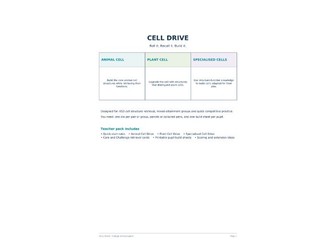
A complete KS3 biology retrieval game for teaching and revising animal cells, plant cells and specialised cells. Pupils roll a die, answer a retrieval question and earn each structure as they build a biologically accurate cell.
This 11-page printable A4 PDF includes:
quick-start teacher guidance and scoring
Animal Cell Drive
Plant Cell Drive
Specialised Cell Drive covering sperm cells, root hair cells, neurones and ciliated epithelial cells
core retrieval cards with answers
challenge retrieval cards for structure-function reasoning
three spacious pupil build sheets
Cell Scientist finisher and plenary prompts
SEND-friendly adaptations and a no-elimination rule
The game is designed for KS3 cell structure and function lessons, retrieval practice, revision, mixed-attainment groups, intervention, cover work and science clubs. It requires only ordinary dice, pencils or coloured pens and the printed pupil sheets.
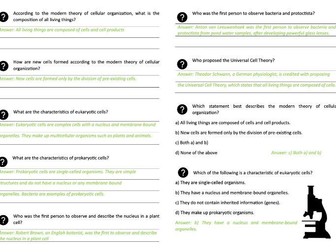
Pupils retrieve the functions of the cell membrane, nucleus, cytoplasm, mitochondria, ribosomes, cell wall, chloroplasts and permanent vacuole. The plant-cell round explicitly reinforces that plant cells share core structures with animal cells, while also identifying plant-specific structures.
Suitable for individual play, pairs, table groups or a whole-class championship. Finished pupils become Cell Scientists who check answers, read cards or complete extension questions, so nobody is eliminated.
A mature, low-threat times tables and multiplication game for KS3, intervention, SEND and Functional Skills Maths. Pupils practise recall while using coordinates, strategy and self-checking answers.
This resource includes:
a four-page printable A4 landscape PDF
an editable PowerPoint version
one blank Times Table Battleships game board
an Easy Facts example fleet
a Mixed Facts example fleet
a Hard Facts example fleet
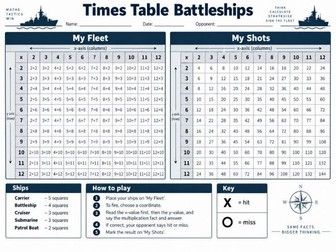
two 11 × 11 grids covering the 2 to 12 times tables
multiplication facts printed on the My Fleet grid
answers printed on the My Shots grid for independent checking
clear instructions, ship sizes and hit/miss symbols on every sheet
The coordinate layout consistently uses the first number on the x-axis and the second number on the y-axis. Pupils choose a coordinate, read the multiplication fact, calculate the answer and discover whether they have scored a hit or miss.
The example fleets offer different starting points without making the activity look childish. Teachers can use the blank sheet for pupils to position their own ships or provide one of the differentiated examples for a quicker start.
Suitable for paired practice, maths intervention, retrieval, starter activities, revision, SEND support, cover work and Functional Skills Maths. The navy and grey design is clear when printed and remains suitable for older pupils.
 Quick View

 Quick View
 Quick View