A level CHEMISTRY  ADVANCED PRACTICAL SKILLSQuick View
asadabbas005

A level CHEMISTRY ADVANCED PRACTICAL SKILLS

(0)
The “9701 – Chemistry Booklet (Advanced Practical Skills)” is a comprehensive guide designed to support students preparing for the practical component of the Cambridge International AS and A Level Chemistry (9701) examination. This booklet focuses on developing and refining advanced practical skills essential for mastering experimental chemistry. Key features of the booklet include: Detailed Experiments: A collection of well-structured experiments that cover key areas of chemistry, such as organic, inorganic, and physical chemistry. Each experiment is designed to enhance students’ understanding of laboratory techniques and data analysis. Step-by-Step Instructions: Clear, step-by-step instructions for conducting each experiment, ensuring that students can follow the procedures accurately and safely. These instructions help build confidence and competence in handling laboratory equipment and chemicals. Skills Development: Emphasis on developing core practical skills, including accurate measurement, observation, data collection, and analysis. Students also learn how to draw valid conclusions and evaluate experimental procedures. Exam Preparation: Guidance on how to approach the practical exams, including tips on time management, common pitfalls to avoid, and how to effectively communicate results and findings. Assessment Criteria: A breakdown of the assessment criteria used in the practical exams, helping students understand what is expected of them and how to achieve high marks. Safety Guidelines: Comprehensive safety guidelines and best practices to ensure safe conduct during laboratory work. This includes information on the proper use of personal protective equipment (PPE) and handling of hazardous substances. This booklet is an invaluable resource for both students and teachers, providing a solid foundation for success in the Advanced Practical Skills component of the 9701 Chemistry syllabus
IAL PHYSICS - UNIT 01 - L1 MomentumQuick View
asadabbas005

IAL PHYSICS - UNIT 01 - L1 Momentum

(0)
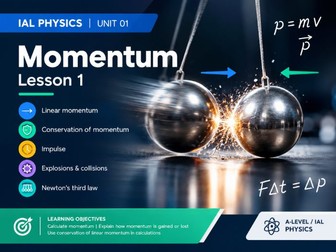
IAL Physics: Momentum – Lesson 1 Teach momentum and collisions with this engaging IAL Physics lesson PowerPoint. Designed to support classroom teaching and revision, this resource covers linear momentum, conservation of momentum, impulse, explosions and Newton’s third law of motion. What’s included? Starter and retrieval tasks to activate prior knowledge. Clear learning objectives and success criteria for different levels of achievement. Linear momentum: understanding momentum as the product of mass and velocity, including its vector nature and direction. Conservation of linear momentum: exploring how total momentum remains constant in a closed system. Impulse: understanding the relationship between force, time and change in momentum. Explosions and collisions: applying momentum conservation to interactions between objects. Newton’s third law: linking equal and opposite forces to changes in momentum and acceleration. Collaboration and discussion prompts to encourage scientific reasoning. PhET simulation activity to explore collisions and momentum interactively. Plenary and exit ticket to assess understanding and identify misconceptions. Learning outcomes By the end of the lesson, students should be able to calculate momentum, explain how objects gain or lose momentum, and perform calculations using the principle of conservation of linear momentum. This resource is suitable for Physics teachers delivering IAL Physics and for students revising the fundamentals of momentum and collisions. It can be adapted to suit different classroom needs and teaching approaches.
IAL Physics - Unit 01 - Topic 1 Mechanics - 1A motionQuick View
asadabbas005

IAL Physics - Unit 01 - Topic 1 Mechanics - 1A motion

(0)
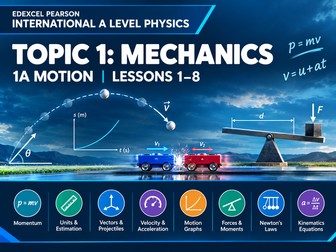
Teach mechanics with this collection of 13 Edexcel Pearson International A Level (IAL) Physics PowerPoint presentations, organised across Lessons 1–8. Covering momentum, vectors, projectiles, motion graphs, forces, moments, Newton’s laws and kinematics equations, this resource follows a consistent lesson structure to support clear explanations, student participation and exam-focused learning. Lessons included Lesson 1: Momentum; Standard Units in Physics Lesson 2: Estimation; Projectiles Lesson 3: Resolving Vectors; Velocity and Acceleration Lesson 4: Motion Graphs; Motion Graphs Part 2 Lesson 5: Adding Forces Lesson 6: Moments Lesson 7: Newton’s Laws of Motion Lesson 8: Kinematics Equations 1 and 2 What makes this resource useful? The presentations follow a consistent teaching structure to help teachers deliver lessons in a logical sequence. The collection supports retrieval practice, clear explanations of physics concepts, worked examples, student discussion, problem-solving and opportunities to review learning. Learning objectives Students will develop their ability to: Use physics quantities, standard units and appropriate terminology. Calculate and interpret momentum, velocity, acceleration and other quantities relevant to mechanics. Resolve vectors and analyse projectile motion. Interpret motion graphs and apply the equations of uniformly accelerated motion. Analyse forces, turning effects and situations involving Newton’s laws. Apply mathematical reasoning to mechanics problems. Suitable for Edexcel Pearson IAL Physics teachers, Year 12 students, classroom teaching, revision lessons and independent study. Resource format: PowerPoint presentations, suitable for classroom delivery and adaptation to suit your students’ needs.