 Quick View
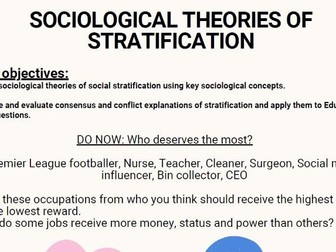
Sociological Theories of Stratification lesson
GCSE Sociology Sociological Theories of Stratification
A fully structured and engaging GCSE Sociology lesson introducing students to the key sociological theories used to explain social stratification and inequality. The lesson is designed to develop students’ knowledge of Functionalism, Marxism, Weberian theory and Feminism, while encouraging them to compare consensus and conflict perspectives and apply their understanding to exam-style questions.
The resource covers Davis and Moore’s role allocation, Parsons and meritocracy, Marxist concepts including the bourgeoisie, proletariat, exploitation and false class consciousness, Weber’s class, status and party, and the feminist concept of patriarchy.
The 24-slide lesson includes a range of activities to maintain engagement and check understanding, including a Do Now activity, quick checks, Think-Pair-Share, mini-whiteboard questioning, application scenarios, retrieval practice, self-assessment, comparison activities and an exit ticket. Students also complete Eduqas-style 4-mark and 9-mark exam practice, with support for structuring extended responses.
Topics and activities include:
Social stratification and inequality
Consensus vs conflict theories
Functionalism – Davis & Moore and role allocation
Parsons – meritocracy
Marxism – bourgeoisie and proletariat
Exploitation and false class consciousness
Weber – class, status and party
Feminism and patriarchy
Theory comparison and application activities
Retrieval practice and self-assessment
Eduqas-style exam practice
Stretch and challenge opportunities
End-of-lesson exit ticket
Ideal for Eduqas GCSE Sociology, particularly the study of social differentiation and stratification, and suitable for both classroom teaching and revision.