Upthrust KS3 ScienceQuick View
Sophia-Gentry

Upthrust KS3 Science

(0)
Fully planned and resourced lesson with self assessment, AFL, scaffolding and challenge tasks. LO: To investigate which fruits have a higher weight than up-thrust 1.To explain when upthrust is exerted To plan an investigation to see which fruits have a greater weight than up-thrust when submerged in water 3.To write a conclusion from our results
pH scale KS3 ScienceQuick View
Sophia-Gentry

pH scale KS3 Science

(0)
Fully planned and resourced lesson with self assessment, AFL, scaffolding and challenge tasks. LO: To be able to give the pH value based on observations Describe what the pH scale tells us. Recall the colours and pH values of different substances and what an indicator is. Explain what makes something an acid and state which atoms are in different laboratory acids.
Reactivity series KS3 ScienceQuick View
Sophia-Gentry

Reactivity series KS3 Science

(0)
Fully planned and resourced lesson with self assessment, AFL, scaffolding and challenge tasks. LO: Explain what the reactivity series is showing Write the correct order of the reactivity series Describe what the reactivity series is showing Describe the term displacement
Antacids KS3 scienceQuick View
Sophia-Gentry

Antacids KS3 science

(0)
Fully planned and resourced lesson with self assessment, AFL, scaffolding and challenge tasks. LO: Explain how antacids work and investigate their effectiveness Describe examples of everyday neutralisation reactions Explain two examples of everyday neutralisation reactions Design a suitable method for investigating the effectiveness on indigestion tablets
Displacement reactions KS3 ScienceQuick View
Sophia-Gentry

Displacement reactions KS3 Science

(0)
Fully planned and resourced lesson with self assessment, AFL, scaffolding and challenge tasks. LO: Investigate displacement reactions Describe what a displacement reaction is Predict which metal will be displaced Write an equation for a displacement reaction
Oxidation KS3 ScienceQuick View
Sophia-Gentry

Oxidation KS3 Science

(0)
Fully planned and resourced lesson with self assessment, AFL, scaffolding and challenge tasks. LO: To describe the term oxidation using equations Describe what oxidation is Write a word equations for reactions with oxygen Write a symbolic equation for oxidation and balance it
Hookes' Law plan and experiment (3 lessons) KS3 ScienceQuick View
Sophia-Gentry

Hookes' Law plan and experiment (3 lessons) KS3 Science

(0)
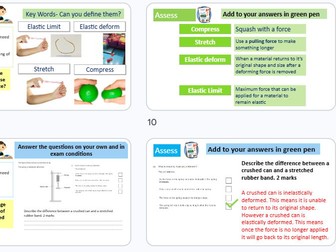
Fully planned and resourced lessons with self assessment, AFL, scaffolding and challenge tasks. Lesson 1- LO: To be able to plan an investigation to see how mass affects the extension of a spring To identify the variables To Write a hypothesis To write a method Lesson 2- LO: To be able to follow your method to investigate how mass affects extension of a spring Design a table to collect results Carry out the experiment Evaluate your method Lesson 3- LO: To be able to draw a graph and write a conclusion of your results. Explain when a bar chart and line graph should be used Decide and draw the correct graph for your results Write a conclusion for your results
Contact and Non-Contact forces KS3 ScienceQuick View
Sophia-Gentry

Contact and Non-Contact forces KS3 Science

(0)
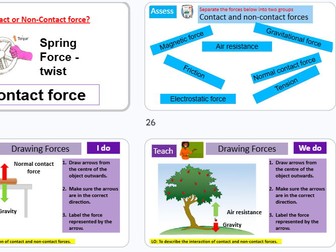
Fully planned and resourced lesson with self assessment, AFL, scaffolding and challenge tasks. LO: To be able to name and identify the different forces acting on an object 1.Identify the difference between contact and non-contact forces. . Label force diagrams and draw the arrows. Explain how an object moves based on the force diagram.
Friction KS3 ScienceQuick View
Sophia-Gentry

Friction KS3 Science

(0)
Fully planned and resourced lesson with self assessment, AFL, scaffolding and challenge tasks. LO: To investigate what factors affect friction Explain what friction is and when it is caused. Design an investigation to see how surface type affects friction Plot a bar graph of results
Stopping distance KS3 ScienceQuick View
Sophia-Gentry

Stopping distance KS3 Science

(0)
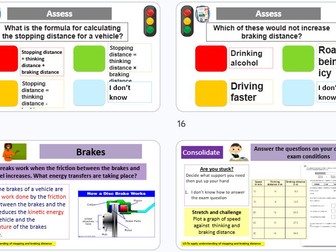
Fully planned and resourced lesson with self assessment, AFL, scaffolding and challenge tasks. LO:To be able to explain what stopping distance is 1.To explain what stopping distance is 2.Give the factors that affect thinking distance 3.Give the factors that affect braking distance
Air resistance KS3 ScienceQuick View
Sophia-Gentry

Air resistance KS3 Science

(0)
Fully planned and resourced lesson with self assessment, AFL, scaffolding and challenge tasks. LO: To investigate how surface area affects air resistance To explain when air-resistance is exerted To plan an investigation into surface area and air resistance To investigate how the surface area of a paper plane affects air resistance. .
Normal contact force KS3 ScienceQuick View
Sophia-Gentry

Normal contact force KS3 Science

(0)
Fully planned and resourced lesson with self assessment, AFL, scaffolding and challenge tasks. LO: To give examples of when normal contact force is exerted 1.To explain when this force is exerted To give examples of scenarios where this force is exerted. 3.To relate this force to Newtons 3rd Law
Resultant forceQuick View
Sophia-Gentry

Resultant force

(0)
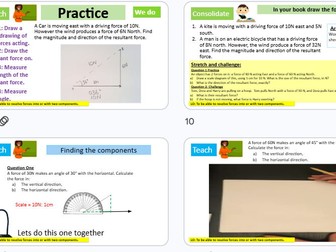
Fully planned and resourced lesson with self assessment, AFL, scaffolding and challenge tasks. LO: To be able to calculate resultant forces To be able to identify the different forces acting on an object To be able to define resultant force To be able to calculate the resultant force from diagrams
Catalysts KS3 ScienceQuick View
Sophia-Gentry

Catalysts KS3 Science

(0)
Fully planned and resourced lesson with self assessment, AFL, scaffolding and challenge tasks. LO: Explain how catalyst speed up a reaction State what a catalyst is using examples Explain how catalysts are used with real life examples. Investigate the rate of reaction with and without a catalyst.
pH lessons (bumper pack of 5) KS3 ScienceQuick View
Sophia-Gentry

pH lessons (bumper pack of 5) KS3 Science

(0)
Five fully planned and resourced lesson with self assessment, AFL, scaffolding and challenge tasks. Most of these lessons also include a practical activity. Lesson 1- Acids and alkalis Lesson 2- pH scale Lesson 3- Red cabbage indicator Lesson 4- Neutralisation Lesson 5- Antacids
Acids and Alkalis KS3 ScienceQuick View
Sophia-Gentry

Acids and Alkalis KS3 Science

(0)
Fully planned and resourced lesson with self assessment, AFL, scaffolding and challenge tasks. LO: To explain what safety precautions to take with acids and bases Identify common acids and alkalis Describe what safety precaution should be taken based on the hazard symbol. Explain why acids and alkali have different strengths.
Neutralisation KS3 ScienceQuick View
Sophia-Gentry

Neutralisation KS3 Science

(0)
Fully planned and resourced lesson with self assessment, AFL, scaffolding and challenge tasks. LO: Explain the process of neutralisation through use of equations State what happens during a neutralisation reaction Carry out the experiment safely and neutralise an acid with a base. Construct word and symbol equations for neutralisation reactions
Red cabbage indicator experiment KS3 ScienceQuick View
Sophia-Gentry

Red cabbage indicator experiment KS3 Science

(0)
Fully planned and resourced lesson with self assessment, AFL, scaffolding and challenge tasks. Follow a method safely to make an indicator using cabbage! Test your indicator and explain what the results show. Evaluate the effectiveness of your indicator
Ceramics and Composites KS3 scienceQuick View
Sophia-Gentry

Ceramics and Composites KS3 science

(0)
Fully planned and resourced lesson with self assessment, AFL, scaffolding and challenge tasks. LO: To compare ceramics and composites To give the properties of ceramics To give the uses of ceramics Compare ceramics to composites
Biodiversity Project bundle (9 lessons) KS3 ScienceQuick View
Sophia-Gentry

Biodiversity Project bundle (9 lessons) KS3 Science

(0)
A series of 9 lessons around Biodiversity where students will choose a human activity that is reducing biodiversity to research, create a presentation and present to their class. Lesson 1- Project introduction Lesson 2- Investigating trees Lesson 3- Flowers and Pollination Lesson 4- Threats to biodiversity Lesson 5- Research Lesson 6- Design your presentation Lesson 7- Create your script Lesson 8- Practice your presentation Lesson 9- Final presentation
Year 8 British science week mini project (4 lessons)Quick View
Sophia-Gentry

Year 8 British science week mini project (4 lessons)

(0)
4 lessons for a mini project that I did with year 8 during British Science week. The project involved the students designing and creating their own self sustaining bottle biome. It is designed to be used in the last 15-20 minutes of a lesson. Lesson 1- Variables and Hypothesis Lesson 2- Biome design Lesson 3- Biome creation Lesson 4- Follow up