

 Quick View
Popular Music – An Introduction |Instruments, Vocals, Structures and Bhangra
Popular Music – An Introduction
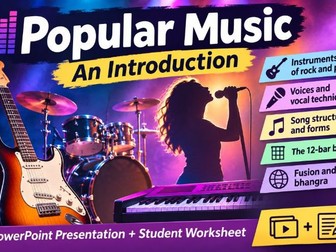
Introduce your students to the key sounds, instruments, voices and structures of popular music with this accessible 12-slide PowerPoint presentation. Designed for secondary music lessons, the resource provides a starting point for exploring pop and rock, supported by visual examples, musical vocabulary and suggested listening activities.
The presentation opens by considering what popular music means, its commercial appeal and the emergence of the teenage audience in the 1950s. Students are encouraged to consider the broad characteristics of pop and rock, with familiar artists and recordings providing useful reference points.
The instrument section introduces the sounds and equipment associated with popular music. Students explore acoustic and electric guitars, including labelled parts of the instruments, and learn performance terms such as double stopping, fall-offs, harmonics, picking, strumming and licks. Keyboards are also covered, including synthesisers, digital pianos and the Hammond organ. A labelled drum-kit illustration helps students identify the main components. A listening activity based on Deep Purple’s ‘Hush’ invites students to listen for power chords, guitar riffs and solos, bass-guitar patterns, chord sequences and the Hammond organ solo.
The voices section introduces lead and backing vocals, traditional voice categories and the meaning of vocal range. Listening references to The Supremes, Diana Ross, the Bee Gees and Meat Loaf provide opportunities to compare vocal approaches, including falsetto and chest voice.
Students then investigate the building blocks of rock and pop song structures. The presentation explains introductions, verses, choruses, pre-choruses, outros, instrumental sections, solos, riffs, bridges and hooks. It also introduces several song forms: strophic form, 32-bar AABA form, verse–chorus form and the 12-bar blues. The blues progression is shown in a clear twelve-bar grid, with chord names and Roman-numeral notation.
The final section explores musical fusion and introduces bhangra, including the role of the dhol and characteristic rhythmic patterns. Listening examples include The Beatles’ ‘Norwegian Wood’, Channi Singh and Apache Indian, giving students opportunities to recognise and discuss different musical influences.
YouTube listening references support teacher-led discussion and classroom analysis. The slides can be used as a complete introductory lesson, spread across a short unit, or revisited for revision. The accompanying student worksheet provides questions, terminology practice, a song-structure matching task and a listening challenge.
Suitable for KS3 Music and as an introduction or recap for GCSE Music, this resource helps students build confidence in identifying, describing and discussing the musical features of popular music.