How successful was Honecker in developing a distinct identity for GDR during the years 1971-85Quick View
s_abhineya

How successful was Honecker in developing a distinct identity for GDR during the years 1971-85

(0)
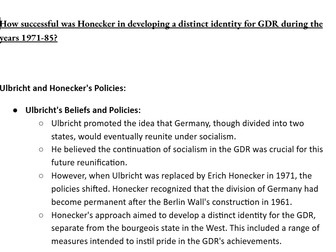
This comprehensive A-Level History revision resource explores how successful Erich Honecker was in developing a distinct national identity for the German Democratic Republic (GDR) between 1971 and 1985. Designed to support students studying East Germany during the Cold War, this resource provides detailed, clearly organised notes covering Honecker’s policies, the role of propaganda, media censorship, cultural identity and sporting achievements. What’s included? Honecker’s Leadership and Policies: The transition from Walter Ulbricht to Erich Honecker and attempts to establish a distinct East German identity. Mass Media and Propaganda: Detailed coverage of newspapers, radio, television, censorship and the SED’s control over information. Abgrenzung (Demarcation): How language, education and cultural policies were used to distinguish East Germany from West Germany. Sport and National Identity: The importance of mass participation, Olympic achievements, international recognition and state-sponsored sporting programmes. Successes and Limitations: An evaluation of Honecker’s attempts to create national pride and the continuing influence of West German culture. Exam-Style Questions: Eight extended-response questions designed to encourage historical analysis, evaluation and essay planning. Why is this resource useful? This resource is ideal for: Consolidating knowledge after lessons. Independent revision and exam preparation. Developing evidence-based arguments for A-Level History essays. Understanding the successes and limitations of Honecker’s policies. Supporting classroom discussions, homework and essay planning. The notes combine key historical events, statistics, examples and evaluation to help students develop a deeper understanding of East German society and national identity during the Cold War. Suitable for: A-Level History students, teachers and independent learners studying the GDR, Cold War Europe and twentieth-century German history.
RP 4 - Exam Questions & Answers A levelQuick View
s_abhineya

RP 4 - Exam Questions & Answers A level

(0)
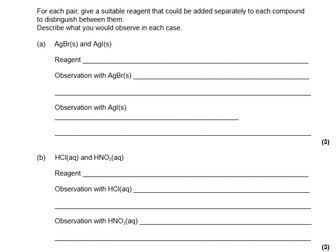
AQA A-Level Chemistry – Required Practical 4: Exam Practice Questions and Mark Schemes A comprehensive collection of 18 exam-style questions with accompanying mark schemes, designed to help A-Level Chemistry students revise and prepare for questions involving test-tube reactions and the identification of unknown substances. This resource focuses on developing students’ understanding of qualitative analysis, chemical testing, experimental observations and the application of practical chemistry knowledge in exam questions. What’s included? 18 exam-style questions with a range of mark allocations. Detailed mark schemes to support independent marking and revision. Questions on identifying halide ions using silver nitrate and ammonia. Precipitation reactions, ionic equations and chemical observations. Testing and distinguishing between organic and inorganic compounds. Halogen displacement reactions and redox chemistry. Practical calculations, experimental errors and interpretation of results. Questions requiring explanations of experimental methods and chemical reactions.
GCSE French – Mon École | School Vocabulary and Sentence BuildingQuick View
s_abhineya

GCSE French – Mon École | School Vocabulary and Sentence Building

(0)
This French sentence-building worksheet helps students practise talking about their school, subjects and teachers in the present tense. The resource includes useful French vocabulary with English translations, making it easier for students to build their own sentences and express their opinions. What’s included: School vocabulary and subjects Phrases to describe your school Giving opinions using j’aime, j’adore and je n’aime pas Using parce que to explain opinions Adjectives to describe subjects and teachers Sentence-building tables to support writing and speaking This resource is useful for classroom activities, homework, revision or extra writing practice. Suitable for: KS3 and GCSE French students (Years 7–11).
How successful was Honecker in developing a distinct identity for GDR during the years 1971-85.Quick View
s_abhineya

How successful was Honecker in developing a distinct identity for GDR during the years 1971-85.

(0)
How successful was Honecker in developing a distinct identity for GDR during the years 1971-85? - A level History notes. This examines Erich Honecker’s efforts to develop a distinct identity for the GDR between 1971 and 1985, focusing on media control, cultural policies, and sports achievements. It evaluates how propaganda, Abgrenzung, and international recognition shaped East German identity. The analysis considers both the successes and limitations of these policies in fostering a separate national consciousness from West Germany.
Information SystemsQuick View
s_abhineya

Information Systems

(0)
This document provides a comprehensive overview of Information Systems (IS) and related foundational concepts in business and data management. Definition of Information Systems Explains what an Information System is and its purpose in organizations. Describes IS Main Components of Information Systems Types of Information Systems Business Processes Data vs. Information Data Processes Census Data Example Sub-systems
Are political parties good for democracy - A level PoliticsQuick View
s_abhineya

Are political parties good for democracy - A level Politics

(0)
Are Political Parties Good for Democracy? – A Level Politics Resource This in-depth teaching resource explores one of the core questions in A Level Politics: Do political parties strengthen or weaken democracy? Perfect for classroom debate, essay preparation, or revision, it provides a balanced framework of strong and weak arguments across three key democratic functions — representation, accountability, and participation. What’s Inside: Comprehensive, well-structured notes on both sides of the debate. Real-world examples from recent UK politics (2024–2025), including cases involving Keir Starmer, Boris Johnson, and major party controversies. Clear distinctions between strong and weak arguments to help students evaluate evidence critically. Coverage of key themes such as FPTP and representation, fusion of powers and accountability, and voter engagement and participation. Ideal for supporting AO1 knowledge, AO2 analysis, and AO3 evaluation skills in AQA or Edexcel specifications
The development of the civil rights movement, 1954-1960  - GCSE History - Edxecel Unit 1  QuestionsQuick View
s_abhineya

The development of the civil rights movement, 1954-1960 - GCSE History - Edxecel Unit 1 Questions

(0)
This document is a comprehensive question set designed for GCSE History students studying the development of the Civil Rights Movement in the United States between 1954 and 1960, following the Edexcel Unit 1 curriculum. It covers key events, people, organisations, and legislation that shaped the early civil rights struggle, including landmark court cases, grassroots activism, and political challenges. The questions are structured to encourage critical thinking, recall of facts, and understanding of the social, political, and legal context of the era, providing a thorough revision and study resource for students.
11+ Verbal Reasoning Practice Paper 4Quick View
s_abhineya

11+ Verbal Reasoning Practice Paper 4

(0)
11+ Verbal Reasoning Practice Paper 4 Time allowed: 45 minutes Instructions: Read each question carefully. Write your answers clearly in the spaces provided. If you’re unsure, move on and come back later. No dictionaries or calculators allowed.
11+ Verbal Reasoning Practice Paper 3Quick View
s_abhineya

11+ Verbal Reasoning Practice Paper 3

(0)
11+ Verbal Reasoning Practice Paper 3 Time allowed: 45 minutes Instructions: Read each question carefully. Write your answers clearly in the spaces provided. If you’re unsure, move on and come back later. You may not use a dictionary or calculator.