Telemann Listening Practice App – Cambridge International AS & A Level Music 9483 (2027–2028) v1.0Quick View
erdemnusretkarakas

Telemann Listening Practice App – Cambridge International AS & A Level Music 9483 (2027–2028) v1.0

(0)
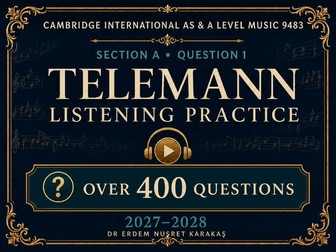
Telemann Listening Practice App – Cambridge International AS & A Level Music 9483 (2027–2028) v1.0 This free interactive question bank and training app has been designed to help students prepare for Cambridge International AS & A Level Music 9483, Listening Exam, Section A, Question 1. It focuses on the 2027–2028 set work: Georg Philipp Telemann: Ouverture-Suite in G minor, TWV 55 Listening recognition can be difficult to practise independently. Students need to hear short, unpredictably selected passages and identify their movement, form, structural section and musical features. Ordinarily, a teacher must select and play each extract manually. For this particular set work, students currently have no dedicated, ready-made question bank of this kind for independent listening practice. This app was created to fill that gap by automatically presenting extracts and questions in a varied, balanced order. Students can therefore practise repeatedly without knowing which movement, section or question type will appear next. The resource can be used for: Independent study and exam preparation Whole-class listening and discussion Classroom starters, plenaries and revision activities Homework and holiday revision Low-stakes assessment and diagnostic testing Identifying movements that require further study Focused practice while teaching a particular movement Reviewing several selected movements together Revisiting harmony, texture, instrumentation and compositional techniques during lessons Teachers can select one or more movements and use the associated questions as part of a lesson. Students can also complete mixed sessions covering the entire set work and download a summary report showing their performance by movement. Features include: 22 embedded audio extracts covering all eight movements Over 400 listening, recognition and knowledge-based questions Recognition of movement, form, section and time signature Questions on harmony, cadences, tonality, rhythm, melody, texture, instrumentation and compositional processes Musical terms and movement-title questions Circle-of-fifths listening challenges Practice focused on one or more selected movements Balanced mixed-exam sessions of 10, 20 or 30 questions Randomised question and answer ordering Automatic separation of repeated movements and question types whenever possible Immediate feedback after each confirmed answer Downloadable PDF results showing the student’s name, score, working time and performance by movement The audio is embedded within the app, so students do not need to receive separate audio files. The main resource is a standalone HTML file that opens in a modern browser and requires no installation. The app contains a full acknowledgement of the publicly available source recording used to prepare the listening extracts.
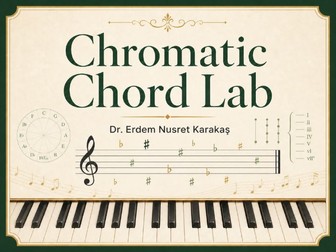
Chromatic Chord Lab – Interactive Harmony Practice App by Dr. Erdem Nusret KarakaşQuick View
erdemnusretkarakas

Chromatic Chord Lab – Interactive Harmony Practice App by Dr. Erdem Nusret Karakaş

(0)
Chromatic Chord Lab is an interactive music-theory app designed to help students construct, identify, see, and hear advanced chords. The app covers: • Major and minor added-sixth chords • Neapolitan sixth chords • Italian, French, and German augmented-sixth chords • Fully diminished seventh chords • Dominant seventh chords with a minor ninth Students can choose from three exercise types: Construct a chord by selecting its notes on an interactive keyboard. Identify a notated chord and, where appropriate, identify its key. Construct the predominant that precedes a given dominant and tonic. Neapolitan and augmented-sixth chords are presented in their characteristic functional positions rather than as freely invertible chords. After students confirm an answer involving one of these chords, the complete predominant–dominant–tonic progression is automatically displayed and played. Students can replay the progression after it finishes. Features include: • Interactive piano keyboard • Compact treble-staff notation • Correct enharmonic spelling • Sustained two-second string-ensemble playback • Automatic predominant–dominant–tonic demonstrations • Questions in keys containing up to four sharps or four flats • Balanced 20-question practice sessions • Immediate right-or-wrong feedback • Root-position and inversion options for applicable chord types • Printable reports showing scores and individual answers • An optional student-name field for personalized reports • No online transmission or permanent storage of names and results • A single standalone HTML file requiring no installation The resource is suitable for advanced secondary-school, conservatory, college, and university music-theory students. It can be used for individual practice, classroom demonstration, homework, revision, or formative assessment. To use the resource, download the HTML file and open it in a modern web browser. No installation is required, and the downloaded version can be used without an internet connection. **Created by Dr. Erdem Nusret Karakaş **
IGCSE Music - Classical music - Sonata form - Mozart KV305 - BundleQuick View
erdemnusretkarakas

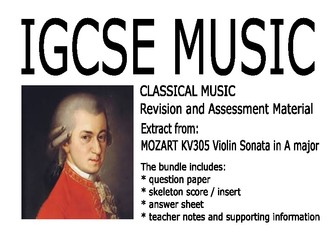
IGCSE Music - Classical music - Sonata form - Mozart KV305 - Bundle

(1)
Cambridge IGCSE Music listening resource based on Mozart’s KV305 Violin Sonata in A major. This bundle includes an exam-style question paper, skeleton score, answer sheet, and teacher notes. This resource has been designed for Cambridge IGCSE Music teachers and students and is based on an extract from the first movement of Mozart’s KV305 Violin Sonata in A major. It provides focused support for listening practice, revision, and exam preparation, and is particularly suitable for teaching topics such as Classical style, sonata form, texture, instrumentation, and related listening skills. The bundle includes: • a question paper in the style of the Cambridge IGCSE Listening Exam • a skeleton score / insert • an answer sheet • teacher notes and supporting information Files are provided in Word, PDF, and Sibelius formats, allowing teachers to adapt the materials for different classroom contexts. The resource may be used for lesson activities, homework, independent study, cover work, revision sessions, or assessment tasks. It can also be modified by adding or removing questions, adjusting the format, or using the skeleton score for guided listening exercises.
Romantic Music - Mendelssohn's Op.21 A Midsummer Night's Dream Ouverture - Detailed AnalysisQuick View
erdemnusretkarakas

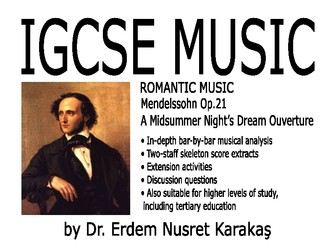
Romantic Music - Mendelssohn's Op.21 A Midsummer Night's Dream Ouverture - Detailed Analysis

(0)
Cambridge IGCSE Music resource on Mendelssohn’s A Midsummer Night’s Dream Ouverture, with detailed analysis of sonata form, program music, harmony, orchestration, and musical meaning. This teaching resource has been designed for Cambridge IGCSE Music teachers and students, but it may also be useful for Cambridge AS Music, extension work, and undergraduate- and graduate-level studies in musical analysis. It focuses especially on the exposition of Felix Mendelssohn’s A Midsummer Night’s Dream Overture, Op. 21, with an **in-depth bar-by-bar musical analysis **forming the main body of the document. The resource explores how Mendelssohn combines Classical formal discipline with Romantic imagination and Shakespearean program music. It examines sonata form, thematic transformation, motivic development, tonal planning, harmony, cadences, modulation, chromaticism, pedal points, orchestration, texture, dynamics, articulation, musical topics, characterization, humor, and extra-musical meaning. The document includes: background information on Mendelssohn, Shakespeare’s A Midsummer Night’s Dream, and the ouverture a general overview of form and programmatic structure detailed analysis of the exposition skeleton score extracts for guided score study visual prompts for discussion suggested extension activities involving harmony, composition, transposition, and short analytical writing Teachers may use the material for pre-listening preparation, revision, guided score study, classroom discussion, homework, extension work, or essay preparation. Individual sections can be selected, simplified, expanded, or adapted according to the level and needs of a particular class. This resource is especially suitable for teaching topics such as Romantic orchestral music, program music, sonata form, music and meaning, musical characterization, and the relationship between literature and instrumental music.
IGCSE Music - Classical music - Chord analysis - Mozart KV6 - BundleQuick View
erdemnusretkarakas

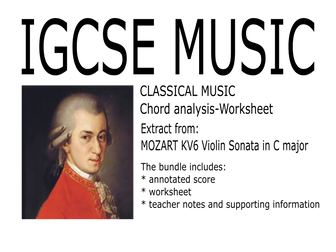
IGCSE Music - Classical music - Chord analysis - Mozart KV6 - Bundle

(0)
Cambridge IGCSE Music theory resource based on Mozart’s KV6. This bundle includes an annotated score, a chord-analysis worksheet designed to support students in analyzing chords in a real Classical-period musical context, and teacher notes. This resource has been designed for Cambridge IGCSE Music teachers and students. It provides focused support for the study of chords, chord qualities, inversions, scale degrees, and harmony in Classical style. It is particularly suitable for helping students transfer their theoretical knowledge of chords into practical score analysis. The bundle includes: • an annotated score with numbered harmonic units a chord-analysis worksheet for identifying chord tones, quality, position, key, and scale degree • teacher notes The annotated score visually guides students through the harmonic structure of the music, while the worksheet provides a clear table for recording their analysis. The resource may be used for classroom activities, homework, guided analysis, revision, independent study, or assessment preparation. It can also be adapted by focusing only on selected areas, such as chord names, inversions, scale degrees, cadences, modulation, Alberti bass, or non-harmony notes.**
IGCSE Music - Romantic music- Variation - Tchaikovsky Op.13 - BundleQuick View
erdemnusretkarakas

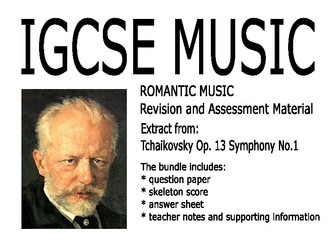
IGCSE Music - Romantic music- Variation - Tchaikovsky Op.13 - Bundle

(0)
Cambridge IGCSE Music listening resource based on Tchaikovsky’s Op. 13 Symphony No.1. This bundle includes an exam-style question paper, skeleton score, answer sheet, and teacher notes. This resource has been designed for Cambridge IGCSE Music teachers and students and is based on an extract from the second movement of Tchaikovsky’s Op. 13 Symphony No.1. It provides focused support for listening practice, revision, and exam preparation, and is particularly suitable for teaching topics such as Romantic style, variation, texture, instrumentation, melody, accompaniment etc. and related listening skills. The bundle includes: • a question paper in the style of the Cambridge IGCSE Listening Exam • a skeleton score • an answer sheet • teacher notes and supporting information Files are provided in Word, PDF, TIF and Sibelius formats, allowing teachers to adapt the materials for different classroom contexts. The resource may be used for lesson activities, homework, independent study, cover work, revision sessions, or assessment tasks. It can also be modified by adding or removing questions, adjusting the format, or using the skeleton score for guided listening exercises.
IGCSE Music - Classical music - Sonata form - Mozart KV285 - BundleQuick View
erdemnusretkarakas

IGCSE Music - Classical music - Sonata form - Mozart KV285 - Bundle

(0)
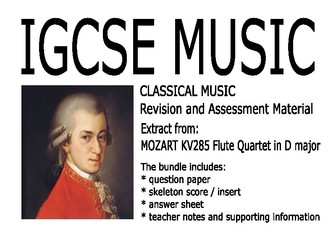
Cambridge IGCSE Music listening resource based on Mozart’s KV285 Flute Quartet in D major. This bundle includes an exam-style question paper, skeleton score, answer sheet, and teacher notes. This resource has been designed for Cambridge IGCSE Music teachers and students and is based on an extract from the first movement of Mozart’s KV285 Flute Quartet in D major. It provides focused support for listening practice, revision, and exam preparation, and is particularly suitable for teaching topics such as Classical style, sonata form, texture, instrumentation, and related listening skills. The bundle includes: • a question paper in the style of the Cambridge IGCSE Listening Exam • a skeleton score / insert • an answer sheet • teacher notes and supporting information Files are provided in Word, PDF, and Sibelius formats, allowing teachers to adapt the materials for different classroom contexts. The resource may be used for lesson activities, homework, independent study, cover work, revision sessions, or assessment tasks. It can also be modified by adding or removing questions, adjusting the format, or using the skeleton score for guided listening exercises.
IGCSE Music - Baroque music- Ritornello - Vivaldi RV533 - BundleQuick View
erdemnusretkarakas

IGCSE Music - Baroque music- Ritornello - Vivaldi RV533 - Bundle

(0)
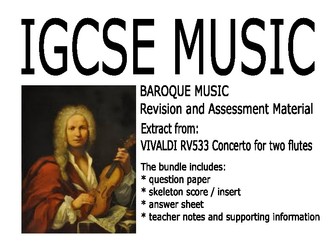
Cambridge IGCSE Music listening resource based on Vivaldi’s RV 533 Concerto for Two Flutes. This bundle includes an exam-style question paper, skeleton score, answer sheet, and teacher notes. This resource has been designed for Cambridge IGCSE Music teachers and students and is based on an extract from the first movement of Vivaldi’s RV 533 Concerto for Two Flutes. It provides focused support for listening practice, revision, and exam preparation, and is particularly suitable for teaching topics such as Baroque style, ritornello form, texture, instrumentation, and related listening skills. The bundle includes: a question paper in the style of the Cambridge IGCSE Listening Exam a skeleton score / insert an answer sheet teacher notes and supporting information Files are provided in Word, PDF, and Sibelius formats, allowing teachers to adapt the materials for different classroom contexts. The resource may be used for lesson activities, homework, independent study, cover work, revision sessions, or assessment tasks. It can also be modified by adding or removing questions, adjusting the format, or using the skeleton score for guided listening exercises.
Interactive Major and Minor Scale Practice App by Dr. Erdem Nusret KarakaşQuick View
erdemnusretkarakas

Interactive Major and Minor Scale Practice App by Dr. Erdem Nusret Karakaş

(0)
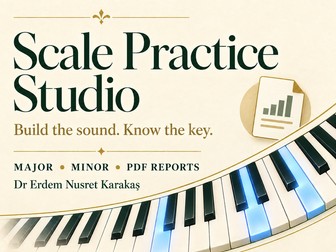
Scale Practice Studio is an interactive scale-construction and listening app covering 13 major and 13 minor scales, including keys with up to six flats and six sharps. Knowledge of keys is fundamental to music theory, harmony, analysis and composition. Knowing a key ultimately means knowing its scale: being able to recall, construct, hear and play its notes without consulting a reference. Memorizing the circle of fifths as a formula does not necessarily provide this practical understanding. Students may know how many accidentals a key contains but remain unable to construct its scale, recognize an incorrect note or identify the key of a musical passage. This becomes particularly problematic in modulatory passages, where the current key may not match the printed key signature. The app addresses these difficulties by requiring students to construct scales themselves on an unlabeled interactive keyboard. Students hear each note as they select it and can play the complete scale before submitting their answer. The sounding keys are highlighted during playback, allowing students to listen critically, locate possible mistakes and revise their work. The app supports differentiation and can be adapted to different syllabuses and levels of fluency. Teachers can introduce keys gradually, while advanced students can include keys with more accidentals. Students can also concentrate on particular keys that require further work. The app also helps teachers monitor students’ scale practice outside the classroom, which is normally difficult to assess in detail. At the end of a session, the student can download a PDF report and send it to the teacher. The report shows the student’s name, session date, beginning and ending times, total recorded practice time, accuracy and first-attempt successes. It also records the time, attempts, mistakes and result for every exercise, allowing the teacher to see what the student practiced, how long they worked and which keys require further attention. Minor-scale exercises have a specially structured design. Students first construct the relative major and then proceed to the natural, harmonic and melodic minor forms. Completed keyboards remain visible for comparison and can be replayed. Melodic minor is constructed using separate ascending and descending keyboards. Features include: • Randomized practice using scales selected by the student • Even distribution of the selected scales across a session • Built-in piano sound and visual playback • Three independent attempts followed by three guided attempts • Incorrect notes highlighted after submission during guided practice • Presentation and playback of the correct answer only after all attempts are used • Downloadable PDF practice reports The app is supplied as a standalone HTML file. Its piano sound and PDF reporting system are contained within the app, so no installation or separate audio files are required. Created by Dr Erdem Nusret Karakaş