AQA New Specification - The World of the Microscope - B1.1Quick View
MySciEyeSpy

AQA New Specification - The World of the Microscope - B1.1

(0)
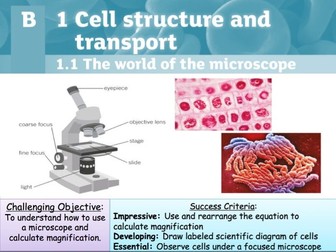
The world of the microscope lesson created in accordance to the NEW AQA Specification (9-1). Designed for a mixed ability class. I have also included a hand-out on conversions as well as the required practical hand-out method, student sheet for recording practical and exam questions with answers. It may be worth doing the RP after the plant/animal and prokaryotic/eukaryotic lesson however. There are also homework questions and answers and a plenary. AQA spec link: 1.1.5 Relevant chapter: B1 Cell structure and transport. AQA Biology third edition textbook-Page 4-5 Specification requires students to know the following; Students should be able to: • understand how microscopy techniques have developed over time • explain how electron microscopy has increased understanding of sub-cellular structures. Limited to the differences in magnification and resolution. An electron microscope has much higher magnification and resolving power than a light microscope. This means that it can be used to study cells in much finer detail. This has enabled biologists to see and understand many more sub-cellular structures. WS 1.1 Students should be able to carry out calculations involving magnification, real size and image size using the formula: magnification = size of image size of real object Students should be able to express answers in standard form if appropriate. MS 1a, 1b, 2h, 3b WS 4.4 Use prefixes centi, milli, micro and nano.
AQA new specification-Homeostasis and Reflex actions-B10.1 and B10.3Quick View
MySciEyeSpy

AQA new specification-Homeostasis and Reflex actions-B10.1 and B10.3

(0)
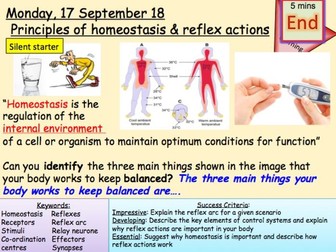
Principles of homeostasis combined with reflex actions lesson created in accordance to the NEW AQA Specification (9-1). Designed for a mixed ability class, although content can be adjusted to suit any ability. Includes powerpoint timers, embedded video, worksheet and anwers, plenary, exam question progress check, homework and answers. Plus homeostasis and reflex arcs catchphrase game plenary AQA spec link: 4.5.1 Relevant chapter: B10 The human nervous system. AQA Biology combined edition textbook-Page 133-134 Students are required to know the following; Students should be able to explain that homeostasis is the regulation of the internal conditions of a cell or organism to maintain optimum conditions for function in response to internal and external changes. Homeostasis maintains optimal conditions for enzyme action and all cell functions. In the human body, these include control of: • blood glucose concentration • body temperature • water levels. These automatic control systems may involve nervous responses or chemical responses. All control systems include: • cells called receptors, which detect stimuli (changes in theenvironment) • coordination centres (such as the brain, spinal cord and pancreas) that receive and process information from receptors • effectors, muscles or glands, which bring about responses which restore optimum levels. AQA spec link: 4.5.2 Relevant chapter: B10 The human nervous system. AQA Biology combined edition textbook-Page 137-13 Students are required to know the following; Students should be able to explain how the various structures in a reflex arc – including the sensory neurone, synapse, relay neurone and motor neurone – relate to their function. Students should understand why reflex actions are important. Reflex actions are automatic and rapid; they do not involve the conscious part of the brain.
AQA new specification-Animal and plant cells-B1.2 and Eukaryotic and prokaryotic cells-B1.3Quick View
MySciEyeSpy

AQA new specification-Animal and plant cells-B1.2 and Eukaryotic and prokaryotic cells-B1.3

(0)
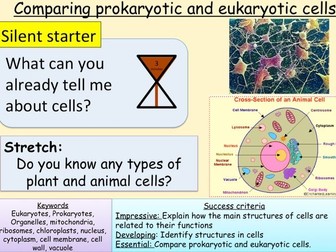
Animal and plant cells lesson combined with Eukaryotic and prokaryotic cells lesson created in accordance to the NEW AQA Specification (9-1). Designed for a mixed ability class, although content can be adjusted to suit any ability. Includes: slide animations, embedded videos and practice questions with answers on slides and built in task timers. Also homework and in class worksheets with answers! AQA spec link: 1.1.1 and 1.1.2 Relevant chapter: B1 Cell structure and transport. AQA Biology third edition textbook-Page 6-9 Specification requires students to know the following; Students should be able to explain how the main sub-cellular structures, including the nucleus, cell membranes, mitochondria, chloroplasts in plant cells and plasmids in bacterial cells are related to their functions. Most animal cells have the following parts: • a nucleus • cytoplasm • a cell membrane • mitochondria • ribosomes. In addition to the parts found in animal cells, plant cells often have: • chloroplasts • a permanent vacuole filled with cell sap. Plant and algal cells also have a cell wall made of cellulose, which strengthens the cell. Specification requires students to know the following; Plant and animal cells (eukaryotic cells) have a cell membrane, cytoplasm and genetic material enclosed in a nucleus. Bacterial cells (prokaryotic cells) are much smaller in comparison. They have cytoplasm and a cell membrane surrounded by a cell wall. The genetic material is not enclosed in a nucleus. It is a single DNA loop and there may be one or more small rings of DNA called plasmids. Students should be able to demonstrate an understanding of the scale and size of cells and be able to make order of magnitude calculations, including the use of standard form. MS 1b, 2a, 2h WS 4.4 Use prefixes centi, milli, micro and nano.