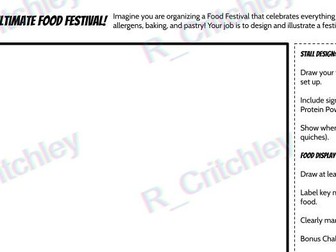
KS3 Food Tech - Ultimate Food FestivalQuick View
r_critchley

KS3 Food Tech - Ultimate Food Festival

(0)
Sudents design a festival food stall, sketching layouts, creating menus with macronutrient and allergen labels, and showcasing baking and pastry skills. This engaging cover lesson challenges students to apply their knowledge of macronutrients, allergens, and baking by designing a stall for the Ultimate Food Festival. Ideal for Year 8 Food Technology, this task encourages creativity while reinforcing key food preparation and nutrition concepts with minimal teacher input. What’s Included in the Task? Draw a detailed food festival stall, considering signage, layout, and food display. Design a menu featuring at least three food items (cakes, bread, pizza, or quiche) with macronutrient and allergen labels. Explain how foods fit into a balanced diet, using key nutrients learned in class. Bonus challenge: Create a promotional poster or a special festival meal deal. Perfect for: Independent cover lessons that require little teacher guidance. Encouraging creativity, problem-solving, and real-world food industry insights. Reinforcing baking, pastry, and nutrition skills in an interactive way. Formats: One A3 Sheet cuts down on printing cost and Time Printable PDF worksheet or editable digital document. A great way to keep students engaged while applying their learning in a fun and practical context.
KS3 Food Tech- Restaurant of the Future TaskQuick View
r_critchley

KS3 Food Tech- Restaurant of the Future Task

(0)
Students design a futuristic, healthy, and allergen-friendly fast-food restaurant, sketching layouts, creating menus, and exploring efficiency in food service. This creative cover lesson challenges students to apply their knowledge of allergens, restaurant service, and healthy cooking methods by designing a Restaurant of the Future! This task requires no teacher input, perfect for when emergency cover is needed and engages students in problem-solving, creativity, and food industry insights. What’s Included in the Task? Sketch a futuristic restaurant layout, considering kitchen design, ordering systems, and allergen safety measures. Create a healthy menu, labeling macronutrients and allergens while using alternative cooking methods (e.g., air frying instead of deep frying). Explain speed & efficiency techniques, considering preparation strategies used in real-world restaurant settings. Bonus challenge: Design a promotional poster or meal deal! Perfect for: Independent cover lessons requiring minimal teacher input. Encouraging creativity, problem-solving, and industry knowledge. Reinforcing key concepts from hospitality and catering, food preparation, and nutrition courses. Formats: One A3 sheet - Low printing costs. Printable PDF worksheet or editable digital document. Great for engaging students while reinforcing real-world food industry skills!
Cooking Methods: Egg Poaching Prac & sheetQuick View
r_critchley

Cooking Methods: Egg Poaching Prac & sheet

(0)
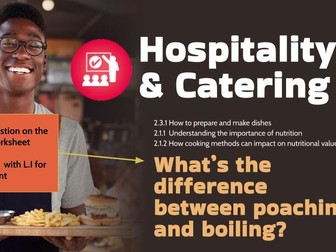
Students learn to poach eggs using an “I do, we do, you do” method, comparing poaching to boiling and practicing key cooking skills with guided support. This structured practical lesson teaches students how to poach eggs correctly, using the I do, we do, you do approach for scaffolded learning. Ideal for KS4 Hospitality & Catering or similar course, this lesson also explores the differences between poaching and boiling, reinforcing key cooking techniques and food science concepts as well as building skills for practical examinations. What’s Included in the Lesson? Lesson Slides with key term, activities and prompts. I do: Teacher demonstration of how to poach an egg, explaining technique, water temperature, and common mistakes. We do: Students attempt poaching together with teacher guidance, troubleshooting issues as a class. You do: Independent student practice, aiming for the perfect poached egg. All worksheets required including matrix for evaluating others and their independant practice. Compare & Contrast Activity: Students analyze the differences between poaching and boiling, discussing texture, cooking method, and nutritional impact. Perfect for: Structured food practicals with clear progression and hands-on learning. Reinforcing core cooking techniques in a simple, effective way. Encouraging critical thinking about different cooking methods and their outcomes. Formats: Printable lesson plan & student worksheet, editable digital document. A well-paced, interactive way for students to master poaching while developing key cooking skills!
KS3 Food Tech - Nutrient Hero/VillainQuick View
r_critchley

KS3 Food Tech - Nutrient Hero/Villain

(0)
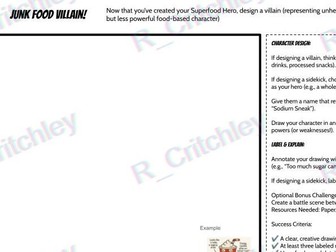
Students design a superhero based on healthy nutrients and a villain representing unhealthy food, reinforcing nutrition knowledge through creativity and art. This engaging and creative cover lesson challenges students to apply their knowledge of nutrition, healthy eating, and food choices by designing their own Nutrient Hero and Junk Food Villain. Perfect for KS3 Food Technology, this task requires minimal teacher input while reinforcing key concepts in a fun, interactive way. What’s Included in the Task? Create a Superfood Hero, inspired by key nutrients (e.g., “Captain Carrot” for Vitamin A or “Iron Man” for iron-rich foods). Design a Junk Food Villain, representing unhealthy choices (e.g., “Dr. Sugar Rush” or “The Grease Monster”). Annotate their powers, explaining how the nutrients (or unhealthy foods) impact the body. Bonus challenge: Illustrate a battle scene between the hero and villain! Perfect for: Independent cover lessons with no teacher input required. Reinforcing nutritional knowledge in a creative, engaging way. Encouraging artistic expression and problem-solving skills. Formats: Two A3 sheets, printed back to back or single for lower printing costs #Printable PDF worksheet or editable digital document. A fun and memorable way for students to explore nutrition and healthy eating while using their creativity!
Festive Biscuit DesignQuick View
r_critchley

Festive Biscuit Design

(0)
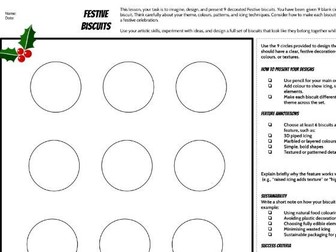
Students design a coordinated set of nine festive biscuits, exploring decoration techniques, colour, pattern, and presentation while annotating key design features and considering sustainability. This engaging cover or design-focused lesson challenges students to apply creativity, visual communication, and food design knowledge by planning a complete festive biscuit collection. Ideal for Year 7–8 Food Technology or Design & Technology, this task encourages independent thinking and high-quality presentation with minimal teacher input Christmas Festive Biscuit . What’s Included in the Task? Design 9 decorated festive biscuits using provided blank biscuit templates Develop a strong, consistent theme while ensuring variety across the set Add annotations to at least 6 biscuits, explaining key design features such as: 3D piped icing Marbled or layered colours Bold shapes and patterns Texture and surface detail Write a short sustainability note, considering eco-friendly decoration and packaging choices Clear success criteria to support independent work and self-assessment Bonus / Extension Opportunities: Design festive gift packaging for the biscuit set Create a name and branding for the biscuit collection Perfect for: Independent or emergency cover lessons Encouraging creativity, annotation, and design justification Developing understanding of presentation, sustainability, and food styling Cross-curricular links between Food Technology and Graphics Formats: Single A3 worksheet – reduces printing time and costs Suitable for print or digital completion A fun, festive way to keep students engaged while developing their design thinking, annotation skills, and visual creativity.
KS3/4 Food Tech - Prac RubricQuick View
r_critchley

KS3/4 Food Tech - Prac Rubric

(0)
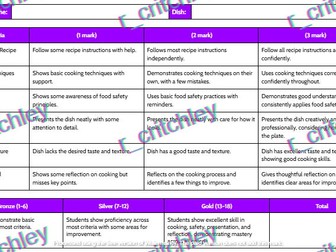
A simple, highlight-and-score rubric for assessing practical cooking skills. Supports peer, self, and teacher assessment with clear criteria and feedback. This easy-to-use practical assessment rubric provides a structured way to evaluate students’ cooking skills during a Food Technology lesson. With clear marking criteria and a simple highlight-the-box format, this resource allows for peer, self, and teacher assessment, making it ideal for formative assessment, self-reflection time (SRT), and practical grading. What’s Included in the Rubric? Six key assessment areas: Following the recipe (accuracy and independence). Cooking techniques (confidence and skill). Food safety (hygiene and best practices). Presentation (plating and attention to detail). Taste & texture (flavor, consistency, and execution). Reflection & improvement (evaluating and learning from mistakes). Three marking levels (Bronze, Silver, Gold) to categorize overall performance. Total scoring system for easy grading and student progress tracking. Flexible use: Can be completed by the teacher, a peer, or the student for self-assessment. Perfect for: Quick and structured practical assessment in Food Technology lessons. Encouraging student reflection and improvement in cooking skills. Providing formative feedback with minimal teacher workload. Formats: Printable PDF or editable document, ideal for individual or group assessments. A straightforward, effective tool to track student progress and enhance self-evaluation in practical cooking lessons!