Simple software tool to draw a variety of cubesQuick View
NevilleRichards

Simple software tool to draw a variety of cubes

(0)
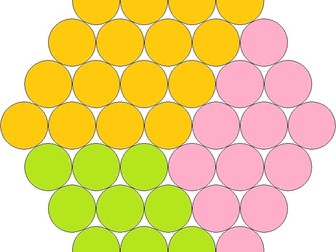
The program will draw from 1 to 10 cubes, with variable line-thickness, variable numbers of internal cubes, and variable perspective views. The cubes can then be used in an almost endless number of mathematical applications. It isn’t an application for pupils, it’s an application which can help to produce material for pupils.
A Simple Investigation into CubesQuick View
NevilleRichards

A Simple Investigation into Cubes

(0)
The work sheet guides participants to investigate the numbers involved in the SUM of CUBES. While the material could be a useful introduction to the sum of cubes at 6th form level, it is also accessible to pupils in the lower school, and class 6 in primary schools. In the sixth form it could be an introduction to the sum of cubes, which can be followed up with rigorous proof. The intention for pupils below the age of 16 would be to introduce the wonder and excitement in some of the relationships found in mathematics.
PDP8 Computer Simulation to demonstrate to students.Quick View
NevilleRichards

PDP8 Computer Simulation to demonstrate to students.

(0)
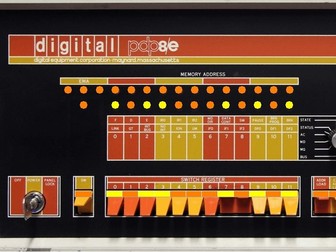
The simulation is effectively a working PDP8 computer, allowing students to write and run code either at full speed, or in single-step mode. The accumulator, address, and contents registers are displayed. There is a small coded program which will display multiplication in operation. PDP-8 Simulation The PDP-8 was a family of 12-bit minicomputers that was produced by Digital Equipment Corporation (DEC) and release in March 1965. It was the first commercially successful minicomputer, with over 50,000 units being sold over the model’s lifetime. The PDP-8 combined low cost, simplicity, expandability, and careful engineering for value. The greatest historical significance was that the PDP-8’s low cost and high volume made a computer available to many new customers for many new uses. Its continuing significance is as a historical example of value-engineered computer design Download URL https://secure.internxt.com/d/sh/file/7487812d-5eb8-402b-a254-d3fced86835e/14193d82cde5bef8b2a78b02a88b2bf52fbdc72b72aa98f4509320965522fff4
Linear Programming Simplex Demonstration SoftwareQuick View
NevilleRichards

Linear Programming Simplex Demonstration Software

(0)
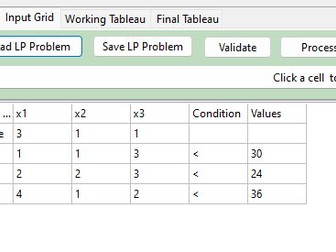
The software enables users to explore the Simplex Algorithm for small problems. Linear Programming problems can be entered, edited, saved, and loaded. The solution can be followed stage by stage, allowing users to specify pivot points, or providing the pivot points automatically. If required, the whole Simplex solution can be performed automatically. An installation for the software can be downloaded from the link below. https://share.ue.internxt.com/d/sh/file/8fa2b330-6e61-47cf-aa5b-4a245124ad39/ee2a701db0334350e5aff1e233d61037b1d83ea6ba98492ec588f4d40320ec90 The installation program is inside the downloaded zip file.
The Twelve Days of ChristmasQuick View
NevilleRichards

The Twelve Days of Christmas

(0)
The resource gives an investigation of numbers involved in the 12 days of Christmas. A formula is developed for variations where any other number is used.
Factorise: Numbers, Trinomials, or CubicsQuick View
NevilleRichards

Factorise: Numbers, Trinomials, or Cubics

(0)
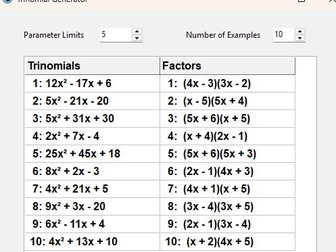
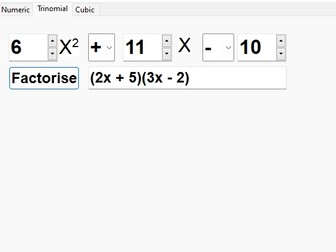
Factorise is a 64-bit program for Windows which will factorise three types of expression: A number, A quadratic trinomial, or A cubic polynomial (which has factors). Recently enhanced, download link: https://drive.google.com/file/d/1Ef7THvPuEYfjY3iXmn5WuNI1Eb0DzuEB/view?usp=drive_link If you have any comments to make about this item, I would be pleased to receive them at n3.14158r@yahoo.com
Linear Optimisation and Free SoftwareQuick View
NevilleRichards

Linear Optimisation and Free Software

(0)
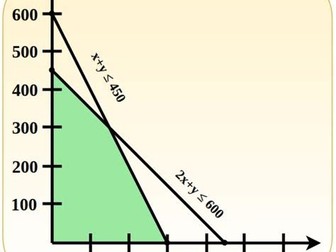
The resource shows a simple Linear Optimisation problem together with its solution, obtained by software. The software is available to download. The software can be downloaded using the link below. https://secure.ue.internxt.com/d/sh/file/5635225a-8fea-4bf9-965a-501aeb6f625d/a9f80f7c45ea045b15216bebd84bfc21af44230b29d5da59baee412861af14ec The file provided is a zip file which contains the installation file, Extract the installation file and run it. There will be warnings from the operating system, which need to be ignored to progress the installation. If you have any comments to give me about this resource, I shall be very pleased to receive them.
Simulation of PDP8 Computer for studentsQuick View
NevilleRichards

Simulation of PDP8 Computer for students

(0)
The PDP8 was the world’s first widely available computer. It has a very small instruction set and had a maximum of 32768 words of 12-bit memory. Instructions (in binary) can be entered via the 12 switches on the front panel, and programs can be run at full speed, or in single-step mode. During program execution, the accumulator is displayed on the panel. It can load programs off images of paper tape. A copy of the installation can be obtained by emailing pdp@meltonisl.com
Finding an Expression for the Sum of Fourth PowersQuick View
NevilleRichards

Finding an Expression for the Sum of Fourth Powers

(0)
A level students will encounter the expressions for the sums of powers of integers, often using mathematical induction to prove their validity, but I don’t remember students ever being asked to investigate and derive those expressions. This note shows how the sum of fourth powers of integers can be derived and understood by A-level, or younger students. It must be understood that this method does not prove the validity of the expression obtained, but it will allow readers to understand how the expression can be derived.
Sums of Powers of IntegersQuick View
NevilleRichards

Sums of Powers of Integers

(0)
What is described here is a method of finding expressions for several sums of squares at once. The number can be determined by the user. The only drawback with this method is that it gives the expressions in polynomial form, rather than in factor form.