What, How, WhyQuick View
shannon_allen1909

What, How, Why

(0)
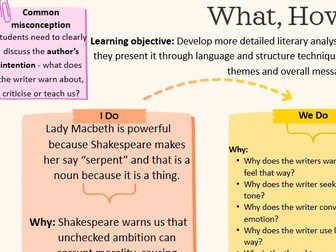
What, How, Why is a writing activity that helps students develop more detailed literary analysis by connecting carefully chosen quotations to a clear analytical explanation. Macbeth is used throughout the resource as the example text, making the activities particularly useful for English teachers teaching Shakespeare and literature. As Macbeth is one of the most commonly taught Shakespeare plays in UK secondary English classrooms across KS3-4, the examples provide a familiar and immediately applicable context for many teachers and students. The activity encourages students to explore what the writer presents, how they present it through language, form and structure, and why these choices are significant. Students learn to move beyond identifying a quotation or technique and instead develop a clear explanation of its meaning, effects and significance. However, What, How, Why is not intended to create a formulaic or limiting structure. Instead, it provides a flexible writing frame that helps students develop their ideas and make meaningful connections between the writer’s choices, their effects, and the wider character, themes and message of the text. Learning Objective: Develop more detailed literary analysis by explaining what the writer presents, how they present it through language and structure techniques, and why this is significant to the character, themes and overall message of the text. What’s Included? A ready-to-use presentation An accompanying student worksheet in PDF format An overview of the lesson activities I Do: Teacher modelling We Do: Guided practice You Do: Independent application A modelled example of effective What, How, Why analysis Common misconceptions and guidance for addressing them The What, How, Why activity encourages students to develop a clear chain of analysis rather than treating quotations and techniques as isolated points. Students consider what is being presented, how the writer’s choices communicate meaning, and why those choices are significant. This helps students move from simple identification and explanation towards analysis that is detailed, connected and perceptive, while giving them a practical framework for developing their own interpretations.
Because, But, So Writing FrameQuick View
shannon_allen1909

Because, But, So Writing Frame

(0)
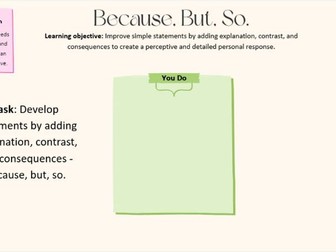
Help students move beyond short, simple statements with this Because, But, So writing frame. This practical writing resource gives students a simple structure for developing their ideas through explanation, contrast and consequence. It is designed to help students create more detailed, connected and perceptive personal responses without relying on complicated writing terminology. Macbeth is used throughout the resource as the example text, making the activities particularly useful for English teachers teaching Shakespeare and literature. As Macbeth is one of the most commonly taught Shakespeare plays in UK secondary English classrooms across KS3-4, the examples provide a familiar and immediately applicable context for many teachers and students. Learning Objective: Improve simple statements by adding explanation, contrast, and consequences to create a perceptive and detailed personal response. What’s Included? A ready-to-use presentation An accompanying student worksheet in PDF format An overview of the lesson activities I Do teacher modelling We Do guided practice You Do independent application Macbeth-based examples and activities Opportunities for students to develop personal responses Common misconceptions and guidance for addressing them Updated 03/10/2026
Quotation Pairing StrategyQuick View
shannon_allen1909

Quotation Pairing Strategy

(0)
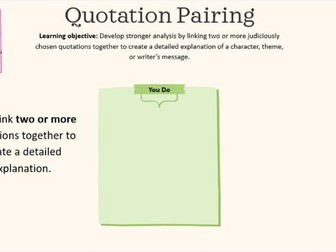
Help students develop stronger, more detailed analysis by teaching them how to connect two or more carefully chosen quotations. This practical writing resource introduces quotation pairing as a strategy for moving beyond analysing quotations in isolation. Students learn how to compare and connect quotations to explore what they reveal together about a character, theme or the writer’s message. Macbeth is used throughout the resource as the example text, making the activities particularly useful for English teachers teaching Shakespeare and literature. As Macbeth is one of the most commonly taught Shakespeare plays in UK secondary English classrooms across KS3-4, the examples provide a familiar and immediately applicable context for many teachers and students. By linking quotations, students can identify patterns, contrasts, developments and changes, helping them build more thoughtful, connected and perceptive interpretations of a text without relying on complicated analytical terminology. Learning Objective: Develop stronger analysis by linking two or more judiciously chosen quotations to create a detailed explanation of a character, theme or writer’s message. What’s Included? A ready-to-use presentation An accompanying student worksheet in PDF format An overview of the lesson activities I Do teacher modelling We Do guided practice You Do independent application Modelled example of effective quotation pairing Common misconceptions and guidance for addressing them Quotation pairing encourages students to select two or more quotations that can be meaningfully connected. Rather than analysing each quotation separately, students consider what the quotations reveal together and use the relationship between them to develop a stronger interpretation. This helps students move from simple, isolated points towards analysis that is connected, developed and perceptive. Updated 03/10/2026
Build Your Own Globe Theatre: Home of MacbethQuick View
shannon_allen1909

Build Your Own Globe Theatre: Home of Macbeth

(0)
This project-based lesson introduces students to the design and construction of Shakespeare’s Globe Theatre and explores how its architecture shaped the experience of watching Macbeth. Using a PowerPoint presentation and accompanying research worksheet, students investigate key features of the theatre before applying their learning to design and create their own Globe model. It could easily be adapted for a different play. Key Stage: KS3/KS4 English / KS3 Drama Duration: 2-4 lessons (depending on model-building time) Resources: PowerPoint presentation, Globe Theatre Research Sheet, art and modelling materials Learning objectives: Remember the plot of Macbeth. Understand the unique architectural features of the Globe Theatre. Apply your understanding and analyse how Macbeth was originally performed in the Globe Theatre. Evaluate how the design of the Globe Theatre enhanced the audience’s experience of Macbeth. Design and create a 3D model of the Globe Theatre. Cross-Curricular Links English: Shakespeare, performance, analysis Drama: Stagecraft and audience engagement History: Elizabethan and Jacobean theatre DT/Engineering: Structural design and model construction Art: Creative design and presentation skills
The Verona Chronicle: Love, Lies & Scandal – Romeo and Juliet Newspaper Report WritingQuick View
shannon_allen1909

The Verona Chronicle: Love, Lies & Scandal – Romeo and Juliet Newspaper Report Writing

(0)
Turn students into investigative journalists with The Verona Chronicle: Love, Lies & Scandal, an exciting cross-curricular English resource inspired by Shakespeare’s Romeo and Juliet. In this engaging lesson, pupils step into the role of newspaper reporters to uncover the truth behind Verona’s most shocking events and create their own front-page news articles. This resource helps pupils: Explore plot, characters, and themes in Romeo and Juliet Develop newspaper and journalistic writing techniques Use evidence from the text to support reporting Consider bias, audience, and different viewpoints Improve writing, editing, and communication skills Engage creatively with Shakespeare in a modern context Included: Powerpoint for lessons - including worksheets and printable information Lanyard cards Investigation worksheet Newspaper template Certificate of achievement Perfect for KS2, KS3, and Shakespeare-themed literacy units, this lesson combines literary analysis with real-world writing skills, making one of Shakespeare’s most famous tragedies accessible, relevant, and memorable for young learners. Breaking news from Verona - love, conflict, secrets, and scandal await on every page!
From Script to Step: A Midsummer Night’s Dream – A Cross-Curricular Dance & English AdventureQuick View
shannon_allen1909

From Script to Step: A Midsummer Night’s Dream – A Cross-Curricular Dance & English Adventure

(0)
Bring Shakespeare to life through movement, creativity, and storytelling with From Script to Step: A Midsummer Night’s Dream. This engaging cross-curricular lesson combines English and Dance, allowing pupils to explore characters, themes, and key scenes from Shakespeare’s magical comedy through expressive movement and choreography. Perfect for upper KS2 and KS3, this resource supports both curriculum areas by helping students: Explore characters, plot, and themes through active learning Interpret text through creative movement and dance Develop teamwork, confidence, and performance skills Strengthen comprehension and dramatic understanding Engage with Shakespeare in an accessible and memorable way An ideal resource for English lessons, Dance units, arts enrichment projects, World Book Day, Shakespeare Week/Day, or cross-curricular learning events.