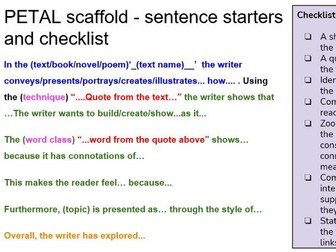
To support analysis paragraph writing skills, this set of slides is designed to discretely work on the skills for each section of PETAL writing. Including examples, worksheets and sentence starters, the slides can be taught as a whole or dropped into pre-made lessons. Aimed at KS3, but adaptable for KS4, this is designed to support development of skills.
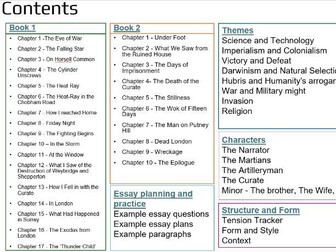
To support detailed and organised revision notes, this Knoweldge Organiser has blank slides for each chapter, prompting students to find high value quotes, summarise events, consider chapter titles and make wider links to themes across the text. There are also thematic and characterisation sections.
Be aware that this is designed for students to complete and as such has pre-made but empty slides for each chapter in the novel. The example slides are detailed and the Pwpt can be used in conjunction with the top quotes doc to aide students with selecting good quotes and areas to analyse.
There are two example slides completed for students, as well as example essay questions, example essay plans and example paragraphs. This resource also includes a doc with 4-6 quotes from each chapter that can be used for a wider range of themes and essay questions.
Also included are a set of classroom posters featuring quotes from each chapter of the text with thematic icons. These can be used as classroom displays, printable flashcard or in class annotation revision. The pwpt includes quotes with no theme icons and a printable icons table that can be used as a classroom task or revision tool.
Aimed at students completing the Cambridge IGCSE English Literature, this resource could be used as an extended homework task, in class revision task (shared with an entire class to work on collaboratively) or as AFL after each chapter is taught.
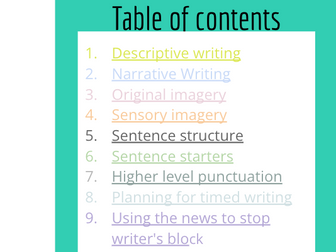
Nine fully resourced areas designed to develop and improve creative writing skills. The focus in on idea generation, language and grammar skills, and exam technique. Each section could be a lesson or split into two, depending on lesson times. Included are a range of tasks to support AFL, collaborative learning and responding to feedback.
Sections include:
Descriptive writing
Narrative Writing
Original imagery
Sensory imagery
Sentence structure
Sentence starters
Higher level punctuation
Planning for timed writing
Using the news to stop writer’s block
Included in this presentation are 5 speeches/TedTalks that can be studied as unseen non-fiction examples of speeches preparing for the Language Paper 1 IGCSE for Edexcel.
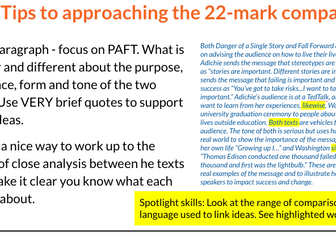
Each speech has a grammar focus to support student speech writing skills, as well as example paragraphs on comparing the unseen with a text from the Edexcel Anthology. Additionally, there are two exam-styled questions at the end of each slide to use as practice for Question 5 (comparative non-fiction). All of the anthology texts are covered in these exam-styled example questions.
The resource uses a PAFT focus (taken from Edexcel materials and training) to support students in approaching unseen material and ensuring their own speech writing is clearly meeting the assessment objectives.
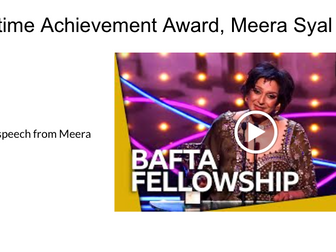
Edexcel IGCSE English Language Unseen non-fiction speech analysis. A short focused analysis of Meera Syal’s BAFTA acceptance speech as an unseen non-fiction text. Questions and sentence starters to scaffold the comparisons response for the 22-marker.


 Quick View