Amazing Asia: KS3 SEND/LPA Geography BookletQuick View
bennyanzawa1996

Amazing Asia: KS3 SEND/LPA Geography Booklet

(0)
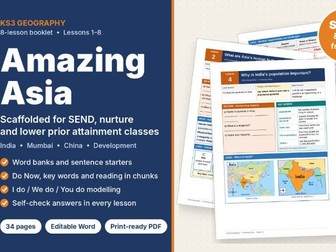
Scaffolded KS3 Geography booklet on Asia for SEND, nurture and LPA classes. 8 ready-to-teach lessons: India’s population, Mumbai, China and development. This 34-page lesson booklet covers a whole Asia unit, written for students who need extra support. It comes as an editable Word file and a print-ready PDF. Every lesson follows the same routine, so students know what comes next and can work more independently. Each lesson includes: A lesson banner with Last lesson / Today I am learning to… / Next lesson A Do Now retrieval starter with a key words box Short reading split into chunks, with key words in bold, plus maps, diagrams or tables Checks for understanding: word banks, circle-the-answer tables and tick boxes Modelled tasks: I do / We do / You do and “explain it 3 times” chains Writing frames with a “Say it first” prompt, sentence starters and lined space Self-check answers students mark in green pen, and a “How did I do?” confidence check Lessons: What are the countries of Asia? Locating six key countries and using compass directions What are Asia’s human features? Human vs physical features, megacities and a country fact file How do Asian countries compare? Development indicators for Japan, Bangladesh and Afghanistan Why is India’s population important? Where India is, reading population pyramids, India vs China India’s population: challenge or opportunity? Sorting facts, chains of reasoning and a scaffolded letter to the Prime Minister of India Why do people move to Mumbai? Push and pull factors and a structured paragraph What are the opportunities and challenges in Mumbai? Dharavi, using numbers as evidence, a note-taking frame for a documentary and a short article What is China like? Location, and sorting physical and human features Also included: a cover page, a how-to-use page (Read, Look, Say, Write, Check, Ask), a learning journey tracker, a glossary of the unit’s key words and an end-of-unit review quiz. Ideal for: Year 7 and Year 8 classes, SEND and nurture groups, lower prior attainment sets, interventions and cover lessons. The self-check answers mean students can work on their own. Lesson 7’s note-taking task works with any short documentary clip about Mumbai or Dharavi (clip not included). Curriculum links: KS3 National Curriculum locational knowledge (Asia, including China and India), place knowledge, human geography (population, urbanisation, development) and geographical skills (maps, graphs and data).
Weimar and Nazi Germany Edexcel GCSE WorkbookQuick View
bennyanzawa1996

Weimar and Nazi Germany Edexcel GCSE Workbook

(0)
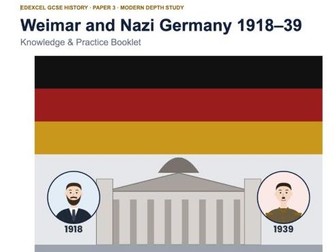
Complete Edexcel GCSE History Weimar and Nazi Germany 1918-39 workbook: 16 lessons, knowledge organisers, Paper 3 exam practice and full answers. Editable. One 75-page booklet that takes your class through the whole Paper 3 depth study, from the Kaiser’s abdication to Kristallnacht. Print it, hand it out and teach. It comes as an editable Word document, so you can adapt it to your students. WHAT’S INCLUDED 16 structured lessons covering all four key topics, plus four review lessons and an end-of-unit assessment Four colour-coded knowledge organisers (key dates, key words, lesson questions) A 1918-39 timeline, an illustrated key people page and clear diagrams 130+ retrieval questions: a Do Now in every lesson, retrieval grids and an 18-question final quiz Full answers to every task A specification-linked self-assessment checklist EVERY LESSON INCLUDES A Big Question, learning checklist, Do Now retrieval quiz, key words, short chunks of reading, Stop and check questions and scaffolded practice. Ideal for mixed-ability classes, cover lessons and non-specialists. EXAM TECHNIQUE FOR EVERY PAPER 3 QUESTION Step-by-step guides, sentence starters, worked examples and answer plans for: Q1 Inference (4 marks) Q2 Explain why (12 marks) Q3(a) Utility of sources (8 marks) Q3(b) Main difference between interpretations (4 marks) Q3© Why interpretations differ (4 marks) Q3(d) How far do you agree (16 marks + 4 SPaG) Plus the NOP (Nature, Origin, Purpose) method, useful phrases and a guide to what makes a Level 4 answer. Note: the practice sources and interpretations were written for classroom use. As the booklet is editable, you can swap in those from your textbook or past papers. LESSONS KT1 The Weimar Republic: the birth of the Republic; early challenges (Versailles, Spartacists, Kapp Putsch); hyperinflation 1923; the Stresemann years. KT2 Hitler’s rise to power: the early Nazi Party and Munich Putsch; the lean years; the Depression and Nazi support; how Hitler became chancellor. KT3 Nazi control and dictatorship: creating a dictatorship (Reichstag Fire, Enabling Act, Night of the Long Knives); the police state; propaganda and censorship; opposition. KT4 Life in Nazi Germany: women; young people and education (Hitler Youth); work and living standards; persecution of minorities (Nuremberg Laws, Kristallnacht). Perfect for whole-unit teaching, homework, revision, cover lessons, intervention and tutoring.
Elizabethan England Edexcel GCSE WorkbookQuick View
bennyanzawa1996

Elizabethan England Edexcel GCSE Workbook

(0)
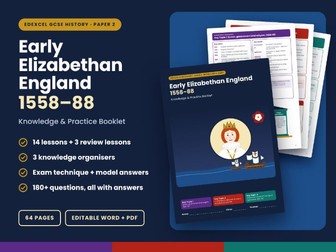
Complete Edexcel GCSE History Early Elizabethan England 1558-88 workbook: 14 lessons, knowledge organisers, Paper 2 exam practice and answers. Editable. One 64-page booklet that takes your class through the whole British depth study, from Elizabeth’s accession to the Armada and Roanoke. Print it, hand it out and teach. It comes as an editable Word document as well as a PDF, so you can adapt it to your students. WHAT’S INCLUDED 14 structured lessons covering all three key topics, plus three review lessons and an end-of-unit quiz Three colour-coded knowledge organisers (key dates, key words, lesson questions) A 1558-88 timeline, an illustrated key people page and clear diagrams of the Religious Settlement, the Catholic plots and the causes of poverty 115 retrieval questions: a five-question Do Now in every lesson, a retrieval grid for each key topic and an 18-question final quiz 70+ Stop and check questions to test understanding as students read Answers to every Do Now, Stop and check, retrieval grid and quiz question A specification-linked self-assessment checklist EVERY LESSON INCLUDES A Big Question, learning checklist, Do Now retrieval quiz, short chunks of reading and Stop and check questions. Lessons follow an I do, We do, You do structure, with tasks such as ranking, sorting, matching and gap fills. Ideal for mixed-ability classes, cover lessons and non-specialists. EXAM TECHNIQUE FOR EVERY PAPER 2 SECTION B QUESTION Step-by-step guides, model answers and sentence starters for: Q(a) Describe two features (4 marks) Q(b) Explain why (12 marks) Q© How far do you agree (16 marks) Plus timings, PEEL paragraphs, useful phrases and a guide to what makes a Level 4 answer. Every review lesson ends with exam practice. LESSONS KT1 Queen, government and religion, 1558-69: Elizabeth’s England, society and government; problems facing Elizabeth in 1558; the Religious Settlement of 1559; challenges to the Settlement; the problem of Mary, Queen of Scots. KT2 Challenges to Elizabeth at home and abroad, 1569-88: the Revolt of the Northern Earls; plots, spies and the execution of Mary (Ridolfi, Throckmorton, Babington); relations with Spain; the road to war, 1585-88; the Spanish Armada. KT3 Elizabethan society in the Age of Exploration, 1558-88: education and leisure; the problem of the poor; exploration and Drake’s circumnavigation; Raleigh and the Virginia colony. Perfect for whole-unit teaching, homework, revision, cover lessons, intervention and tutoring.
Edexcel A Level Politics Core Ideas RevisionQuick View
bennyanzawa1996

Edexcel A Level Politics Core Ideas Revision

(0)
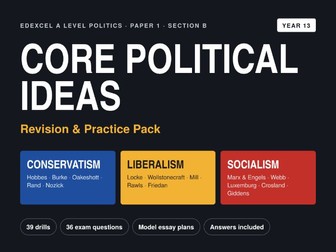
Edexcel A Level Politics core political ideas revision: conservatism, liberalism, socialism. Retrieval drills, essay plans, 36 exam questions and answers. One editable revision and practice pack for Paper 1, Section B (9PL0). It covers all three core ideologies using the same five-part structure, so students learn the routine once and apply it three times. Built for Year 13, it gets students practising and writing, not just re-reading notes. WHAT’S INCLUDED FOR EACH IDEOLOGY Part 1 Knowledge organiser: core ideas, a strand grid across human nature, the state, society and the economy, a thinker table (two key ideas each) and the five debates every question tests Part 2 Retrieval drills 1-8: rapid recall, thinker attribution, strand spotting, brain dump grid, definitions, odd one out, thinker recall grid and a two-minute blast Part 3 Analysis drills 9-13: agreement audit, ranking divisions, thinker vs thinker, and rewriting AO1 into AO2 and AO2 into AO3 Part 4 Essay planning: a worked model plan, a guided plan, four blank plan templates, 12 exam-style 24-mark questions and an AO1/AO2/AO3 self-marking checklist Part 5 Answers: answers and indicative answers for the drills, plus a list of where students lose marks COVERAGE Conservatism: traditional, One Nation and the New Right (neo-liberal and neo-conservative). Thinkers: Hobbes, Burke, Oakeshott, Rand, Nozick. Liberalism: classical and modern. Thinkers: Locke, Wollstonecraft, Mill, Rawls, Friedan. Socialism: revolutionary socialism, democratic socialism, social democracy and the Third Way. Thinkers: Marx and Engels, Webb, Luxemburg, Crosland, Giddens. THE ESSAY METHOD Students learn to organise by debate, not by strand: three comparative paragraphs, each ending in a mini-judgement, then a conclusion that ranks the divisions. Includes timings for the 30-minute answer and a 60-second pre-writing check. ALSO INCLUDED A clear guide to what Section B asks and how AO1, AO2 and AO3 are rewarded A suggested four-week revision route that interleaves the three ideologies A retrieval tracker for spaced practice Final revision across all three ideologies: a 15-thinker roll-call, the nine deepest divisions to rank, a timed essay log and the five mistakes that cost marks in every ideology PERFECT FOR Year 13 revision from autumn through to the summer exams Homework, independent study and intervention Mock preparation and timed essay practice Tutors and non-specialist Politics teachers Supplied as a PDF and editable Word document, so you can adapt the questions and tasks for your class.
Water and Carbon Cycles AQA A-level WorkbookQuick View
bennyanzawa1996

Water and Carbon Cycles AQA A-level Workbook

(0)
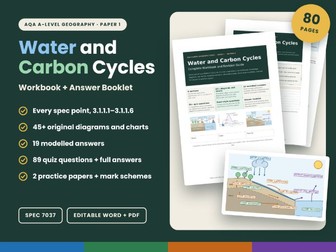
Complete AQA A-level Geography Water and Carbon Cycles workbook + answer booklet: every spec point, model answers, practice papers, mark schemes. Editable. A 65-page workbook that covers every part of AQA specification 3.1.1.1 to 3.1.1.6 in order, plus a separate 15-page answer booklet, so you can print the workbook and hand it out with no answers visible. Both come as editable Word documents and PDFs. WHAT’S INCLUDED Six content sections in specification order, plus a Paper 1 Section A exam skills section 45+ original diagrams and charts, colour-coded throughout (blue inputs, green stores, orange flows, purple outputs) 19 modelled answers and worked examples, with the connectives that build an explanation underlined 89 closed-book quiz and calculation questions, plus three label-from-memory diagrams Exam-style questions in every section Two full 36-mark Section A practice papers with self-marking grids A specification checklist and a “Numbers to know” page of key figures Answer booklet: answers to every quiz, label task and calculation, model answers and mark schemes for every exam-style question, and level descriptors for both practice papers EVERY SECTION INCLUDES “I can” statements, spec-linked sub-topics, key words with pronunciation guides, diagrams, modelled answers, stretch tasks, a one-page key points summary, a retrieval quiz and exam-style practice. CONTENTS 1 Systems and feedback (3.1.1.1): systems concepts; open and closed systems; the Earth as a cascading system; feedback and dynamic equilibrium. 2 The water cycle (3.1.1.2): global water stores; processes that change them; drainage basins as open systems; the water balance; runoff and flood hydrographs; changes over time. 3 The carbon cycle (3.1.1.3): global carbon stores; flows and transfers; plant, sere and continental scales; changes over time; the carbon budget. 4 Water, carbon, climate and life on Earth (3.1.1.4): the greenhouse effect; links between the cycles; feedbacks and climate change; human interventions and mitigation. 5 Quantitative skills (3.1.1.5): unit conversions; discharge; water balance; percentages; describing data with TEA; choosing graphs. 6 Case studies (3.1.1.6): the Amazon rainforest; the Somerset Levels (Parrett and Tone) catchment; a case-study bank including Arctic permafrost. 7 Exam skills: Section A explained, command words, answer structures and planning the 20-marker. 8 Practice papers: two full Section A papers (4 + 6 + 6 + 20 marks). Use it as a unit workbook taught in sequence (about five weeks), for homework and independent study, or as a revision guide before mocks. Independent resource written for the AQA A-level Geography specification (7037). Not produced, approved or endorsed by AQA.
North Korea Year 7 KS3 Geography LessonsQuick View
bennyanzawa1996

North Korea Year 7 KS3 Geography Lessons

(0)
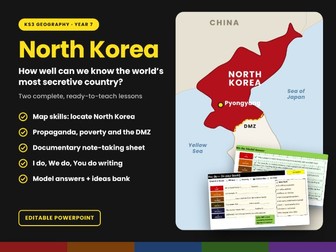
Two ready-to-teach KS3 Year 7 Geography lessons on North Korea: location, dictatorship, propaganda, poverty, military and the DMZ, plus extended writing. Enquiry question: How well can we know North Korea? These two lessons take Year 7 from locating North Korea on a map to writing a developed paragraph on why it is one of the most secretive countries in the world. Fully editable PowerPoint. LESSON 1: WHERE IS NORTH KOREA AND WHAT IS LIFE LIKE THERE? Do Now retrieval quiz with answers Mini-whiteboard hook: what do you already know about North Korea? Location task: describe North Korea’s continent, hemispheres, borders and seas, with a gap-fill scaffold and answer slide Propaganda music starter with context and three think-pair-share questions Documentary note-taking sheet with five headings: government and control, poverty and food, military and security, everyday life, and why North Korea is secretive Answer slides on the military, poverty and famine, censorship and propaganda, and the DMZ LESSON 2: WRITING ABOUT NORTH KOREA Retrieval questions on lesson 1 Video task: add five new facts to the notes sheet I do: a modelled PCNE paragraph (Point, Case study, Numbers, Explain x3) on “What is life like for ordinary people in North Korea?” We do: a scaffolded paragraph on poverty, followed by a model answer You do: an independent PCNE paragraph on the military, poverty, censorship or the DMZ, with sentence starters and an ideas bank of key facts Stretch questions run through both lessons, for example “Will more countries become like North Korea?” Video links are on the slides, and timings are given for the timed tasks. Fits a KS3 unit on Asia, development or global issues, and works well for cover lessons or as a standalone enquiry.
AQA GCSE Economics Complete Course WorkbookQuick View
bennyanzawa1996

AQA GCSE Economics Complete Course Workbook

(0)
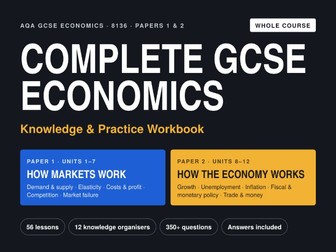
AQA GCSE Economics 8136 complete workbook: 56 lessons for Paper 1 and Paper 2, knowledge organisers, exam practice and full answers. Editable Word and PDF. One 289-page workbook that teaches the whole AQA specification, from needs and wants to exchange rates. Print it, hand it out and teach. It comes as an editable Word document and a print-ready PDF. Print pages 1-276 for a pupil copy without the answers. WHAT’S INCLUDED 56 lessons across 12 units, each mapped to its AQA specification point 12 unit reviews with retrieval, exam practice and self-assessment, including full Paper 1 and Paper 2 reviews 12 knowledge organisers, one per unit 350+ mark-allocated questions, from multiple choice and calculations to 6- and 9-mark answers Clear supply and demand diagrams and step-by-step worked examples Full answers for every unit A CLEAR ROUTINE IN EVERY LESSON Big Question, “By the end I can” checklist, key words, Do Now retrieval quiz, short chunks of reading with everyday analogies, I do / We do / You do practice and a check for understanding. Students always know what to do next, which makes it ideal for mixed-ability classes, cover lessons and non-specialist teachers. EXAM SKILLS AND CALCULATIONS 6-mark and 9-mark questions with planning frames, sentence starters and levels-based mark schemes Calculation practice throughout: price elasticity of demand and supply, revenue, costs and profit, interest, income tax, National Insurance and net pay, inflation and index numbers, GDP per head and percentage change UP-TO-DATE UK EXAMPLES Real cases students recognise: the 2022 cost-of-living crisis, Bank of England rate rises, the VodafoneThree merger, Tata Steel at Port Talbot, London’s ULEZ and the sugar tax, plus 2025/26 tax figures. UNITS Paper 1 How Markets Work: 1 Economic foundations; 2 Resource allocation; 3 Demand, supply and equilibrium; 4 Related markets and elasticity; 5 Costs, revenue and profit; 6 Competitive and concentrated markets; 7 Market failure. Paper 2 How the Economy Works: 8 The national economy; 9 Growth and unemployment; 10 Inflation, trade balance and inequality; 11 Managing the economy; 12 Trade, globalisation and money. PERFECT FOR Teaching the whole course, homework, revision, cover lessons, intervention and tutoring.