Modern Ghost Story Lesson PlanQuick View
thompsontaiwo55

Modern Ghost Story Lesson Plan

(0)
This resource is a comprehensive lesson plan and presentation focused on exploring the themes, characters, and genre conventions of modern ghost stories, using Anna Dressed in Blood by Kendare Blake as the central text. It includes a detailed plot overview, character insights, thematic analysis, and structured discussion prompts. The slides guide students through key elements of YA horror, such as supernatural danger, emotional depth, trauma, identity, justice, and genre blending.
Compare Supernatural Figures – Venn Diagram OrganizerQuick View
thompsontaiwo55

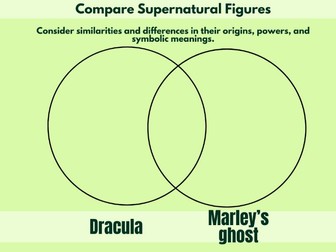
Compare Supernatural Figures – Venn Diagram Organizer

(0)
This resource is a visual comparison tool designed to help students analyse and contrast two iconic supernatural characters: Dracula and Marley’s ghost. The worksheet features a large Venn diagram that encourages learners to explore similarities and differences in the characters’ origins, powers, roles, and symbolic meanings.
Adverts Analysis WorksheetQuick View
thompsontaiwo55

Adverts Analysis Worksheet

(0)
This resource is a practical worksheet designed to help students critically analyse advertisements and understand persuasive techniques in media. It focuses on LEGO’s commercial “Inspire Imagination and Keep Building” and prompts learners to answer key questions such as: What product is being sold? What persuasive techniques are used?
Key Differences in Approach – Media Comparison ChartQuick View
thompsontaiwo55

Key Differences in Approach – Media Comparison Chart

(0)
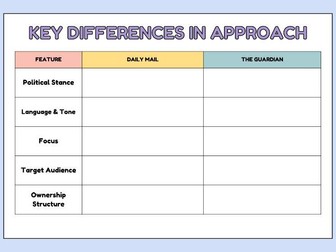
This resource is a structured comparison chart designed to analyse and contrast the editorial approaches of two major UK newspapers: Daily Mail and The Guardian. It encourages learners to research and fill in details, making it an excellent tool for lessons in media studies, journalism, and critical thinking. By comparing these newspapers, students gain insights into how media outlets differ in ideology, style, and audience engagement.
Colour Symbolism WorldwideQuick View
thompsontaiwo55

Colour Symbolism Worldwide

(0)
This resource is a comprehensive presentation exploring the cultural meanings and symbolism of colours across different regions of the world. It covers seven major colours—Red, White, Black, Yellow, Blue, Green, and Purple—and explains how each color is perceived in Western, Asian, Middle Eastern, and African contexts. The presentation also highlights practical applications of colour symbolism in branding and advertising, using examples from global companies like Facebook, McDonald’s, and Coca-Cola.This resource is ideal for lessons in media studies, cultural communication, marketing, and design, helping learners understand how colour influences perception and behavior worldwide.