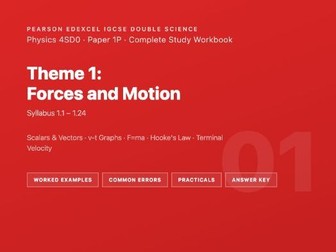
Edexcel IGCSE Double Science Physics (4SD0 Paper 1P) — Theme 1: Forces and Motion. 7 sessions × 30 min. Covers SI units, scalars and vectors, distance-time graphs, v-t graphs, v²=u²+2as, F=ma, W=mg, stopping distance, terminal velocity, and Hooke’s law. Every session includes Common Error panels, a 4-step worked example, and practice questions. Two full practicals. Complete answer key.
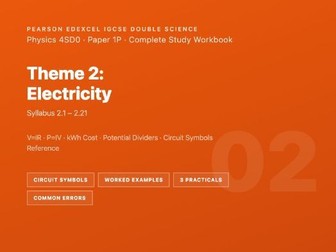
30-page study workbook for Pearson Edexcel IGCSE Double Science Physics (4SD0, Paper 1P), covering all of Theme 2: Electricity across 6 structured 30-minute sessions. Includes a 14-symbol circuit symbols reference table, six 4-step worked examples with verification, kWh and cost calculations with a worked example, three complete practical investigations (I-V characteristics, series/parallel circuits, resistance vs wire length) with variables tables, sources of error, and improvements, a potential divider subsection with formula and LDR/thermistor applications, and 10 Common Error panels. An Answer Key covers all 26 practice questions with method-level verification.
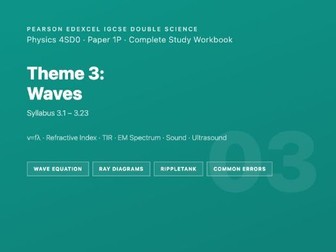
30-page study workbook for Pearson Edexcel IGCSE Double Science Physics (4SD0, Paper 1P), covering all of Theme 3: Waves across 6 structured 30-minute sessions. Includes transverse vs longitudinal wave comparison, the wave equation v=fλ with 4-step worked examples, the Doppler effect, reflection ray diagrams with i=r law, refraction through a glass block with n=sin i/sin r, critical angle calculation using sin c=1/n, TIR conditions and optical fibres, the full EM spectrum with mnemonic including uses and dangers, and sound wave properties including ultrasound. Two complete practicals (ripple tank and refraction). 8 Common Error panels. 6 draw tasks. Answer Key covers all 24 practice questions.
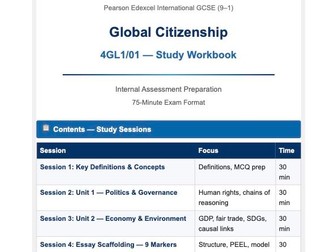
A 40-page self-study workbook for Pearson Edexcel IGCSE Global Citizenship (4GL1/01), Unit 1 and Unit 2, structured into 7 focused 30-minute sessions. Covers key definitions, Politics & Governance, Economy & Environment, Community Action Project scaffolding, and full essay technique for 9- and 15-mark questions. Includes model paragraphs, chains of reasoning, PEEL structures, and a final revision checklist.
The timing table in Session 7 notes that Section D is “not in 75-min internal” — but many buyers may be preparing for the full exam. Consider a brief note or an addendum page clarifying this scope decision, so buyers are not surprised. Please get in touch for additional amendments.
**A one-page “How to answer source questions” guide would be upon request."
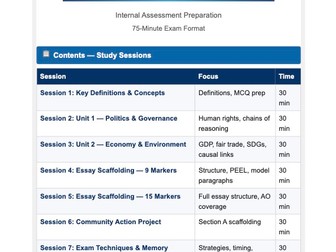
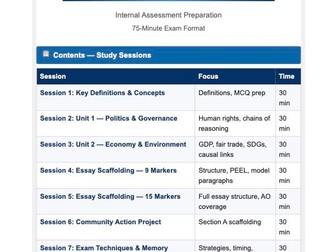
List the 7 sessions with their focus areas.
Session 1: Key Definitions & Concepts (Definitions, MCQ prep) Session 2: Unit 1 — Politics & Governance (Human rights, chains of reasoning)
Session 3: Unit 2 — Economy & Environment (GDP, fair trade, SDGs, causal links)
Session 4: Essay Scaffolding — 9 Markers (Structure, PEEL, model paragraphs)
Session 5: Essay Scaffolding — 15 Markers (Full essay structure, AO coverage)
Session 6: Community Action Project (Section A scaffolding)
Session 7: Exam Techniques & Memory (Strategies, timing, practice)
Included:
Model PEEL paragraphs for 9-mark questions;
full scaffolded essay for 15-mark “how far do you agree” questions with Level 1–4 descriptors;
Community Action Project Section A scaffolding with mark-by-mark templates for 1(a)–1(d);
chains of reasoning for Politics & Governance and Economy & Environment;
Quick-Fire Self-Test tables;
Final Revision Checklist.
“Unlike general revision guides, this workbook is built directly around the 4GL1 mark scheme and Assessment Objectives (AO1–AO3). Students aren’t just given notes to read — they are walked through the exact thinking process examiners reward, with model answers annotated by AO, PEEL sentence starters, and ‘Common MCQ Traps’ callout boxes.”
“Ideal for: students revising independently at home; teachers setting structured pre-exam homework; international schools preparing students for Edexcel internal assessments; tutors working with IGCSE Global Citizenship candidates.”
“All content is self-contained — no additional textbook required. Print-ready PDF format. Students can highlight, annotate, and self-test directly on the page.”
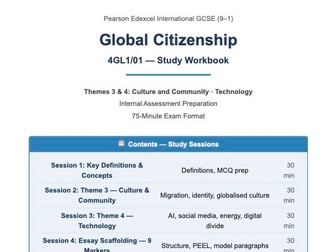
Edexcel IGCSE Global Citizenship 4GL1 (Themes 3 & 4) — 40 pages, 7 sessions of 30 minutes. Covers all key definitions, MCQ traps, push/pull migration factors, global/national culture, AI, censorship, social media, digital divide, and climate technology. Two full 9-mark PEEL model answers. One Level 4 15-mark essay. Community Action Project scaffold for all four Section A parts. 75-minute timing plan included.
Edexcel IGCSE Biology | Topic 1: Nature & Variety of Living Organisms | 4SD0 + 4BI1 | Complete Workbook | Four-Phase Revision Cycle | MCQs, Calculations, Extended Answer + Full Mark Scheme
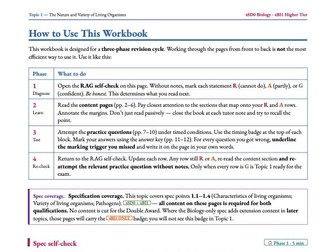
“This is the complete, dual-specification workbook for Topic 1 of the Pearson Edexcel IGCSE Biology (4BI1) and IGCSE Science Double Award (4SD0) specifications. It covers every assessment objective in Topic 1 — spec points 1.1 through 1.4 — and is confirmed in the resource itself to be fully applicable to both qualifications. Unlike a standard revision sheet or summary notes document, this workbook is a structured four-phase learning system: students diagnose their own gaps, study the content sections most relevant to those gaps, attempt timed practice questions matched to exam conditions, and re-check their own progress against a mark scheme that uses Edexcel’s own marking conventions. Every design decision — the timing badges, the reject annotations, the two-column RAG self-check, the prokaryote versus eukaryote comparison table, the cross-topic application questions — exists to prevent the specific mark-losing mistakes that appear in Edexcel IGCSE Biology mark schemes.”
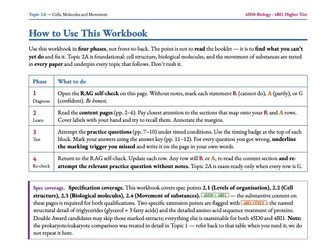
“The workbook opens with a How to Use This Workbook guide that explains the four-phase revision cycle: Phase 1 (Diagnose) has students complete the nine-statement RAG self-check — rating themselves Red, Amber, or Green on each skill — without notes, in five minutes. Phase 2 (Learn) directs students to the content pages most relevant to their Red and Amber rows, with explicit margin annotation prompts at each Tutor Note. Phase 3 (Test) runs students through the practice questions under timed conditions using the timing badge on each block — 1 minute per MCQ mark, 1.5 minutes per short-answer mark, 3–4 minutes per calculation question — and instructs them to underline the marking trigger they missed for every wrong answer. Phase 4 (Re-check) sends students back to the RAG self-check to update the End columns: any row still Red or Amber means re-reading the relevant content section and re-attempting the practice question without notes. Topic 1 is exam-ready only when every row is Green. This four-phase structure is printed in the resource itself — students do not need the teacher present to use it correctly.”
Students preparing for Edexcel IGCSE Biology (4BI1) or Edexcel IGCSE Science Double Award (4SD0) at Higher Tier; teachers looking for a print-ready Topic 1 supplement that includes a complete learning cycle from diagnosis through to re-check; tutors preparing IGCSE Biology or Double Award students who need structured, self-directed revision materials; students working independently without a teacher, particularly in the final revision period; international schools running Pearson Edexcel IGCSE programmes who need dual-spec certified resources; home educators delivering Edexcel IGCSE Biology or Double Award Science curricula.
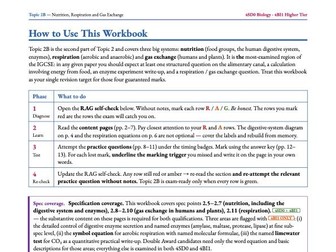
Complete workbook for Topic 2B of the Edexcel IGCSE Biology (4BI1) and Double Award (4SD0) specifications — the most-examined section of the entire IGCSE. Covers food groups, calorimetry calculations, the digestive system, enzyme groups (amylase/protease/lipase), bile, lock-and-key model, enzyme practicals, aerobic and anaerobic respiration, oxygen debt, the breathing system, and gas exchange in leaves. 24 exam-style questions with full mark scheme and 4BI1-only content clearly badged.
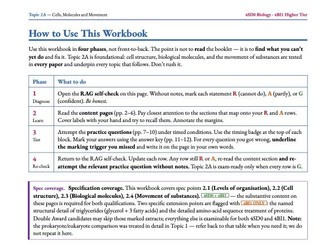
Complete workbook for Topic 2A of the Edexcel IGCSE Biology (4BI1) and Double Award (4SD0) specifications. Covers levels of organisation, plant and animal cell structure, six named specialised cells, biological molecules, all four food tests, diffusion, osmosis, active transport, water potential, and osmosis percentage-change calculations. 23 exam-style questions across five formats, with full Edexcel-convention mark scheme. Four-phase revision cycle. Dual-spec confirmed.
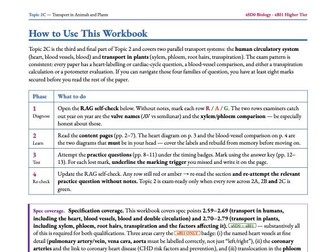
Complete workbook for Topic 2C of the Edexcel IGCSE Biology (4BI1) and Double Award (4SD0) specifications. Covers why large organisms need transport systems, double circulation, the heart (anatomy, cardiac cycle, left ventricle thickness), blood vessels (arteries, veins, capillaries), blood components, haemoglobin, xylem and phloem, root hair cells, transpiration, four factors affecting transpiration, and the potometer practical. 24 exam-style questions, potometer volume calculations, cardiac output calculations, and full mark scheme.
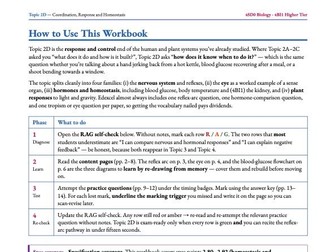
Complete workbook for Topic 2D of the Edexcel IGCSE Biology (4BI1) and Double Award (4SD0) specifications. Covers the nervous system, reflex arcs, synaptic transmission, the eye (accommodation, pupil reflex, rods/cones), nervous vs hormonal coordination, homeostasis, negative feedback, blood glucose regulation (insulin and glucagon), Type 1 diabetes, thermoregulation, plant tropisms, and auxin (4BI1). Kidney, nephron, ADH, and water balance are included and clearly badged as 4BI1 only. 22 questions, full mark scheme.
Complete 26-page workbook for Edexcel IGCSE Biology (4BI1 Higher Tier) and Science Double Award (4SD0), covering all specification points 3.1–3.45 across 22 structured sections. The only Topic 3 resource with dedicated full sections on sex-linked inheritance (haemophilia worked cross), IVF (four stages + ethical considerations), codominance with the ABO blood group Punnett square, and pedigree analysis with “gold rules”. 21 graded exam-style questions with full mark-scheme answers across 6 topic sections. 17-point RAG self-check. 30+ Tutor Notes and Exam Traps. All 4BI1-only extensions clearly badged. Safe to distribute directly to 4SD0 groups without modification.
“The workbook opens with a 17-point RAG self-check tracker in which students mark each statement Red, Amber, or Green before working through the workbook and again after. The 17 statements are organised to mirror the six content families of Topic 3 and include all content areas: asexual versus sexual reproduction; flower labelling and function; cross- versus self-pollination comparison; fertilisation, seed formation and germination; human reproductive system labelling; placenta and amniotic fluid; four menstrual cycle hormones and hormone graph reading; IVF and ethical implications; DNA structure and gene-protein relationship; key genetics vocabulary; mitosis and meiosis comparison including chromosome number and variation; monohybrid Punnett square using the seven-step method; sex-linked inheritance cross and explanation of why more males are affected; codominance cross including the ABO blood group system; causes of variation and continuous versus discontinuous; natural selection with Lamarckian rejection; and pedigree diagram analysis with dominant or recessive determination and genotype assignment. Statement 17 (pedigree analysis) is identified in the Tutor Note as new to this edition and as the highest-priority Red statement to address for 4BI1 candidates. The dual-recheck structure — one column before, one column after — provides a measurable formative assessment record that teachers can review without any marking, and that students can use as an examination-readiness test independent of any teacher involvement.”
“This is the complete four-workbook series for Topic 2 of the Pearson Edexcel IGCSE Biology (4BI1) and IGCSE Science Double Award (4SD0) specifications. Topic 2 is — by Edexcel’s own paper design — the highest-examined region of the entire IGCSE. In any given examination session, you should expect at least one structured question on the digestive system or alimentary canal, a calculation involving energy from food, an enzyme experiment write-up, a respiration or gas exchange question, a heart-labelling or cardiac cycle question, a blood vessel comparison, a transpiration calculation or potometer evaluation, and a reflex arc or homeostasis question. That is a minimum of eight separate mark-earning opportunities, all drawn from the four sub-topics in this series. This series is your single revision target for all of them.”
“Each workbook in the series incorporates exam-intelligence features derived directly from Edexcel mark-scheme and examiner report analysis. In Topic 2A, the osmosis Tutor Note identifies the two most common mark-losing errors in the percentage-change calculation — dividing by the final mass instead of the initial, and omitting the positive or negative sign — directly at the point in the worked example where those errors occur. In Topic 2B, the enzyme Tutor Note identifies the exact exam-language chain that mark schemes reward for denaturation questions (‘bonds break → active site changes shape → substrate no longer fits → reaction stops’) and explicitly flags the reject terms ‘destroyed’, ‘killed’, and ‘broken’. In Topic 2C, the valve Tutor Note identifies ‘prevent backflow’ as the functional phrase that earns marks — and warns against the common reversal error that the ‘lub-dub’ heart sound is the opening of valves rather than their closure. In Topic 2D, the reflex arc Tutor Note identifies the five-step pathway (‘receptor → sensory → relay → motor → effector’) as earning five marks in the standard format question, and the sweating Tutor Note provides the precise two-step chain (‘water evaporates → evaporation requires latent heat taken from the body’) that the mark scheme requires. Across all four workbooks, fourteen dedicated Tutor Notes address the specific misconceptions and loose language that Edexcel mark schemes reject most consistently. These are not general biology teaching notes — they are mark-scheme intelligence notes, designed to convert near-miss answers into full-mark answers.”
“All four workbooks share an identical four-phase revision structure that enables completely self-directed study without teacher supervision. Phase 1 (Diagnose): students complete a dual-column RAG self-check — rating themselves Red, Amber, or Green on each skill statement without notes — in six minutes. The dual-column format records both a Start and an End rating, creating a measurable before-and-after progress record that teachers can collect for formative assessment without any marking. Phase 2 (Learn): students read only the content sections that map onto their Red and Amber rows, with explicit cover-and-recall instructions at each diagram. Phase 3 (Test): students attempt timed practice questions using the timing badges on each block, mark their answers against the Edexcel-convention mark scheme, and underline the specific marking trigger they missed for every wrong answer. Phase 4 (Re-check): students return to the RAG self-check, update the End columns, and re-read and re-attempt any section still rated Red or Amber. The workbook is declared exam-ready only when every row is Green — a completion criterion that is built into the document itself. The series is also explicitly chained: the Phase 4 re-check at the end of each workbook specifies exactly what knowledge the next workbook will assume, creating a revision sequence that builds systematically from cell structure through to coordination and homeostasis.”
“The four workbooks are available as a discounted bundle or individually. Each is print-ready as a complete student booklet with the answer key held separately. The dual-column RAG self-check in each workbook creates a measurable progress record that requires no teacher marking. The timing badges on each practice block allow students to run exam-condition practice independently. The series chaining means that a student who works through 2A, 2B, 2C and 2D in sequence, completing all four phases of each workbook before moving to the next, will have covered every Topic 2 specification point, practised 93 exam-style questions under timed conditions, received feedback on every wrong answer via the mark scheme, and confirmed their readiness through a four-cycle RAG self-assessment — all without requiring a single lesson. For teachers, this means Topic 2 revision can be set as structured independent work with a built-in formative checkpoint at the end of each sub-topic.”
A complete three-resource bundle for Edexcel IGCSE Media Studies French New Wave textual analysis, targeting the 7-8 mark band (Excellent: Insightful, Mature, Sophisticated). Includes: a 16-step, 5-phase student guide with example paragraphs; a 10-section student workbook with vocabulary banks, sentence starters, and planning spaces; and a comprehensive teacher grading checklist covering all assessment criteria. Covers mainstream FNW and Left Bank techniques.
“This three-resource bundle gives teachers everything they need to prepare Edexcel IGCSE Media Studies students for a sophisticated French New Wave textual analysis — from first film viewing through to final assessment. The Step-by-Step Guide, Student Workbook, and Teacher Grading Checklist work as an integrated system, each resource reinforcing the others across a structured five-week preparation timeline.”
Step-by-Step Outline (16 steps across 5 phases): A detailed teacher and student guide covering film selection, technical and narrative innovation identification, deep FNW contextual analysis, essay structure (introduction, body, conclusion with worked examples), vocabulary upgrade tables (basic → sophisticated), a depth-check progression ladder from Band 1–2 (listing) to Band 7–8 (evaluating), and a 5-week phase-by-phase timeline. Includes full example paragraphs for Breathless, The 400 Blows, and Hiroshima Mon Amour.
Y10 Student Workbook (10 sections): A scaffolded planning and drafting workbook with individual sections covering Film Introduction & Context, Genre & Codes/Conventions, Motifs/Symbols/Themes, Cinematography, Mise-en-scène, Sound & Music, Editing & Narrative Structure, Performance & Direction, Comparative Analysis, and Conclusion. Each section includes a subject-specific vocabulary bank, descriptive adjective and adverb lists, sentence starters, planning space, and writing space. Includes a self-assessment checklist and assessment band-targeting guide.
Teacher Grading Checklist: A detailed assessment tool structured around the 7-8 band descriptors, covering Evaluation (not description), Detailed/Accurate/Relevant evidence, Compelling Moving Image Vocabulary, FNW-specific technical terms and movement concepts, content requirements for introduction/body/conclusion, FNW contextual understanding, sophistication markers, visual evidence standards, structural quality, writing quality, and common pitfalls (red flags). Includes a Depth Check (Levels 1–8) and a marking summary section with spaces for strengths, areas for improvement, and band justification. Pre-loaded with primary film: Un mot dans le vent.
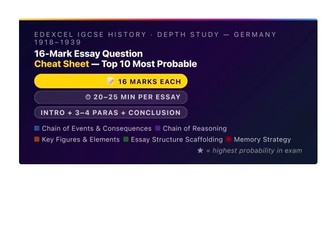
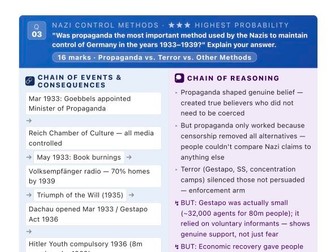
A probability-ranked cheat sheet covering the 10 most likely 16-mark essay questions for the Edexcel IGCSE History Germany 1918–1939 Depth Study. Each question includes a full Chain of Events, Chain of Reasoning with counter-arguments, Key Figures & Statistics panel, step-by-step Essay Structure Scaffolding, a named Memory Strategy mnemonic, and an Exam Technique model. Designed to take students from description (Level 1–2) to sophisticated evaluation (Level 4).
“This resource gives Edexcel IGCSE History students everything they need to approach the 10 most probable 16-mark essay questions on the Germany 1918–1939 Depth Study with confidence, structure, and the analytical sophistication that earns Level 4. Unlike generic revision notes, each question is broken down into six distinct analytical tools that work together to turn content knowledge into structured, evaluative essay writing.”
For each of the 10 questions, students receive: (1) Chain of Events & Consequences — a sequential timeline showing how causes connected and led to outcomes, giving students a narrative spine for their essay; (2) Chain of Reasoning — a bullet-point argument structure showing agree points, counter-arguments (clearly marked), and a final synthesising conclusion statement; (3) Key Figures & Elements — a four-cell reference panel covering the essential people, policies, statistics, and concepts required for detailed, accurate evidence; (4) Essay Structure Scaffolding — a numbered paragraph-by-paragraph guide showing exactly what each section should argue and how to sequence the response; (5) Memory Strategy Mnemonic — a named, themed acronym for each question (e.g., FEND, DWND, PTCE, VSDW) with a visual metaphor to make revision stick; (6) Exam Technique Model — a named analytical model (e.g., “The Kindling Fire,” “The Web of Control,” “The Infected Wound”) showing students how to think about the question at Level 4 and providing a model sentence that demonstrates what sophisticated evaluation looks like in practice.
A 40-page self-study workbook for Pearson Edexcel IGCSE Global Citizenship (4GL1/01), (Unit 1 - Unit 4) structured into 7 focused 30-minute sessions. Covers key definitions, Politics & Governance, Economy & Environment, Community Action Project scaffolding, and full essay technique for 9- and 15-mark questions. Includes model paragraphs, chains of reasoning, PEEL structures, and a final revision checklist.
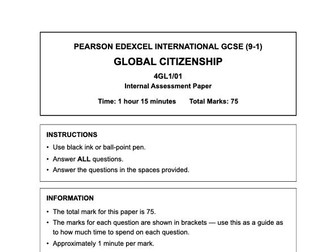
A 75-minute practice assessment paperfor Pearson Edexcel IGCSE Global Citizenship (4GL1/01), structured across four sections (A–D) and matching the internal assessment format exactly. Includes a two-source booklet (Human Rights; GDP & Development), MCQs, short-answer questions, two 9-mark evaluative questions, and one 15-mark extended essay. Marking Scheme Included. Total: 75 marks.
A full 75-minute practice assessment paperfor Pearson Edexcel IGCSE Global Citizenship (4GL1/01), structured across four sections (A–D) and matching the internal assessment format exactly. Includes a two-source booklet (Human Rights; GDP & Development), MCQs, short-answer questions, two 9-mark evaluative questions, and one 15-mark extended essay. Marking Scheme Included. Total: 75 marks.
What’s Included:
Sources Booklet (Source A & B); Section A: CAP questions Q1(a)–1(d), 20 marks; Section B: Politics & Governance — 4 MCQs + 2 short-answer + 1 × 9-mark, 18 marks; Section C: Economy & Environment — 4 MCQs + 2 short-answer + 1 × 9-mark, 18 marks; Section D: 1 × 15-mark extended essay, 15 marks. Total: 75 marks / 75 minutes.
“Every question has been written to mirror the exact question types, command words, mark allocations, source integration requirements, and section structure of the Edexcel 4GL1/01 internal assessment. MCQ distractors replicate common traps; 9-mark questions use the ‘provide reasoned arguments to support and oppose’ format; and the 15-mark question includes the bullet-point guidance format used in the live exam.”
“A fully worked mark scheme with level descriptors for the 9- and 15-mark questions, annotated MCQ answers, and model responses for short-answer questions is available as a separate resource.”
“Print-ready PDF. Questions are laid out with lined answer spaces matching the actual exam paper format. No additional resources required — Sources Booklet is included within the same document.”
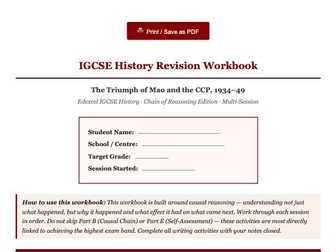
A comprehensive, self-study revision workbook for Edexcel IGCSE History students covering The Triumph of Mao and the CCP, 1934–49 (China: Conflict, Crisis and Change breadth study). Suitable for any IGCSE or GCSE China history course. Fully self-contained — no textbook, teacher, or login required. Supplied as a print-ready PDF.
Designed for the Edexcel IGCSE Breadth Study but flexible enough for any China history course covering Mao and the CCP.
Built around a Chain of Reasoning approach: students do not just recall facts — they learn to explain why each event caused the next, which is precisely what the highest exam bands reward.
Session 1 The Long March, 1934–35
Session 2 The Sino-Japanese War, 1937–45
Session 3 The Civil War, 1946–49 & Battle of Huai-Hai
Session 4 Reasons for CCP Victory: Military, Political, Economic, Social
Session 5 Synthesis: The Master Causal Chain, 1934–49
Essay Session Building the Full 16-Mark Essay
Quick Reference Final-Day Revision Summary
Each session includes as a minimum:
Knowledge Organiser,
Causal Chain Activity,
Factor Weighting Activity,
Exam Practice Questions (6-mark and 8-mark with scaffolding frameworks),
Self-Assessment Checklist with action points.
Includes a dedicated Essay Session with full planning frameworks for the 16-mark essay, including Band 4 conclusion strategies — the skill most students lose marks on.
Approx. 30 printable A4 pages across 7 sessions.
“Every question is built around the distinction between describing (Level 1–2), explaining (Level 3), and evaluating (Level 4). Each Chain of Reasoning section explicitly marks agree points, counter-arguments, and final synthesis — training students to move beyond narrating facts into weighing causes and making substantiated judgements. The named Exam Technique models (such as ‘The Kindling Fire’ for the Depression/Hitler appointment question and ‘The Web of Control’ for the propaganda question) give students a visual and conceptual framework that makes the difference between a formulaic response and one that demonstrates genuine historical insight.”
Students preparing for Edexcel IGCSE History Paper 1, Unit 31 (Germany 1918–1939 Depth Study); teachers looking for structured revision resources that model Level 4 essay technique; students working independently in the final weeks before the exam; tutors preparing IGCSE History candidates; international schools following the Edexcel 1HI0 specification.
This is a free sample of the workbook. It only consists the first section.
A complete 40-page self-study workbook for Pearson Edexcel IGCSE Global Citizenship (4GL1/01), structured into 7 focused 30-minute sessions. Covers key definitions, Politics & Governance, Economy & Environment, Community Action Project scaffolding, and full essay technique for 9- and 15-mark questions. Includes model paragraphs, chains of reasoning, PEEL structures, and a final revision checklist.
The timing table in Session 7 notes that Section D is “not in 75-min internal” — but many buyers may be preparing for the full exam. Consider a brief note or an addendum page clarifying this scope decision, so buyers are not surprised. Please get in touch for additional amendments.
**A one-page “How to answer source questions” guide would be upon request."
List the 7 sessions with their focus areas.
Session 1: Key Definitions & Concepts (Definitions, MCQ prep) Session 2: Unit 1 — Politics & Governance (Human rights, chains of reasoning)
Session 3: Unit 2 — Economy & Environment (GDP, fair trade, SDGs, causal links)
Session 4: Essay Scaffolding — 9 Markers (Structure, PEEL, model paragraphs)
Session 5: Essay Scaffolding — 15 Markers (Full essay structure, AO coverage)
Session 6: Community Action Project (Section A scaffolding)
Session 7: Exam Techniques & Memory (Strategies, timing, practice)
Included:
Model PEEL paragraphs for 9-mark questions;
full scaffolded essay for 15-mark “how far do you agree” questions with Level 1–4 descriptors;
Community Action Project Section A scaffolding with mark-by-mark templates for 1(a)–1(d);
chains of reasoning for Politics & Governance and Economy & Environment;
Quick-Fire Self-Test tables;
Final Revision Checklist.
“Unlike general revision guides, this workbook is built directly around the 4GL1 mark scheme and Assessment Objectives (AO1–AO3). Students aren’t just given notes to read — they are walked through the exact thinking process examiners reward, with model answers annotated by AO, PEEL sentence starters, and ‘Common MCQ Traps’ callout boxes.”
“Ideal for: students revising independently at home; teachers setting structured pre-exam homework; international schools preparing students for Edexcel internal assessments; tutors working with IGCSE Global Citizenship candidates.”
“All content is self-contained — no additional textbook required. Print-ready PDF format. Students can highlight, annotate, and self-test directly on the page.”


 Quick View