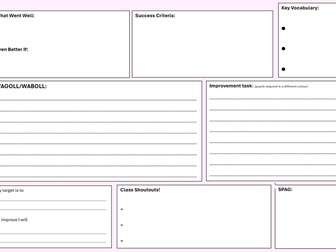
Whole-Class Feedback TemplateQuick View
riyaunadkat

Whole-Class Feedback Template

(0)
Whole-Class Feedback Template | KS3 & KS4 English | Editable Word Document A versatile, fully editable whole-class feedback template for KS3 and KS4 English teachers, designed to support effective marking, assessment and student improvement. This one-page A4 resource provides a clear, structured approach to whole-class feedback, helping teachers identify common strengths, address misconceptions and encourage students to reflect on and improve their work. What’s included: What Went Well (WWW) – Space to highlight three common strengths. Even Better If (EBI) – Space to identify three areas for improvement. Success Criteria – Reinforce the expectations of the task or assessment. Key Vocabulary – Highlight important subject-specific terminology. WAGOLL/WABOLL – Space to provide an excellent or weaker model response for discussion and analysis. Improvement Task – Dedicated space for students to respond to feedback in a different colour. Personal Targets – Encourage students to identify their next steps and explain how they will improve. Class Shoutouts – Recognise and celebrate excellent student work. SPAG – Highlight spelling, punctuation and grammar improvements. Suitable for: KS3 English (Years 7–9) GCSE English Language and Literature (Years 10–11) Creative writing assessments Reading comprehension and analytical writing Extended writing tasks Assessment feedback and dedicated improvement time (DIT) File format – Editable Microsoft Word document (.docx). The template can be adapted to suit different lessons, texts, assessments and examination specifications, including AQA GCSE English Language and Literature. Simply download, edit and reuse throughout the academic year!
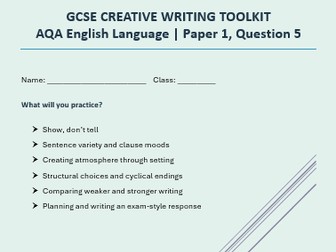
GCSE Creative Writing ToolkitQuick View
riyaunadkat

GCSE Creative Writing Toolkit

(0)
GCSE Creative Writing Toolkit | AQA English Language Paper 1 Question 5 | Editable Word Booklet An editable GCSE English Language creative writing booklet for AQA Paper 1 Question 5, covering descriptive writing, language techniques and story structure. This 13-page booklet is designed to help KS4 students develop their creative writing skills through guided activities, model responses and independent practice. What’s included Show, Don’t Tell – Activities to help students communicate emotions through actions, sensations and descriptive details. Sentence Variety – Explanations and activities covering declarative, interrogative, imperative and exclamative clause moods. Creating Atmosphere – Vocabulary-building activities and descriptive writing tasks focused on developing tension. Five-Part Narrative Structure – Drop In, Zoom In, Flashback, Shift and Circular, with explanations and planning activities. WAGOLL – A model descriptive writing extract with annotation tasks exploring language techniques, sentence structure and suspense. Creative Writing Planning Grid – Guided questions to help students structure their own response. Independent Writing Task – An exam-style descriptive writing prompt with space for students to write their response. Self-Assessment – A checklist and reflection activities to encourage students to review and improve their writing. Suitable for GCSE English Language (Years 10–11) AQA Paper 1 Question 5 preparation Creative and descriptive writing lessons Revision sessions and intervention groups Independent practice and homework File format – Microsoft Word (.docx), fully editable. The booklet can be adapted to suit different abilities, lessons and teaching approaches. It provides a structured way for students to practise key writing techniques before applying them to an extended creative writing task. Ideal for classroom teaching, GCSE revision or additional writing practice.