Y1 arithmetic jokes/codes/riddle worksheet set, counting to 100Quick View
sendcolizzy

Y1 arithmetic jokes/codes/riddle worksheet set, counting to 100

(0)
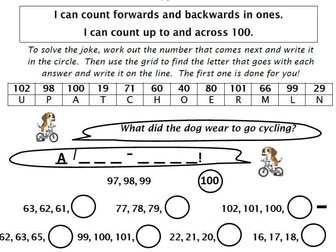
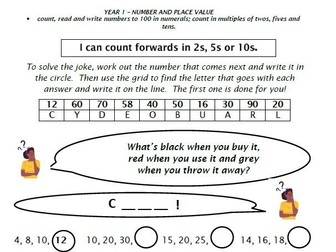
Year 1 Maths – Counting to 100 Forwards and Backwards (Arithmetic Practice Worksheets) This resource includes three engaging arithmetic practice worksheets designed to support the Year 1 objective: count to and across 100, forwards and backwards, beginning with 0 or 1, or from any given number. Each worksheet encourages children to practise identifying the next number in a sequence. Pupils solve each question by working out which number comes next and writing it in the circle. They then use the answer grid to match their number to a letter. When all the questions are completed, the letters reveal the answer to a fun joke or riddle. What’s included: 3 worksheets covering the same counting objective Different jokes/riddles to solve on each sheet Answer grid to decode the joke Engaging format to motivate arithmetic practice These worksheets are ideal for: Year 1 maths lessons Independent practice Morning work / early finishers Homework or consolidation activities A fun way to build confidence in counting forwards and backwards within 100 while keeping learners engaged. Please see my other resources for more maths objectives covered in the same fun way.
Y1 arithmetic jokes/codes/riddle worksheet set, counting in 2, 5, 10Quick View
sendcolizzy

Y1 arithmetic jokes/codes/riddle worksheet set, counting in 2, 5, 10

(0)
Year 1 Maths – Counting in 2s, 5s and 10s (Arithmetic Practice Worksheets) This resource includes three engaging arithmetic practice worksheets designed to support the Year 1 objective: count in multiples of 2, 5 and 10. Each worksheet encourages children to practise identifying the next number in a counting sequence. Pupils solve each question by working out which number comes next and writing it in the circle. They then use the answer grid to match their number to a letter. When all the questions are completed, the letters reveal the answer to a fun joke or riddle. What’s included: 3 worksheets practising counting in 2s, 5s and 10s Different jokes/riddles to solve on each sheet Answer grid to decode the joke Engaging format to motivate arithmetic practice These worksheets are ideal for: Year 1 maths lessons Independent practice Morning work / early finishers Homework or consolidation activities A fun way to build confidence in counting in multiples of 2, 5 and 10 while keeping learners engaged. Please see my other resources for more maths objectives covered in the same fun way.
Y1 arithmetic jokes/codes/riddles worksheet set, 1 more or lessQuick View
sendcolizzy

Y1 arithmetic jokes/codes/riddles worksheet set, 1 more or less

(0)
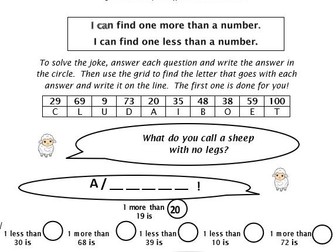
Year 1 Maths – 1 More / 1 Less (Arithmetic Practice Worksheets) This resource includes three engaging arithmetic practice worksheets designed to support the Year 1 objective: find one more and one less than a given number. Each worksheet encourages children to practise identifying one more or one less than a number. Pupils solve each question by working out the correct number and writing it in the circle. They then use the answer grid to match their number to a letter. When all the questions are completed, the letters reveal the answer to a fun joke or riddle. What’s included: 3 worksheets practising finding 1 more and 1 less Different jokes/riddles to solve on each sheet Answer grid to decode the joke Engaging format to motivate arithmetic practice These worksheets are ideal for: Year 1 maths lessons Independent practice Morning work / early finishers Homework or consolidation activities A fun way to build confidence in finding one more and one less within 100 while keeping learners engaged. Please see my other resources for more maths objectives covered in the same fun way.
Y1 arithmetic jokes/codes/riddles worksheet set, reading/writing numbers to 20Quick View
sendcolizzy

Y1 arithmetic jokes/codes/riddles worksheet set, reading/writing numbers to 20

(0)
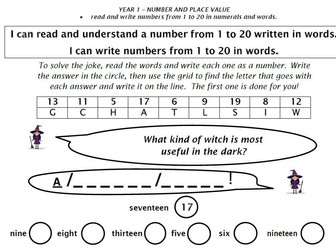
Year 1 Maths – Reading and Writing Numbers to 20 (Arithmetic Practice Worksheets) This resource includes three engaging arithmetic practice worksheets designed to support the Year 1 objective: read and write numbers to 20 in numerals and words. Each worksheet encourages children to practise recognising and recording numbers. Pupils solve each question by reading or writing the correct number and recording the answer in the circle. They then use the answer grid to match their number to a letter. When all the questions are completed, the letters reveal the answer to a fun joke or riddle. What’s included: 3 worksheets practising reading and writing numbers to 20 Different jokes/riddles to solve on each sheet Answer grid to decode the joke Engaging format to motivate arithmetic practice These worksheets are ideal for: Year 1 maths lessons Independent practice Morning work / early finishers Homework or consolidation activities A fun way to build confidence in reading and writing numbers to 20 while keeping learners engaged. Please see my other resources for more maths objectives covered in the same fun way.
'Pause, Opt, Go' scenarios - think before you act (Zones, ELSA)Quick View
sendcolizzy

'Pause, Opt, Go' scenarios - think before you act (Zones, ELSA)

(0)
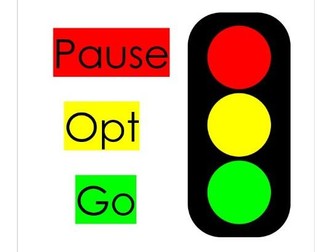
This Pause, Opt, Go resource is designed to support children who find it difficult to think before they act. Through 5 carefully structured scenarios, pupils are guided to pause, consider different choices, and reflect on the possible outcomes of each response. The scenarios encourage discussion around emotional regulation, decision-making and consequences in a safe, supportive way. Each situation helps children explore how a character might react, what other options are available, and how different choices can lead to different outcomes. This resource can be used effectively alongside: Zones of Regulation ELSA sessions SEND support PSHE / emotional literacy interventions Ideal for small-group work, one-to-one support or whole-class discussion, particularly for children who struggle with impulse control, emotional regulation or social decision-making. Key features: 5 relatable, child-friendly scenarios Clear structure: Pause – Opt – Go Promotes reflection before action Supports emotional regulation and social understanding A practical, flexible tool to help children build the skills they need to make calmer, more considered choices.
De-escalation strategies for school staff dealing with challenging behaviours - training/INSET PPTQuick View
sendcolizzy

De-escalation strategies for school staff dealing with challenging behaviours - training/INSET PPT

(0)
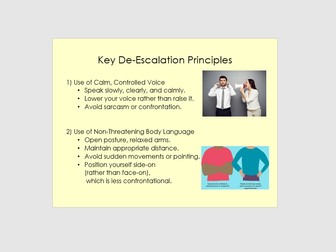
This training resource supports staff in developing effective de-escalation strategies to manage challenging situations calmly and constructively. It is designed to encourage reflection, professional dialogue, and practical takeaways for use in the classroom and wider school environment to support pupil behaviour and regulation. The training includes: Discussion activity with 4 common school scenarios where the adult unintentionally escalates the situation. Staff work together to identify escalation factors and explore alternative, more effective responses. “How it could have gone” examples showing positive approaches and de-escalation done well. A comprehensive toolkit of de-escalation strategies for staff to draw upon in different contexts. An opportunity for staff to reflect on their own triggers and consider how colleagues can support one another in managing difficult situations. Why this resource? Ready-to-use, editable PowerPoint for CPD or INSET training. Promotes reflection, collaboration, and practical skill-building. Helps staff feel more confident and consistent in their responses. Encourages a whole-school supportive approach to behaviour management.
Equity vs. Equality Assembly or Lesson PPTQuick View
sendcolizzy

Equity vs. Equality Assembly or Lesson PPT

(0)
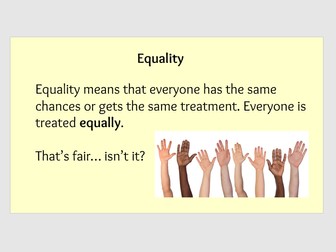
This engaging and fully resourced assembly/lesson helps pupils explore the important difference between equality and equity - and why treating everyone the same isn’t always fair. The resource includes: The “Plaster Game” demonstration (with posters and full instructions) to show how giving everyone the same thing doesn’t always meet their needs. Several clear visual examples of equity vs. equality, such as “same shoes for everyone” vs. “shoes that fit each person.” School-based examples pupils can relate to, e.g. visual supports, word mats, laptops, fidget toys, and other adjustments that help individuals succeed to prompt a discussion on why sometimes having different things is what makes it fair. A suggested story link: “That’s Not Fair”, which reinforces the message that fairness in school is about meeting needs, not just treating everyone identically. Why this resource? Ready-to-use PowerPoint, fully editable. Interactive, pupil-friendly, and easy to adapt. Promotes empathy, inclusion, and understanding. Suitable for whole-school assemblies or PSHE sessions.
ASC/Neurodivergence peer awareness assembly/lesson PPTQuick View
sendcolizzy

ASC/Neurodivergence peer awareness assembly/lesson PPT

(0)
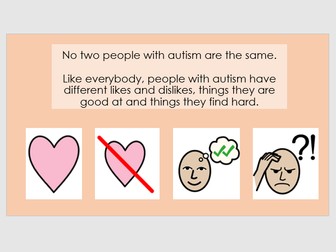
ASC Peer Awareness Assembly (PowerPoint Presentation) This ready-to-use assembly introduces pupils to Autistic Spectrum Condition (ASC) in an engaging and accessible way. It helps promote understanding, empathy, and acceptance by exploring the idea that while some differences are easy to see, others are not - and no two people with ASC are the same. The assembly covers: An introduction to ASC and some of the challenges individuals might face. Different ways we communicate and why communication can sometimes be difficult for people with ASC. Three interactive games to bring concepts to life: Point to the Body Part Game – highlighting why symbols can support communication. Facial Expressions Game – exploring how expressions can be misread. Concentration Game – demonstrating the impact of sensory sensitivities. Inspiring examples of successful people with ASC. Link to a story suggestion “All My Stripes” which could be shared. A final message on how we can all be good friends to someone who is neurodivergent. Why this resource? Fully editable PowerPoint – easy to adapt for your setting. Interactive, inclusive, and pupil-friendly. Encourages empathy, respect, and peer awareness. Perfect for whole-school assemblies or PSHE sessions.