Phonics "Ure" and "Er" Bingo CardsQuick View
jasminenia

Phonics "Ure" and "Er" Bingo Cards

(0)
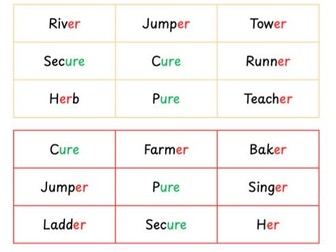
This resource includes six 3x3 phonics bingo cards featuring decodable ure and er words, and a list of all words, designed to support Phase 3 phonics. Each card contains a unique arrangement of nine words that contain the digraphs ure (e.g., pure, cure, lure) and er (e.g., fern, runner, jumper). The game helps children reinforce recognition, decoding, and pronunciation of these tricky vowel combinations in a fun, interactive way. The cards can be used during whole-class carpet time, small group instruction, or as an independent literacy station. Teachers or LSAs can act as the “caller,” reading words aloud while children listen, decode, and mark matching words on their cards. This activity strengthens phoneme-grapheme correspondence, encourages listening skills, and promotes engagement with tricky digraphs in a playful setting. Ideal for revisiting sounds at the end of Phase 3 or during consolidation weeks. Includes: 6 unique bingo cards. Words such as sure, manure, helper, baker, perk. Clear, large print suitable for young readers. Flexible for whole class or guided group use. Optionally, this resource can be extended with visual aids, mini whiteboards for writing the words when called, or used as part of a phonics display.
Phonics "Ure" and "Er" FlashcardsQuick View
jasminenia

Phonics "Ure" and "Er" Flashcards

(0)
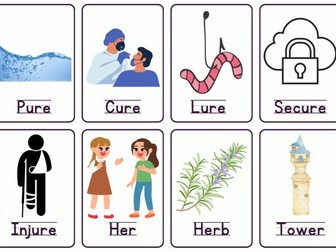
This resource consists of a collection of visually engaging flashcards featuring words containing the ‘ure’ and ‘er’ graphemes, presented in clear, legible text. Words such as “cure,” “secure,” “her,” “farmer,” “teacher,” and “river” are included, offering a mix of common nouns, verbs, and occupations to enhance vocabulary exposure. The flashcards are grouped by grapheme and include both single words (e.g., “lure”, “jumper”) and compound or role-related words (e.g., “baker”, “tower”), making them suitable for phonics activities such as: Grapheme sorting Phoneme spotting Word bingo Matching games Sentence-building prompts This resource is particularly useful for consolidating Phase 3 phonics and supports pupils in blending and segmenting multi-syllabic CVVC and CVC words. It aligns well with differentiated teaching, allowing for adaptation across varying ability groups.
Summer Detectives - Outdoor LearningQuick View
jasminenia

Summer Detectives - Outdoor Learning

(0)
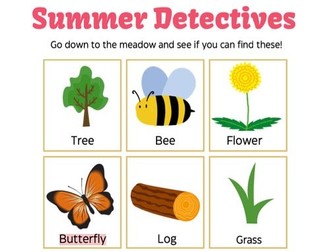
A nature-themed scavenger hunt for children titled “Summer Dectectives” encouraging observation in a natural setting. This engaging outdoor activity sheet is designed to help children explore nature through a simple scavenger hunt. It includes a checklist of common natural items and living things children might spot in a meadow or outdoor area. The items listed are: Tree Bee Flower Butterfly Log Grass Leaf Twig Birds Sun Clouds Stones The activity promotes observational skills, vocabulary development, and connection with the natural environment. It’s ideal for early years or primary school settings, particularly during a summer or science-themed lesson, or as part of a “Summer Detectives” nature walk or outdoor learning experience. It is differentiated at 3 levels.
Pentecost Word Bank - Key Religious Vocabulary for RE Lessons in EYFS and KS1"Quick View
jasminenia

Pentecost Word Bank - Key Religious Vocabulary for RE Lessons in EYFS and KS1"

(0)
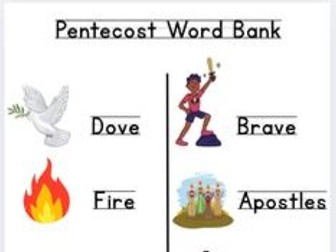
This printable word bank includes key terms associated with the Christian celebration of Pentecost, such as “dove,” “fire,” “apostles,” and “Holy Spirit”-related concepts like “wind” and “brave.” Designed to support vocabulary development and religious literacy, this resource is ideal for writing prompts, class discussions, and craft labelling activities during RE lessons. It reinforces understanding of the Pentecost story while supporting cross-curricular language objectives.
Phonics "Ow" and "Oi" FlashcardsQuick View
jasminenia

Phonics "Ow" and "Oi" Flashcards

(0)
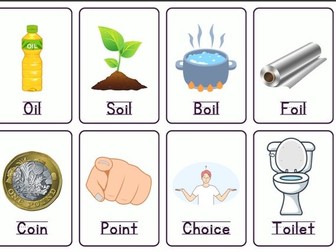
This resource includes a variety of flashcards presenting common ‘ow’ and ‘oi’ words such as “coin,” “boil,” “clown,” “how,” and “shower.” The cards are organized into two distinct grapheme groups, allowing pupils to compare and contrast similar-sounding phonemes. Key uses for this resource: Grapheme sorting: children can group cards into ‘ow’ and ‘oi’ categories. Phoneme identification games: useful for quick recall and sound spotting activities. Word bingo or matching games: reinforce visual and auditory recognition. Vocabulary building and sentence starters: encourage the use of flashcard words in oral or written sentences. This set supports Phase 3 phonics objectives, particularly for developing fluency in reading CVVC and CCVC words. The resource is ideal for both teacher-led and independent phonics tasks and supports differentiated instruction through group, pair, or individual use.
"RE Scavenger Hunt: Interactive Resource for Exploring Christian Symbols and Figures".Quick View
jasminenia

"RE Scavenger Hunt: Interactive Resource for Exploring Christian Symbols and Figures".

(0)
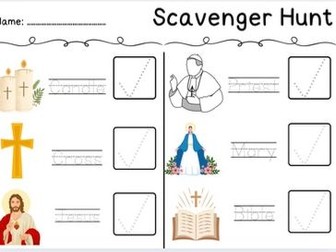
This engaging, printable scavenger hunt invites children to search for and identify key Christian symbols and figures such as “candle,” “cross,” “Jesus,” “priest,” “Mary,” and “Bible.” Designed for use in RE lessons, this resource encourages active learning through movement and observation, either in the classroom, school environment, or church setting. Ideal for Early Years and Key Stage 1, it supports vocabulary acquisition, visual recognition, and discussion of religious artefacts, making it a versatile tool for introducing key elements of Christianity in an interactive and memorable way. This resource includes larger images of each hidden item, and multiple hunt sheets at three differentiated levels.

Seaside Word BankQuick View
jasminenia

Seaside Word Bank

(0)
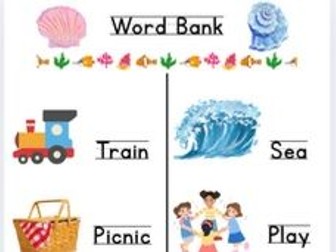
This simple, printable resource provides a themed word bank with vocabulary such as “train,” “picnic,” “sandcastle,” and “beach,” designed to support lessons on seaside holidays. Ideal for writing tasks, sentence building, and topic-based discussions, the word bank enhances children’s understanding of seaside experiences in the past and supports cross-curricular literacy development.
"Teddy Bears’ Picnic Maths Pack: Exploring Number Bonds, Addition & Subtraction through Play"Quick View
jasminenia

"Teddy Bears’ Picnic Maths Pack: Exploring Number Bonds, Addition & Subtraction through Play"

(0)
A printable set of teddy bear illustrations ideal for Early Years maths activities exploring number bonds, addition, and subtraction through play-based learning. This resource provides a series of teddy bear graphics that can be cut out and used for hands-on maths tasks, particularly in a “Teddy Bears’ Picnic” themed context. Though the file contains only images, the visuals are adaptable for a variety of practical numeracy tasks in Reception and Key Stage 1 settings. Example uses include: Number bonds: Place teddy bears in different groupings to represent number bonds to 5, 10, or 20 (e.g., 3 bears eating cake, 2 bears drinking tea = 5 total). Addition and subtraction stories: Children can act out picnic scenes using bears to solve problems (e.g., “3 bears came to the picnic and 2 more joined. How many altogether?”). Missing number problems: Use the bears to create visual representations of missing parts in equations. Counting and cardinality: Encourage children to line up and count the bears, assign them food items or plates, and explore 1:1 correspondence. This resource supports curriculum areas such as numeracy, problem-solving, and mathematical reasoning, and it integrates well with role-play and storytelling approaches in the Early Years classroom.