Alkanes and Alkenes Maze Worksheet | GCSE Science Chemistry HydrocarbonsQuick View
LSR_Science

Alkanes and Alkenes Maze Worksheet | GCSE Science Chemistry Hydrocarbons

(0)
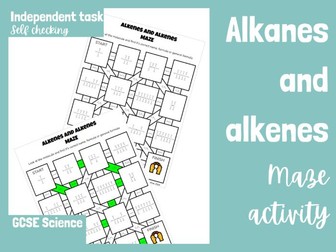
Bring some energy to your chemistry lessons with this fun and interactive Alkanes and alkenes maze worksheet! Students journey through a maze by identifying the correct names, molecular formulas, and general formulas of different hydrocarbons. Each correct answer leads them further along the path until they reach the finish line! Why teachers will love it: Versatile and time-saving – perfect as a starter, plenary, or revision activity. Ready to use – minimal preparation required, ideal for quick lesson planning. Great for assessment – instantly highlights which students can confidently recognise and apply the rules for alkanes and alkenes. Engaging and flexible – works well for individual, paired, or small-group tasks. Why students will enjoy it: Turns learning into a game-like challenge – great for motivation and competition! Builds confidence and fluency in recognising hydrocarbon structures and formulas. Encourages independent thinking and problem-solving as they find the correct path through the maze. Provides a visual and hands-on way to revise key concepts from organic chemistry. Knowledge and skills covered: Identifying alkanes and alkenes from structural diagrams Matching names, molecular formulas, and general formulas Understanding the difference between saturated and unsaturated hydrocarbons Applying chemistry knowledge to make logical connections A perfect, low-prep resource that makes learning about hydrocarbons fun, active, and memorable!
Christmas Science Activity Pack: 4 Fun STEM Activities for Upper KS2 & Lower KS3Quick View
LSR_Science

Christmas Science Activity Pack: 4 Fun STEM Activities for Upper KS2 & Lower KS3

(0)
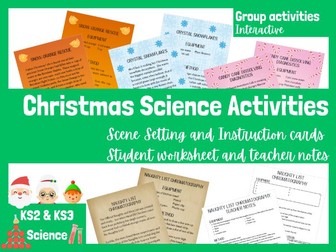
Perfect for end-of-term lessons and Christmas STEM clubs! Bring the magic of the North Pole into your science classroom with this set of four fully resourced Christmas-themed practical activities. Each activity includes a story-based scene-setter, clear instructions, a structured student worksheet and complete teacher notes. Everything is ready to print and teach - no extra planning needed! Designed to develop core scientific enquiry skills in Upper Key Stage 2 (Years 5-6) and Lower Key Stage 3 (Years 7-8), these activities support concepts such as dissolving, mixtures, density, chromatography, evaporation and particle behaviour, all wrapped in imaginative festive stories to keep learners engaged right up to the holidays. What’s included (for each of the 4 activities) Scene Setting Story Card (suggested print A5) Instruction Card (suggested print A5) Student Worksheet (suggested print A4) Teacher Notes (suggested print A4) Activities included Candy Cane Dissolving Diagnostics Investigate which liquids dissolve a candy cane fastest, helping the Elf Candy Engineers perfect their flavour-changing designs. Snow-Orange Rescue Challenge A magical buoyancy and density puzzle involving a peeled orange that must be retrieved without spilling the water. Mrs Claus’ Crystal Creations Grow sparkling festive crystals while learning about saturation, evaporation and particle arrangement. Naughty List Chromatography Investigation Use chromatography to discover which elf altered the Naughty and Nice List! Each activity can be completed in 20-40 minutes. Why students will love this resource Festive, story-driven investigations bring Science to life. Highly interactive and hands-on. Encourages curiosity, creativity and problem-solving. Great for group work and independent inquiry. Why teachers will love it too Fully prepared and ready to print just grab the equipment listed and go. Clear methods + simple equipment = easy to run even in a busy end-of-term week. Strong curriculum links to dissolving, mixtures, particles, chromatography, density, and scientific enquiry skills. Differentiated by structure: all students can succeed, but tasks allow challenge and depth. Teacher notes provide all the science explanations you need. Flexible: use as a one-off, a carousel, part of a science advent, or a festive STEM day. Curriculum Links Working Scientifically: variables, fair testing, observation, recording results, drawing conclusions Particles and their behaviour Solubility and dissolving Mixtures and separation techniques (chromatography) Density and floating/sinking Crystal formation and evaporation Scientific communication and literacy
Moles, Concentration & Volume Calculation Maze | GCSE Chemistry | A Level Chemistry | n = cVQuick View
LSR_Science

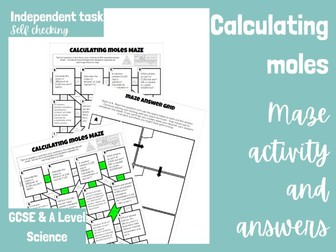
Moles, Concentration & Volume Calculation Maze | GCSE Chemistry | A Level Chemistry | n = cV

(0)
Turn tricky mole calculations into an engaging challenge with this chemistry maze worksheet! Students start at the first question and must calculate the correct answer (showing full working on a separate sheet). Their answer then leads them to the next question in the maze, continuing until they reach the end. This self-guided activity encourages independent thinking, strengthens problem-solving, and helps students spot and correct their own mistakes- if they go the wrong way, the maze won’t work! What’s included Moles, concentration & volume maze (student worksheet) Answer sheet Clearly structured start and finish points Uses n = c × V and rearranged forms Covers calculating moles, concentration, and volume Who is it suitable for GCSE Chemistry AS Level Chemistry revision or consolidation KS4 to KS5 transition activities Perfect for independent work, revision lessons, or fun class challenges Skills developed Converting between cm³ and dm³ Using and rearranging n = c × V Applying chemical maths in context Following multi-step quantitative reasoning Teacher notes Students work through at their own pace using the maze path Ideal for self-checking practice - only correct answers lead to the next valid question Encourages accurate calculation and critical thinking Print on A4 or A3 for best results A great way to make quantitative chemistry interactive, independent, and enjoyable! Suitable for classroom use, homework, or revision sessions.
AS Level Chemistry: Relative Atomic Mass Card Loop Activity Printable and DigitalQuick View
LSR_Science

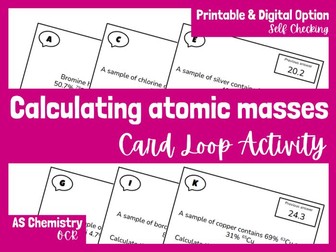
AS Level Chemistry: Relative Atomic Mass Card Loop Activity Printable and Digital

(0)
A self-checking, active learning challenge for KS5 Chemistry students! Make practicing relative atomic mass calculations engaging and memorable with this fun, self-checking Card Loop Station Activity. Students work independently or in pairs, solving linked questions where each correct answer leads them to the next station - finishing the loop only when every calculation is correct! This versatile resource includes both a printable classroom version and a digital Google Form version, giving you flexibility to use it as a starter, plenary, revision task, or homework assignment. What’s Included Printable Version: Teacher instruction sheet - clear, step-by-step setup and guidance 12 station cards (A–L) - each with a relative atomic mass calculation Student answer sheet - double-sided, ready to print Full answer key - for easy teacher reference Self-checking design - students finish where they started if all answers are correct Student instructions - friendly and clear, printed at the top of the worksheet Digital Google Form Version: Editable Google Form link - ready to copy, customise, and assign Teacher setup guide - includes step-by-step instructions for Google Classroom or secure sharing Built-in student instructions - clearly guide students through the form Self-checking format - leads students to a “Nice work!” screen when all answers are correct Flexible use - perfect for homework, revision, starters, or plenaries You must have a Google account to use the link! Learning Focus Practice calculating relative atomic mass using isotopic data Reinforce AS Level Chemistry quantitative skills Encourage independent checking and logical reasoning Promote active engagement through movement and participation Why you will Love It Encourages independent thinking and self-correction Works well for individuals, pairs, or small groups Offers both printable and digital formats for flexible use Low-prep and reusable year after year Suggested Uses Quick-start classroom challenge Homework task or flipped learning activity Interactive plenary to consolidate understanding Revision lesson or topic review Turn your next Chemistry lesson into a loop of learning - where every correct answer leads students closer to mastering calculating relative atomic mass!
AQA GCSE Combined Science Chemistry Chapter 3 Structure and bonding Revision mat with answersQuick View
LSR_Science

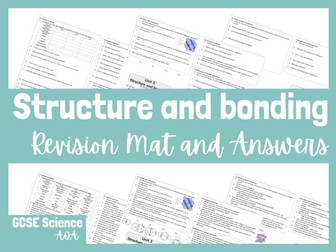
AQA GCSE Combined Science Chemistry Chapter 3 Structure and bonding Revision mat with answers

(0)
Looking for an AQA GCSE Combined Science and Chemistry resource to use when teaching Unit 3 Structure and bonding? This resource includes: A 3 page revision resource including all students need to learn about Unit 3 Structure and bonding to check their understanding of states of matter, ions, ionic bonding, covalent bonding, simple molecules, giant ionic structures, giant covalent structures, fullerenes, graphene, bonding in metals and giant metallic structures. Answers! Your students will love having everything they need to learn about this unit in one place and you’ll love the time you have saved. It could be used as revision for an end of unit assessment, part of a revision pack which you send home or the basis for a revision session. Will be best printed in A3 for students to write on or electronically for them to type their own answers.
AQA GCSE Combined Science Chemistry Chapters 1 - 4 Atoms, bonding and moles Revision mat and answers packQuick View
LSR_Science

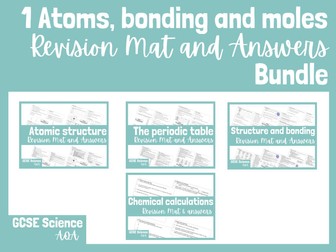
AQA GCSE Combined Science Chemistry Chapters 1 - 4 Atoms, bonding and moles Revision mat and answers pack

4 Resources
Looking for AQA GCSE Combined Science / Chemistry resources to use when teaching Chapters 1 - 4? This bundle contains a revision mat plus answers for Chapter 1 Atomic structure (atoms, chemical equations, separating mixtures, fractional distillation, paper chromatography, history or the atom, structure of the atom, ions, atoms and isotopes and electronic structure) Chapter 2 The periodic table (development of the periodic table, electronic strutures and the periodic table, group 1 - alkali metals, group 7 - the halogens, explaining trends) Chapter 3 Structure and bonding (states of matter, ions, ionic bonding, covalent bonding, simple molecules, giant ionic structures, giant covalent structures, fullerenes, graphene, bonding in metals and giant metallic structures) Chapter 4 Chemical calculations (relative atomic masses and moles, equations and calculations, using masses to balance equations and calculating concentration using mass and volume) This bundle will save you time when planning revision for the first half of AQA GCSE Paper 1 and your students will love having all they need to access easily
AQA GCSE Combined Science Chemistry Chapter 4 Chemical calculations Revision mat with answersQuick View
LSR_Science

AQA GCSE Combined Science Chemistry Chapter 4 Chemical calculations Revision mat with answers

(0)
Looking for an AQA GCSE Combined Science Chemistry resource to use when teaching Unit 4 Chemical calculations? This resource includes: A 1 page revision resource including all students need to learn about Unit 4 Chemical calculations to check their understanding of relative atomic masses and moles, equations and calculations, using masses to balance equations and calculating concentration using mass and volume. Answers including workings! Your students will love having everything they need to learn about this unit in one place and you’ll love the time you have saved. It could be used as revision for an end of unit assessment, part of a revision pack which you send home or the basis for a revision session. Will be best printed in A3 for students to write on or electronically for them to type their own answers.
AQA GCSE Combined Science Chemistry Chapter 2 The periodic table Revision mat with answersQuick View
LSR_Science

AQA GCSE Combined Science Chemistry Chapter 2 The periodic table Revision mat with answers

(0)
GCSE AQA Chemistry Unit 2:The periodic table – Revision Sheet A two page revision sheet covering the essential concepts, keywords, and processes for GCSE AQA Chemistry Unit 2:The periodic table (can also be used for other exam boards). This resource contains one revision mat (over 2 pages) for GCSE AQA Chemistry Unit 2:The periodic table along with the answer sheet. It can be used as revision for an end of unit assessment, part of a revision pack which you send home or the basis for a revision session. Will be best printed in A3 for students to write on or electronically for them to type their own answers.
GCSE AQA Combined Science Chemistry C4.1 Relative formula mass practice worksheet and answersQuick View
LSR_Science

GCSE AQA Combined Science Chemistry C4.1 Relative formula mass practice worksheet and answers

(0)
Looking for some extra practice questions for GCSE AQA C4.1 Relative formula mass? This resource includes: A 2 page worksheet with lots of practice for calculating relative formula mass including space for their workings Answers including workings Watch your students’ confidence in these calculations increase and you’ll love sharing the step-by-step answers with them. It could be used as practice or homework after teaching C4.1, end of unit revision or revision of the topic for A level students.
AQA GCSE Combined Science Chemistry Chapter 1 Atomic structure Revision mat with answersQuick View
LSR_Science

AQA GCSE Combined Science Chemistry Chapter 1 Atomic structure Revision mat with answers

(0)
Looking for an AQA GCSE Chemistry resource to use when teaching Unit 1 Atomic structure? This resource includes: A 2 page revision resource including all students need to learn about Unit 1 Atomic structure to check their understanding of atoms, chemical equations, separating mixtures (fractional distillation and paper chromatography), history of the atom, protons, neutrons and electrons, atomic and mass number, ions, isotopes and electronic structure Answers, including workings! Your students will love having everything they need to learn about this unit in one place and you’ll love the time you have saved. It could be used as revision for an end of unit assessment, part of a revision pack which you send home or the basis for a revision session. Will be best printed in A3 for students to write on or electronically for them to type their own answers.
OCR AS Chemistry 2.1.3 Atomic massesQuick View
LSR_Science

OCR AS Chemistry 2.1.3 Atomic masses

(0)
Looking for an OCR AS Chemistry resource to use when teaching 2.1.3 Atomic masses? This resource includes: Presentation including all students need to learn about Atomic masses including exam board definitions Worksheet to check their understanding of relative isotopic mass, relative atomic mass, relative molecular mass and relative formula mass Answers! Your students will love using their skills to solve problems and you’ll love the time you have saved. Written to work with OCR AS Chemistry but can be used for other exam boards too.
OCR AS Chemistry Atomic StructureQuick View
LSR_Science

OCR AS Chemistry Atomic Structure

(0)
Looking for an OCR AS Chemistry resource to use when teaching 2.1.2 Atomic structure? This resource includes: Presentation including all students need to learn about Atomic structure including exam board definitions Worksheet to check their understanding of protons, neutrons and electrons, isotopes and atomic structure of isotopes Answers! Your students will love using their skills to solve problems and you’ll love the time you have saved. Written to work with OCR AS Chemistry but can be used for other exam boards too.
OCR AS Chemistry Shells and orbitalsQuick View
LSR_Science

OCR AS Chemistry Shells and orbitals

(0)
Looking for an OCR AS Chemistry resource to use when teaching 2.2.1 Shells and orbitals? This resource includes: Presentation including all students need to learn about Shells and orbitals including exam board definitions Worksheet to check their understanding of electron shells, orbitals and how we represent them Answers! Your students will love the fun activity to help them visualize shapes of orbitals in a fun and hands-on way and you’ll love a ready made lesson. Written to work with OCR AS Chemistry but can be used for other exam boards too.
GCSE Combined Science Chemistry Electrolysis Revision Mat and answersQuick View
LSR_Science

GCSE Combined Science Chemistry Electrolysis Revision Mat and answers

(0)
This resource contains a one page revision mat for GCSE AQA Science Chemistry Unit 6: Electrolysis along with the answer sheet (could be used for other exam boards). It could be used as revision for an end of unit assessment, part of a revision pack which you send home or the basis for a revision session. Will be best printed in A3 for students to write on or electronically for them to type their own answers.
Card loop Using the Periodic TableQuick View
LSR_Science

Card loop Using the Periodic Table

(0)
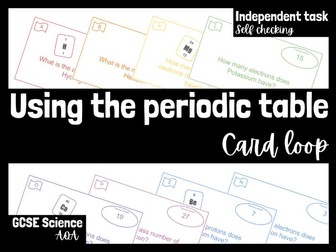
Looking for a resource to consolidate what your students have learned about the Periodic Table? That checks they know the difference between the mass number and atomic number? And can use them to work out the number of sub atomic particles? Well this is your resource! This resource includes: Two versions of a self-checking card loop; one including the information for each element from the Periodic Table and one where they will need their own copy of the Periodic Table. Can be used individually or as a class (sixteen cards ) Print the document, laminate and cut into separate cards and let the fun begin! Your students will love sorting the cards and you will be able to assess what they have learned easily