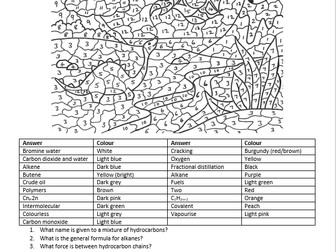
Colouring by numbers activity for GCSE Chemistry/science revision. Easy revision activity or home work which allows pupils to practice recall of key facts. Pupils simply answer each question, then find the answer in the table to know which colour to use when colouring in the picture for that question number. Foundation version also included.
Colouring by numbers activity for GCSE Chemistry/science revision. Includes AQA C1, C2, C3 and C4. Easy revision activity or home work which allows pupils to practice recall of key facts. Pupils simply answer each question, then find the answer in the table to know which colour to use when colouring in the picture for that question number.
Great fun revision activity or homework. Pupils answer each question and find the answer on the table to find out which colour to use when colouring in the diagram (e.g. the answer to question 1 gives the colour pink, so all number 1’s in the picture are to be coloured in pink).
Each has around 12 questions and can be adapted by changing the questions.
For extra challenge, consider giving the colour table and picture but no questions; pupils then have to think of question with the answers that are in the table and colour the picture accordingly!
Topics include:
Calculating means
Units
P1 energy sources
P2 electrical symbols (by name and by description)
P2 electricity facts
P3 (very easy)
P4 inside the atom
P4 radiation particles
P5 forces revision
P6 waves
P7 magnets and electromagnets
Great fun revision activity or homework. Pupils answer each question and find the answer on the table to find out which colour to use when colouring in the diagram (e.g. the answer to question 1 gives the colour pink, so all number 1’s in the picture are to be coloured in pink).
Each has around 12 questions and can be adapted by changing the questions. All hand drawn (I hope you like the evolution one especially!)
For extra challenge, consider giving the colour table and picture but no questions; pupils then have to think of question with the answers that are in the table and colour the picture accordingly!
Topics include:
B1 facts
B1 parts of a cell
B2 food tests
B2 heart
B2 leaf
B3 diseases
B4 photosynthesis
B4 respiration
B5 Homeostasis and response
B6 Inheritance, variations and evolution
B7 adaptations
B7 food webs
B7 ecology facts
Colouring by numbers activity for GCSE Chemistry/science revision. Includes AQA C5 (Energy changes calculations), C6 (Rate and extent of chemical change), C7 (Organic chemistry) and C8 (Chemical analysis). Easy revision activity or home work which allows pupils to practice recall of key facts. Pupils simply answer each question, then find the answer in the table to know which colour to use when colouring in the picture for that question number.
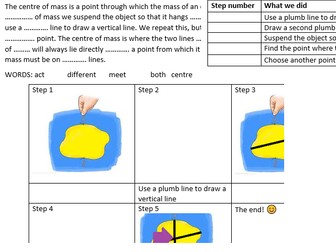
Worksheet for pupils to use to scaffold recalling how to find the centre of mass of an irregular object. Bronze option is a sentence sort to put steps in order, Silver is a fill in the gaps and gold is a complete the storyboard activity. Words are provided for the ‘fill in the gap’ activity but could easily be removed to increase difficulty or provide an extra option. Made so that each activity is on its own page for easy printing.
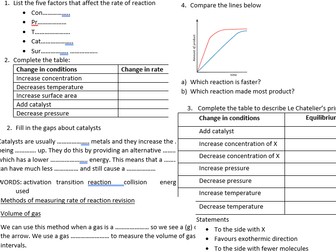
A range of worksheets, with answers, to help pupils to revise aspects of rates of reaction, including:
Methods of measuring rate
Factors affecting rate
Calculating rates of reaction
Le Chatelier’s principle and reversible reactions
Also includes a RAG table to help pupils identify which sheet will help them progress.
Two worksheets to help pupils practice the types of questions which come up about water of crystallisation; with answers. One sheet has the three common types of question separated for pupils to practice that type only; the other has the types mixed in together such that pupils have to identify which type of calculation to do before carrying it out.
Three worksheets of practice carrying out concentration calculations using moles. Sheet labelled m is scaffolded to help pupils carry out the calculations. Also includes a set of practice questions intended as homework but could be used as revision or extra practice. All with answers.
Colouring by numbers revision activities to revise all AQA chemistry topics. Some large topics have been covered in several colouring activities due to amount of content. All images hand drawn. 20 activities in total. Great fun revision!
Three part worksheet, where learners practice finding numbers of moles from mass, then number of particles from moles (using Avogadro’s constant) then bringing both together to find the number of particles from mass; this last part also includes practice of finding the number of atoms in polyatomic molecules. Full answers included.
Colouring by numbers activity for GCSE Physics/science revision. Easy revision activity or home work which allows pupils to practice recall of key facts. Pupils simply answer each question, then find the answer in the table to know which colour to use when colouring in the picture for that question number.
Colouring by numbers activity for GCSE Chemistry/science revision. Easy revision activity or home work which allows pupils to practice recall of key facts. Pupils simply answer each question, then find the answer in the table to know which colour to use when colouring in the picture for that question number.
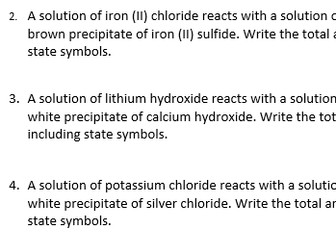
Worksheet with answers comprising 8 questions where pupils find the total and net ionic equations; and a homework with 5 further practice questions and answers.
Bronze, silver and gold worksheets for practicing the ideal gas law in Chemistry. Bronze focuses on applying numbers to the equation, Silver on converting units and Gold on all of the above and applying knowledge of mole calculations to find moles before using it in the equation.
Colouring by numbers activity for GCSE Biology/science revision. Easy revision activity or home work which allows pupils to practice recall of key facts. Pupils simply answer each question, then find the answer in the table to know which colour to use when colouring in the picture for that question number. Includes an activity focused on facts from B1 and one about parts of plant and animal cells.
Colouring by numbers activity for GCSE Chemistry/science revision. Easy revision activity or home work which allows pupils to practice recall of key facts. Pupils simply answer each question, then find the answer in the table to know which colour to use when colouring in the picture for that question number. Two activities included - foundation facts and bond energy calculations focused colourings.
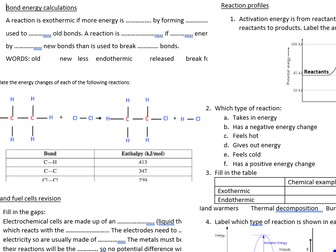
A range of worksheets, with answers to help pupils review their understanding and cement recall of the Energy changes topic. Includes:
Exothermic/endothermic
Reaction profiles
Bond energy calculations
Triple only: Fuel cells
Also includes a mini RAG sheet to help pupils select the right activity for them.
Two worksheets to provide learners with the opportunity to practice writing half equations for a described reaction. This includes writing the correct formula for ions, adding the correct number of electrons using the change in oxidation states (and adding them to the correct side of the equation) and adding H+, OH- and H2O to chemically balance the equation. Answers included on the second page of each sheet.
Colouring by numbers activity for GCSE Physics/science revision. Easy revision activity or home work which allows pupils to practice recall of key facts. Pupils simply answer each question, then find the answer in the table to know which colour to use when colouring in the picture for that question number.