Real-Life Math: Calculating Area with Local ExamplesQuick View
ayyan240

Real-Life Math: Calculating Area with Local Examples

(0)
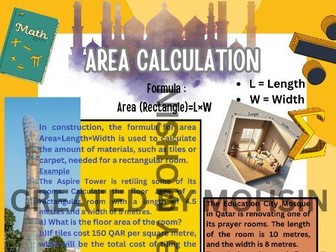
This math poster is a vibrant and educational guide that teaches how to calculate the area of a rectangle using the formula Area = Length × Width. It features real-life examples from Qatar, such as the Aspire Tower and the Education City Mosque, to show how area calculations are used in construction and renovation projects. The poster includes clear explanations, solved problems, and visuals like buildings, rooms, and mathematical symbols to make learning engaging and relatable. It effectively combines math with practical applications, helping students understand how to find floor areas and calculate costs for materials like tiles.

Japan’s High Socio-Economic Development and Its Environmental ImpactQuick View
ayyan240

Japan’s High Socio-Economic Development and Its Environmental Impact

(0)
This presentation explores Japan’s significant socio-economic development—driven by strong infrastructure, a highly skilled workforce, and a robust healthcare system—and the environmental consequences that accompany this advancement. While Japan is globally recognized for its rapid industrialization, innovation, and efficient systems, these achievements have also led to environmental challenges such as pollution, waste management issues, and resource depletion. The presentation balances the benefits of Japan’s development with the environmental costs, providing a clear view of the trade-offs between economic progress and sustainability. when you buy it there will be no watermark
Explore Our Solar SystemQuick View
ayyan240

Explore Our Solar System

(0)
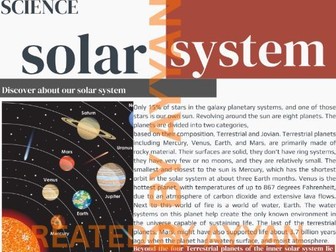
This image is an educational poster about the solar system designed to inform readers about the structure and characteristics of our planetary system. It features a visual diagram of the eight planets orbiting the Sun, clearly labeled and arranged in order. The poster explains that the solar system is made up of terrestrial planets (Mercury, Venus, Earth, and Mars) and Jovian planets (Jupiter, Saturn, Uranus, and Neptune), highlighting their unique features such as size, composition, temperature, and the presence of rings or moons. It also discusses the asteroid belt, Kuiper Belt, and Oort Cloud, which contain dwarf planets and icy objects. The text includes interesting facts, such as the Sun holding 99.86% of the solar system’s mass and Pluto being reclassified as a dwarf planet in 2006. The layout combines informative text with engaging visuals, making it suitable for science learning and classroom display.