Infection and Response Key Terms - AQA GCSE BiologyQuick View
hopihippie

Infection and Response Key Terms - AQA GCSE Biology

(0)
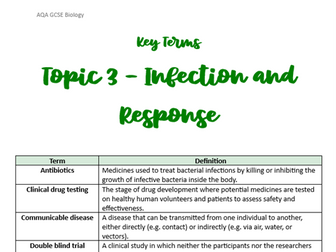
Document 1: Terms and Definitions Table This document provides a clear and structured table that lists the key terms and their definitions for Topic 3 – Infection and Response in the AQA GCSE Biology curriculum. The terms cover a variety of concepts related to infectious diseases, the immune system, drug testing, and the mechanisms by which pathogens spread and cause harm. Terms like Antibiotics, HIV, Malaria, and Placebo are clearly defined to help students understand the terminology they will encounter when studying infections, immune responses, and disease prevention. Purpose: This resource is designed to support students in building their understanding of important biological concepts related to infection and disease. It helps students learn the specific terms required for understanding how infections spread, how vaccines work, and how medicines are developed to treat disease. Structure: The document is presented in a straightforward table format, with terms listed in the first column and their definitions in the second. The terms are organised in a logical order, beginning with general concepts such as Pathogens and Communicable Diseases, and moving through specific diseases, drug testing stages, and immune responses. The table allows for easy reference and quick study. Document 2: Key Terms Table (Blank Version) This document mirrors the content of Document 1 but with the second column left blank for students to fill in their own definitions. The terms remain in the first column, and students can test their understanding by writing down their knowledge of each term. This exercise encourages students to engage actively with the material and reinforce their understanding of the key concepts. Purpose: This blank version of the table serves as a self-assessment tool and revision activity. Students can attempt to recall and write down the definitions, which helps to consolidate their learning and assess their grasp of the topic. It is an effective way to prepare for exams and solidify knowledge of key terms. Structure: Similar to the first document, the terms are arranged in a table with space in the second column for students to fill in their definitions. The blank table includes all the important terms such as Gonorrhoea, Monoclonal Antibodies, Preclinical Drug Testing, and Non-specific Defence, encouraging students to familiarise themselves with the biological processes and terms related to infection and immunity.
Cell Biology Key Terms - AQA GCSE BiologyQuick View
hopihippie

Cell Biology Key Terms - AQA GCSE Biology

(0)
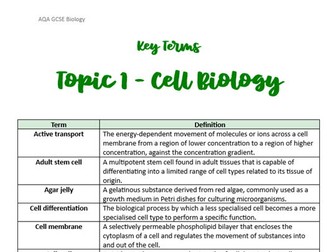
Document 1: Terms and Definitions Table This document provides a comprehensive list of key terms related to the topic of Cell Biology for the AQA GCSE Biology curriculum. Each term is defined clearly and concisely, providing students with the essential vocabulary required to understand the concepts in this topic. The table includes terms such as Active Transport, Adult Stem Cells, Mitosis, and Osmosis, alongside detailed descriptions that explain their meanings and relevance within biological processes. Purpose: This resource is designed to support students in building their scientific vocabulary and understanding of the core concepts in cell biology. It provides a reference point for students to study and revise the fundamental terms they need to know. Structure: The document features a simple, easy-to-read table format, with the term in the first column and its definition in the second. It covers a wide range of topics, including cell structures, processes (e.g., Diffusion, Mitosis), types of cells (e.g., Eukaryotic Cell, Prokaryotic Cell), and processes such as Cell Differentiation and Active Transport. The table can be printed for in-class or home study use. Document 2: Key Terms Table (Blank Version) This document contains the same list of key terms from the Cell Biology topic, but in a blank table format. The terms are listed in the first column, with a space left in the second column for students to fill in their own definitions or understanding of each term. This interactive format encourages active learning and self-testing, enabling students to engage more deeply with the content. Purpose: The blank table is an excellent tool for revision, allowing students to assess their grasp of the key terms. It can be used as an exercise in class or as a homework task, helping to consolidate knowledge of the terms by encouraging students to recall and apply their definitions. Structure: The document features a straightforward table with two columns. The first column lists the key terms, and the second column is left blank for students to write in their definitions. It covers the same terms as the first document, ensuring that students have the same content to work with, but with the added challenge of generating their own understanding of each concept.
Organisation Key Terms - AQA GCSE BiologyQuick View
hopihippie

Organisation Key Terms - AQA GCSE Biology

(0)
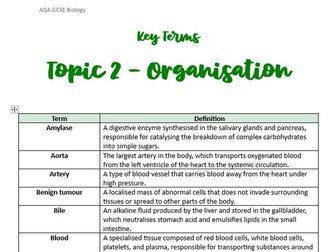
Document 1: Terms and Definitions Table This document contains a comprehensive table listing the key terms and their definitions for Topic 2 – Organisation in the AQA GCSE Biology curriculum. The terms cover a wide range of concepts within the topic, from Amylase and Lipase, to Cancer, Heart and Xylem. Each term is paired with a clear, concise definition that explains the concept and its role in biological systems, particularly focusing on processes related to digestion, the circulatory system, plant biology, and disease. Purpose: This resource is designed to help students familiarise themselves with the essential terminology of the Organisation topic. It provides students with a clear and structured overview of key concepts in human biology and plant physiology, which will be fundamental for understanding more complex systems and processes in future lessons. Structure: The document is organised in a simple table format, with the term in the first column and the definition in the second column. It covers a broad range of topics such as the cardiovascular system, digestive enzymes, tissues and organs, and plant transport systems. The document is structured for easy navigation, and students can quickly look up terms and definitions as needed for study or revision purposes. Document 2: Key Terms Table (Blank Version) This document features the same list of key terms from Topic 2 – Organisation, but with the second column left blank for students to fill in their own definitions. This interactive format provides an opportunity for students to test their knowledge and actively engage with the subject matter. Students can attempt to recall the definitions and write their own explanations, which will help reinforce their understanding of each term. Purpose: This blank table serves as an excellent revision tool for students to self-assess and consolidate their learning. It encourages students to recall the definitions of the terms, reinforcing their understanding and ensuring that they are familiar with the language used in the GCSE exam. Structure: Similar to the first document, the terms are listed in the first column, with space for students to fill in their definitions in the second column. The table includes terms from various areas within Organisation, such as blood vessels, digestive enzymes, and plant structures, allowing for a broad range of content review. The document can be printed for in-class activities or used as homework for independent study.