A fun GCSE Photography starter activity where students create their own vinyl-style photography name using their initials and date of birth.
Great for introducing ideas around photographer identity and branding, or as a quick creative task at the start of a lesson. Students can use their generated name as a portfolio alias or as inspiration for project work.
Perfect for GCSE Photography lessons, cover work or creative warm-up tasks.
This Photography Shoot Plan Template is designed to help GCSE Photography students (and suitable for A Level) plan, organise and justify their photoshoots clearly and effectively.
The template guides students through key planning elements required for successful coursework and exam preparation, including:
What, where and when the shoot will take place
Models or subjects involved
Reference to previous shoots
Colour scheme / palette
Visual inspiration and ideas
Ideal for supporting students who struggle with planning or written annotation, this resource helps learners translate ideas into purposeful shoots, meeting assessment objectives with confidence.
Perfect for:
GCSE Photography (AQA / OCR / Edexcel)
A Level Photography
Exam coursework planning
Independent student use or structured classroom tasks
Can be used digitally or printed for sketchbooks.
This IKEA-style instruction sheet is a versatile KS3 Design & Technology resource that helps students clearly plan how a product will be made.
Inspired by real instruction manuals, the layout guides students to record a final design, list tools and equipment, consider health and safety, and write clear, numbered step-by-step instructions.
The resource is not product-specific, making it suitable for a wide range of D&T projects including resistant materials, electronics, textiles, and mixed materials. Ideal for practical lessons, assessment evidence, or independent tasks during workshop sessions.
Photography Wrapped is a fun, modern, and engaging introduction to GCSE Component 2 (Photography).
Designed in the style of Spotify Wrapped, this resource helps students explore their personal interests, creative preferences, and visual inspirations before beginning their 10-hour exam project.
This pack guides students through a structured but exciting series of slides where they identify themes they love, explore new ideas, collect high-quality inspiration, analyse photographers, take their own photographs, and begin shaping potential final outcomes. It’s an ideal way to ease students into the exam process with confidence and enthusiasm.
What’s Included:
Google Slides / PowerPoint template with a “Photography Wrapped” design
8 fun, high-impact slides that introduce key Component 2 expectations
Tasks covering:
Theme exploration
Inspiration boards
Photo-taking tasks
Editing challenges
Artist research
Visual analysis
Final piece planning
Clear prompts aligned with GCSE Assessment Objectives
Why Teachers Love It:
Turns a daunting exam project into something accessible and exciting
Perfect for January “exam launch” lessons
Helps students generate genuine, personal ideas rather than last-minute themes
Builds a strong foundation for AO1, AO2, and AO3
Works for all exam boards and is ideal for Year 11 students
Why Students Love It:
Familiar, fun visual style inspired by Spotify Wrapped
Encourages self-expression and personal interests
Gives them ownership of their exam project
Makes research and planning feel modern, relevant, and enjoyable
Photography Wrapped is a fun, modern, and engaging introduction to GCSE Component 2 (Art & Design).
Designed in the style of Spotify Wrapped, this resource helps students explore their personal interests, creative preferences, and visual inspirations before beginning their 10-hour exam project.
This pack guides students through a structured but exciting series of slides where they identify themes they love, explore new ideas, collect high-quality inspiration, analyse photographers, take their own photographs, and begin shaping potential final outcomes. It’s an ideal way to ease students into the exam process with confidence and enthusiasm.
What’s Included:
Google Slides / PowerPoint template with a “Art Wrapped” design
8 fun, high-impact slides that introduce key Component 2 expectations
Tasks covering:
Theme exploration
Inspiration boards
Photo-taking tasks
Editing challenges
Artist research
Visual analysis
Final piece planning
Clear prompts aligned with GCSE Assessment Objectives
Why Teachers Love It:
Turns a daunting exam project into something accessible and exciting
Perfect for January “exam launch” lessons
Helps students generate genuine, personal ideas rather than last-minute themes
Builds a strong foundation for AO1, AO2, and AO3
Works for all exam boards and is ideal for Year 11 students
Why Students Love It:
Familiar, fun visual style inspired by Spotify Wrapped
Encourages self-expression and personal interests
Gives them ownership of their exam project
Makes research and planning feel modern, relevant, and enjoyable
A clear and comprehensive GCSE Design and Technology revision resource covering all key material properties, including physical and working properties, timbers, boards, metals and alloys, polymers, and textiles. Designed for KS4 students, this student-friendly PDF is ideal for independent revision or class support. It presents key content in a visually engaging format with clear explanations and real-world examples. Perfect for exam prep, homework, or classroom use—aligned with AQA, Edexcel, and OCR specifications.
This student-friendly revision mind map provides a concise and visual summary of the Life Cycle Assessment (LCA) process, tailored specifically for the GCSE Design and Technology curriculum. It breaks down the key stages of LCA into clear sections, with prompt questions to help learners understand and remember essential content for exams.
A focused GCSE Design and Technology revision guide covering key considerations when selecting materials, including functionality, aesthetics, cost, availability, environmental impact, and cultural and ethical factors. Clearly presented and easy to follow, this student-friendly resource is ideal for KS4 revision, classroom support, or homework tasks. Suitable for AQA, Edexcel, and OCR specifications, it helps learners understand how designers choose appropriate materials for products.
This detailed and student-friendly revision mind map introduces GCSE Design and Technology learners to ergonomics and anthropometric data- core concepts in designing user-friendly, inclusive products. It breaks down key definitions, uses of data in design, and how information is interpreted and presented.
This clear, student-friendly revision resource covers all the key concepts of material management for GCSE Design and Technology. It explains how to plan, cut, and shape materials efficiently to minimise waste and reduce manufacturing costs.
This comprehensive revision resource covers all the essential knowledge on electronic and mechanical systems, with clear explanations and examples designed to support GCSE students. It helps learners understand how different materials and processes are used to create efficient, reliable products in real-world contexts.
This easy-to-follow revision mind map provides GCSE Design and Technology students with a structured overview of energy generation and storage, a key topic in the exam specification. It breaks down the differences between renewable and non-renewable energy sources, outlines key advantages and disadvantages, and includes essential information on energy storage systems.
A detailed and student-friendly GCSE Design and Technology revision guide covering materials, manufacturing processes, forces and stresses, environmental and ethical issues, scales of production, and the sourcing and treatment of timbers, metals, and boards. Ideal for KS4 learners, this resource supports exam preparation with clear explanations, practical examples, and curriculum-aligned content suitable for AQA, Edexcel, and OCR. Perfect for class use, homework, or independent revision.
This high‑quality revision resource covers all the key concepts of mechanical devices and mechanisms, making it perfect for students preparing for GCSE Design and Technology exams. It explains how forces and movements are transferred, transformed and controlled through a range of mechanisms.
Clear diagrams, step‑by‑step explanations and real‑world examples help students understand how mechanical systems work and how they are used in everyday products. Ideal for class teaching, independent study or last‑minute revision.
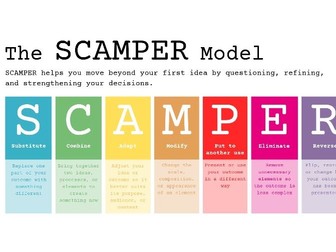
Encourage students to move beyond their first idea and develop more creative, thoughtful outcomes with this Photography SCAMPER resource. Designed specifically for GCSE Photography, this visual guide introduces students to the SCAMPER creative thinking model, providing a simple but highly effective framework for refining, improving, and extending photographic ideas.
The resource breaks down each stage of the SCAMPER process in a clear, student-friendly format, helping learners explore alternative approaches, experiment with new techniques, and develop more original responses within their projects. It is ideal for supporting idea generation, experimentation, and annotation throughout the coursework process.
SCAMPER stands for:
Substitute
Combine
Adapt
Modify
Put to Another Use
Eliminate
Reverse
Each section includes a concise explanation that helps students question their decisions, challenge their initial ideas, and identify opportunities for further development.
Perfect for:
GCSE Photography (AQA and other exam boards)
Personal investigations and coursework
Project development pages
Experimentation and refinement tasks
Sketchbook and portfolio work
Independent learning and cover lessons
What’s included:
1-page visual SCAMPER guide
Photography-focused creative thinking framework
Easy-to-understand student-friendly language
Suitable for a wide range of photographic themes and genres
Printable and ready to use immediately
This resource is an excellent tool for promoting creative risk-taking, purposeful experimentation, and deeper development of ideas. It helps students generate more sophisticated outcomes while providing teachers with a practical framework that can be used across multiple projects and year groups.
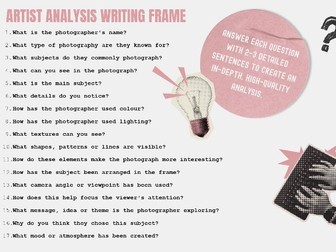
Help students write detailed, analytical, and high-quality artist studies with this ready-to-use GCSE Photography Artist Analysis Writing Frame. Designed specifically for KS4 Photography students, this resource supports learners in developing stronger written analysis and making meaningful connections between photographers’ work and their own projects.
The writing frame contains 27 carefully sequenced questions that guide students through observation, analysis, interpretation, evaluation, and personal response. Students are encouraged to explore photographic techniques, composition, lighting, colour, mood, meaning, and artistic intentions before reflecting on how they can apply ideas to their own work.
A dedicated Grade 7-9 Challenge Section encourages deeper thinking by prompting students to include quotes, comparisons, and alternative interpretations, helping to push responses beyond description and into higher-level critical analysis.
Perfect for:
GCSE Photography (AQA and other exam boards)
Artist research pages
Coursework and portfolio development
Homework tasks
Cover lessons
Independent learning
What’s included:
2-page printable PDF
27 structured artist analysis questions
Clear guidance for extended written responses
Grade 7-9 challenge prompts
Suitable for analysing any photographer or photographic image
This resource saves teachers valuable planning time while providing students with a consistent framework for producing thoughtful, well-developed artist analyses throughout their GCSE Photography course.
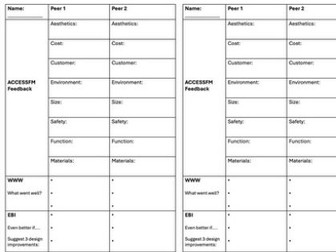
Make peer assessment meaningful, structured, and easy to manage with this KS3 Design & Technology ACCESSFM Feedback Sheet. Designed to support product evaluation and design critique, this resource helps students give constructive feedback using the widely recognised ACCESSFM framework.
Students assess each other’s designs against key design criteria, encouraging them to think critically about how products meet user needs and design requirements. The structured layout guides learners to provide specific feedback on aesthetics, cost, customer needs, environmental impact, size, safety, function, and materials before identifying strengths and suggesting improvements.
The sheet includes space for feedback from two peers, helping students gather multiple viewpoints and use this information to refine and improve their designs.
Perfect for:
KS3 Design & Technology
Design evaluation lessons
Peer assessment activities
Product analysis tasks
Design portfolio evidence
Independent and collaborative learning
What’s included:
Ready-to-print ACCESSFM feedback template
Space for feedback from two peer assessors
Dedicated sections for each ACCESSFM category
WWW (What Went Well) prompts
EBI (Even Better If) prompts
Opportunities to suggest specific design improvements
Suitable for a wide range of KS3 D&T projects
This resource promotes thoughtful peer critique, develops design vocabulary, and helps students understand how to evaluate products against established design criteria. A practical, time-saving tool for any KS3 Design & Technology classroom
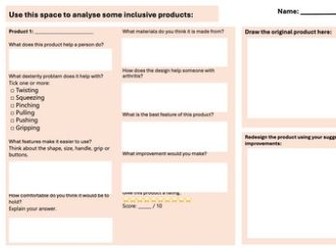
Help students develop an understanding of inclusive design and user-centred design principles with this engaging KS3 Design & Technology analysis worksheet. This resource encourages learners to investigate how products are designed to support people with dexterity difficulties and conditions such as arthritis, while developing their product analysis and design evaluation skills.
Students analyse two inclusive products, considering how design features such as shape, size, grip, handles, buttons, and materials improve accessibility and ease of use. They then evaluate the effectiveness of each product, identify areas for improvement, and redesign the product to better meet user needs.
The structured worksheet promotes empathy-driven design thinking while helping students understand how designers create products that are accessible, functional, and inclusive.
Perfect for:
KS3 Design & Technology
Inclusive design and accessibility projects
User-centred design lessons
Product analysis and evaluation activities
Cover lessons
Homework and independent learning
What’s included:
2-page printable worksheet
Analysis activities for two inclusive products
Focus on dexterity challenges and arthritis-friendly design
Product evaluation and rating tasks
Design improvement prompts
Original product sketch section
Product redesign activity
Opportunities to develop design thinking and problem-solving skills
Learning Outcomes: Students will learn how designers consider the needs of a wide range of users, analyse the effectiveness of existing products, and apply inclusive design principles to create improved design solutions.
A ready-to-use resource that combines product analysis, accessibility awareness, creative thinking, and practical design development in one engaging activity.
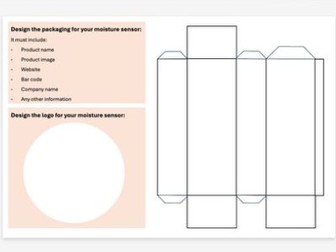
Help students develop their graphic design, branding, and product marketing skills with this engaging KS3 Design & Technology resource. Created to accompany a moisture sensor project, this workbook guides students through the process of generating logo ideas, developing a brand identity, and designing professional product packaging.
Using a series of structured design tasks, students explore different visual approaches to logo design before creating a final logo and packaging concept for their moisture sensor product. The resource encourages creativity while introducing key concepts such as branding, symbolism, target audience, product presentation, and commercial design.
Students experiment with a range of logo development techniques, including the use of symbols, typography, company names, and futuristic design styles, before applying their ideas to a realistic packaging net.
Perfect for:
KS3 Design & Technology
Electronics and smart product projects
Branding and packaging design units
STEM and product design activities
Cover lessons
Independent design work
What’s included:
2-page printable workbook
Structured logo development activities
Multiple design prompts to generate creative ideas
Packaging design template and net
Branding and marketing design tasks
Opportunities for iterative design and refinement
Suitable for Year 7, Year 8 and Year 9 students
Key Skills Developed:
Logo design
Brand identity creation
Packaging design
Graphic communication
Creative thinking
Product marketing
Design development and iteration
This ready-to-use resource helps students understand how successful products are branded and presented while providing an enjoyable, industry-inspired design challenge that links creativity with product design.


 Quick View