The Beauty of Hexagons-Tessellation-Drawing a HexagonQuick View
babarsaify

The Beauty of Hexagons-Tessellation-Drawing a Hexagon

(0)
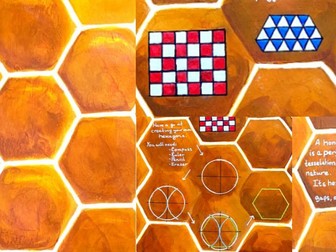
The Beauty of Hexagons Nature is one of the greatest mathematicians. Look closely at a honeycomb and you’ll discover a masterpiece built from one remarkable shape – the regular hexagon. This hand-painted artwork celebrates the perfect balance between art and mathematics, transforming a simple honeycomb into a vibrant visual reminder that maths is everywhere. Every brushstroke highlights the symmetry, precision and repeating patterns that make geometry both beautiful and practical. A regular hexagon is one of only three regular polygons that tessellate. Tessellation means shapes fit together perfectly, covering a surface with no gaps and no overlaps. The three regular shapes that tessellate are: Equilateral Triangle – 3 equal sides and 3 equal angles of 60°. Square – 4 equal sides and 4 right angles of 90°. Regular Hexagon – 6 equal sides and 6 equal angles of 120°. These shapes appear throughout architecture, engineering, design and the natural world, proving that mathematics creates both strength and beauty. Draw Your Own Regular Hexagon All you need is a compass, ruler, sharp pencil and eraser. Draw a circle using your compass. Without changing the compass width, place the compass point anywhere on the circle and mark the next point on the circumference. Repeat this process six times around the circle. Each step is exactly one radius long. Use a ruler to join the six points in order. Erase the circle if you wish, leaving a perfect regular hexagon. Repeat your hexagons side by side to create your own honeycomb tessellation. Add colour, patterns or shading to turn your mathematical construction into a unique piece of geometric art. Challenge Yourself: Can you explain why a regular pentagon cannot tessellate on its own? What makes triangles, squares and hexagons so special? Mathematics isn’t just about numbers—it’s about discovering the patterns that shape our world.
FIFA World Cup 2026 Footballers Maths CodebreakerQuick View
babarsaify

FIFA World Cup 2026 Footballers Maths Codebreaker

(0)
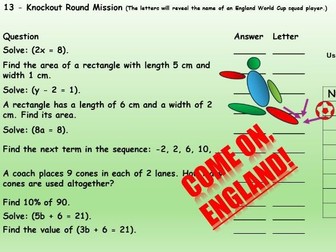
FIFA World Cup 2026 Footballers Codebreaker Maths Puzzle Can your students crack the code? This football-themed maths codebreaker activity contains 26 puzzles, each revealing the name of an England player taking part in the FIFA World Cup 2026. Suitable for KS3 Year 7 pupils, the puzzles develop reasoning, number skills and problem-solving in a fun and engaging way. Players are grouped into goalkeepers, defenders, midfielders and forwards, making this an ideal resource for lesson starters, cover work, maths clubs or end-of-term activities. Challenge your students to crack the code and uncover the names of England’s FIFA World Cup 2026 squad players! This engaging resource contains 26 maths codebreaker puzzles, with each puzzle revealing the name of a different England footballer. The players are organised by position: Goalkeepers Defenders Midfielders Forwards Designed specifically for KS3 Year 7 pupils, the puzzles provide an enjoyable way to practise mathematical reasoning, problem-solving and number skills while linking learning to the excitement of international football. What’s Included? 26 individual codebreaker puzzles England World Cup 2026 squad theme Organised by playing position Suitable for Year 7 / KS3 students Encourages logical thinking and problem-solving Ideal for lesson starters, plenaries, cover lessons, maths clubs or end-of-term activities Learning Benefits Develops mathematical fluency and reasoning skills Encourages perseverance and independent problem-solving Promotes engagement through a popular sporting theme Supports collaborative learning and discussion Perfect for teachers looking to combine maths with the excitement of the FIFA World Cup, keeping students motivated while reinforcing key KS3 skills. Age Range: 11–12 years (Year 7 / KS3) Subject: Mathematics Topic: Problem Solving, Reasoning, Codebreaking Activities Theme: England Football Team – FIFA World Cup 2026 filetype: Powerpoint