Two Degrees Novel Study | Character Cards, Vocabulary Posters & Classroom Display Pack (Grades 5–7)Quick View
andrewegerton

Two Degrees Novel Study | Character Cards, Vocabulary Posters & Classroom Display Pack (Grades 5–7)

(0)
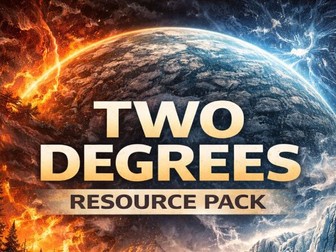
Bring your study of Two Degrees by Alan Gratz to life with this engaging and visually striking classroom display and resource pack. Designed for upper primary classrooms, this resource helps students connect with key characters, themes, and vocabulary while exploring the impact of climate change across multiple storylines. This pack includes high-quality, ready-to-print materials that support comprehension, discussion, and classroom engagement. What’s Included: Character Cards (main and supporting characters) Polar Bear Cards (key events and symbolism) Vocabulary Poster Set Thematic Display Posters Title/Cover Pages for classroom display Perfect For: Novel studies (Years 5–7) Classroom displays and visual learning walls Supporting comprehension and discussion Exploring themes of climate change and interconnected stories Key Features: Clear, student-friendly content Visually engaging, high-impact designs Easy to print and display Supports deeper understanding of characters and themes How to Use: Create a classroom display wall Use character cards for discussion or revision Introduce and reinforce key vocabulary Support inquiry into climate change themes
Weme Game Recording Sheet | Probability & Data (F–6)Quick View
andrewegerton

Weme Game Recording Sheet | Probability & Data (F–6)

(0)
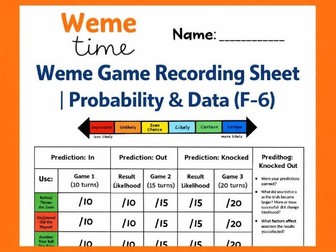
Support students in exploring probability, data collection, and prediction using this recording sheet designed for the traditional Indigenous game Weme. This resource provides a structured way for students to track outcomes, test predictions, and analyse results across multiple trials. It encourages mathematical thinking through hands-on gameplay and reflection. What’s included Recording sheet for tracking gameplay outcomes Prediction section (in, out, knocked, knocked out) Data collection across multiple game lengths (10, 15, and 20 turns) Likelihood scale to support probability understanding Reflection questions to encourage analysis and discussion How it works Students make predictions before playing and record outcomes during gameplay. As shown on page 1, results are tracked across multiple trials, allowing students to compare outcomes and identify patterns . On page 2, reflection questions guide students to evaluate their predictions and consider how results change over time . Perfect for Maths lessons (probability and statistics) Inquiry-based learning Outdoor or active maths sessions Linking mathematics with cultural learning Key features Combines physical activity with mathematical thinking Supports prediction, data collection, and analysis Encourages discussion and reasoning Easy to use with minimal preparation Important note This resource is designed to support learning through gameplay. Teachers may wish to introduce or explain the rules of Weme prior to use.
Circumnavigation of Australia | Flinders & BungareeQuick View
andrewegerton

Circumnavigation of Australia | Flinders & Bungaree

(0)
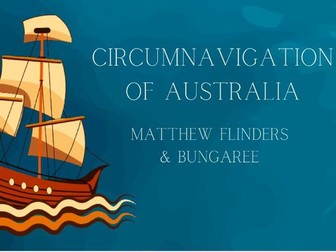
Teach the journey of Australia’s first circumnavigation with this clear and visually engaging slide presentation featuring Matthew Flinders and Bungaree. This resource provides a structured, chronological overview of the expedition, combining historical information with maps and visuals to support student understanding of key events, locations, and perspectives. What’s included 20+ slide presentation Key figures: Flinders and Bungaree Maps tracing the journey around Australia Key locations including Cape Leeuwin, Kangaroo Island and Port Phillip Historical context and interactions with Aboriginal peoples Perfect for History and HASS lessons (Years 4–6) Australian history units Whole-class teaching Inquiry-based learning Key features Clear, student-friendly language Visually engaging slides with maps and images Chronological structure to support understanding Includes both European and Aboriginal perspectives Example content Overview of Flinders’ circumnavigation and mapping of Australia The role of Bungaree as interpreter and guide Key stops such as Kangaroo Island and Port Phillip Challenges including ship damage and crew illness Curriculum links Aligned with Australian Curriculum (HASS/History), including exploration, colonisation, and historical perspectives.
Maths Games Links | 6 Levels from F–6Quick View
andrewegerton

Maths Games Links | 6 Levels from F–6

(0)
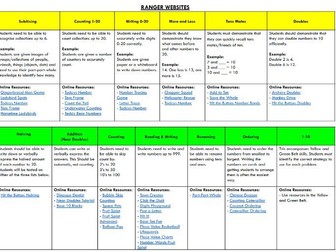
Support your student’s mathematical development through targeted, game-based learning with this structured collection of online maths activities. This resource includes 6 colour-coded levels, each aligned to key concepts identified in research by Di Siemon, focusing on the core skills students need to build strong number understanding and fluency. Levels & Focus Areas: Yellow (Foundation to Year 1) Subitising, counting (1 to 20), number formation (0 to 20), more/less, tens friends, doubles Green (Years 1 to 2) Halving, near doubles, counting, reading & writing numbers, renaming, ordering Pink (Years 3 to 4) Arrays, partitioning, renaming, fractions, ordering, multiplication, multiplicative thinking Black (Years 5 to 6) Multiplication, fractions, decimals, ordering, mental computation, renaming, multiplicative strategies Blue (Money - Across Levels) Coins and notes, value, ordering, totals, calculating change, financial planning, percentages Red (Time - Across Levels) Duration, hour/half hour/quarter hour, minutes, time conversion, AM/PM, timetables, elapsed time What is Included: 6 colour-coded levels for easy differentiation Curated links to engaging maths websites and games Coverage across key number and measurement concepts Ready-to-use format for immediate classroom implementation Perfect For: Maths rotations Early finishers Differentiated learning Independent practice Homework or home learning
The Giver Display Pack | Character Cards & Vocabulary (Y5–7)Quick View
andrewegerton

The Giver Display Pack | Character Cards & Vocabulary (Y5–7)

(0)
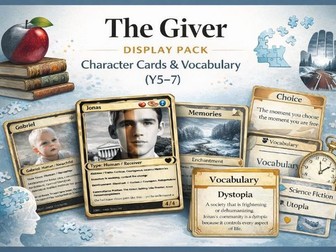
Bring your study of The Giver by Lois Lowry to life with this visually engaging classroom display pack. Designed for upper primary and lower secondary classrooms, this resource supports student understanding of key characters, themes, and vocabulary. The pack includes detailed character cards, symbolic elements, and vocabulary displays to help students explore the novel’s ideas of control, memory, and individuality. What’s included Character cards (Jonas, The Giver, Fiona, Asher, Gabriel, Lily and more) Symbol and theme cards (e.g. memories, choice, sameness, rules) Vocabulary display cards organised by lesson Cover/title page for classroom display How it supports learning Character cards provide clear summaries of traits, development, and relationships. For example, Jonas is shown progressing from obedient to independent, highlighting his role as a seeker of truth . Vocabulary cards introduce key terms such as utopia, dystopia, and science fiction, helping students understand the genre and themes of the novel . Symbol cards reinforce abstract ideas like memory and freedom, supporting deeper comprehension. Perfect for Novel studies (Years 5–7) Classroom display walls Supporting comprehension and discussion Exploring themes and vocabulary Key features Visually engaging and consistent design Clear, student-friendly explanations Supports character, theme, and vocabulary understanding Ready to print and display
Decimals & Measurement Activities | Compare, Order & Convert (Y4–6)Quick View
andrewegerton

Decimals & Measurement Activities | Compare, Order & Convert (Y4–6)

(0)
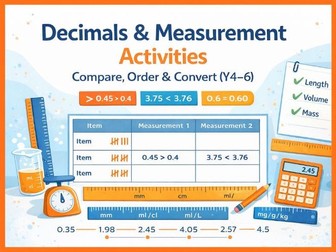
Support students in developing their understanding of decimals and measurement with this engaging set of activities covering comparison, ordering, and unit conversion. This resource includes a variety of tasks that encourage students to apply their knowledge of decimals in real-world contexts, including measuring length, volume, and mass. What’s included Decimal comparison tasks using greater than, less than and equal to Ordering decimal numbers from smallest to largest Measurement activities for length (mm, cm, m) Volume conversion tasks (ml, cl, L) Mass conversion tasks (mg, g, kg) Open-ended tables for recording and analysing results How it works Students compare and order decimal values before applying their understanding to measurement tasks. For example, page 1 includes real-world comparisons such as animal weights and ordering decimal numbers . Subsequent pages guide students through measuring and converting units, encouraging them to identify patterns and relationships between units. Perfect for Maths lessons (Years 4–6) Decimal understanding and fluency Measurement and unit conversion Independent work or small group tasks Key features Combines decimals with real-world measurement contexts Encourages reasoning and pattern recognition Open-ended tasks promote discussion and deeper thinking Easy to implement with minimal preparation
Decimal Place Value Posters | Whole, Tenths, Hundredths, Thousandths (A4)Quick View
andrewegerton

Decimal Place Value Posters | Whole, Tenths, Hundredths, Thousandths (A4)

(0)
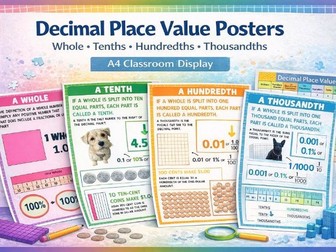
Support student understanding of decimal place value with this set of clear and visually engaging A4 posters. Each poster breaks down key concepts, helping students build a strong foundation in decimals through visual models, real-world examples, and clear explanations. What’s included A Whole (1.00) Tenths (0.1 / 1/10 / 10%) Hundredths (0.01 / 1/100 / 1%) Thousandths (0.001 / 1/1000 / 0.1%) How to read decimal numbers Decimal place value chart and rounding guide How it supports learning Each poster introduces a concept visually and numerically. For example, the whole number poster explains that a whole has no fractional part and represents 100% . The tenths, hundredths, and thousandths posters build progressively, showing how a whole is divided into equal parts and where each value sits on the decimal place chart . Later posters extend understanding by showing how to read decimal numbers and how to round them correctly. Perfect for Maths walls and classroom displays Introducing decimal concepts Supporting visual learners Reinforcing place value understanding Key features A4 printable posters Clear definitions and examples Visual models to support understanding Progressive structure from whole to thousandths