IGCSE PE: The Respiratory System – Revision SuiteQuick View
ReviseDirect

IGCSE PE: The Respiratory System – Revision Suite

(0)
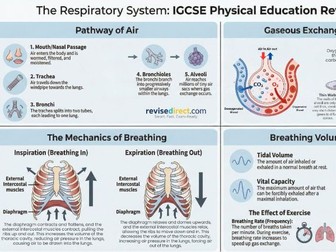
IGCSE PE: The Respiratory System Suite – Exam Practice & Revision Smart. Fast. Exam-Ready. Created for Cambridge IGCSE Physical Education (0413) but fully aligned with all major GCSE PE syllabuses (AQA, Edexcel, OCR, WJEC/Eduqas). What’s in the Pack? Detailed Infographic: A high-impact visual map covering the Pathway of Air, the Mechanics of Breathing (Inspiration vs. Expiration), and the Key Features of Alveoli that facilitate gas exchange. Targeted Exam Practice: Questions specifically styled after IGCSE papers, focusing on Breathing Volumes (Tidal, Vital, and Residual) and the physiological Effects of Exercise. Model Answers: Full mark schemes included. Use these to show students exactly how to structure responses to “Describe” and “Explain” questions to secure maximum marks. Audio & Video Support: Includes a “Mechanics of Breathing” Explainer Video and a Respiratory System Revision Podcast (MP3) for learning on the go. Zero Prep: Everything is ready to print or play the moment you download the folder. Syllabus Aligned: Fully mapped to current IGCSE PE requirements, ensuring students master the terminology of concentration gradients and pressure changes. Key Topics Covered: The Pathway of Air: From the nasal passage and trachea to the bronchioles and alveoli. Gaseous Exchange: How thin walls, large surface area, moist linings, and rich blood supply enable efficient diffusion. Mechanics of Breathing: The specific roles of the diaphragm and intercostal muscles during inspiration and expiration. Breathing Volumes: Clear definitions for Tidal Volume, Vital Capacity, and Residual Volume, plus the essential formula: Minute Ventilation = Breathing Rate x Tidal Volume My Classroom Tip: I love using the Revision Podcast as a “flipped learning” starter. I have students listen to it before the lesson so we can jump straight into the exam-style application tasks and analyze how the respiratory system adapts to high-intensity exercise. For more specialized resources, feel free to browse the rest of the Revisedirect shop.
AS Level PE: Muscle Contractions & Fibre TypesQuick View
ReviseDirect

AS Level PE: Muscle Contractions & Fibre Types

(0)
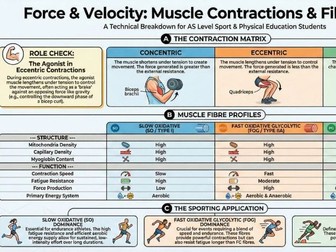
AS Level PE: Force, Velocity and Muscle Fibres – Exam Practice & Revision Smart. Fast. Exam-Ready. Specifically engineered for the Cambridge International AS Level Sport & Physical Education (8386) syllabus, focusing on the technical mechanics of muscular contraction and physiological profiling. What’s in the Pack? Technical Infographic: A high-level visual breakdown of the Contraction Matrix (Concentric, Eccentric, and Isometric) and the detailed Muscle Fibre Profiles (SO, FOG, and FG). Targeted Exam Practice: Questions styled after AS Level papers, requiring students to analyze the relationship between force and velocity and identify specific fiber dominance in elite sporting examples. Model Answers: Full mark schemes designed to help students master the technical language needed for high-weighting “Analyze” and “Evaluate” questions. Audio & Video Support: Includes a “Mechanics of Movement” Explainer Video and a Muscular System Revision Podcast (MP3) for comprehensive reinforcement of AS Level concepts. Zero Prep: Fully optimized and ready to use in the classroom or for independent study immediately upon download. Syllabus Aligned: Mapped to the 8386 specification to ensure students understand the structural and functional differences between Type I, Type IIa, and Type IIb fibers. Key Technical Topics Covered: The Contraction Matrix: Understanding how the Agonist functions as a ‘brake’ during eccentric contractions and how tension is generated without length change in isometric contractions. Structure of Muscle Fibres: Comparative data on Mitochondria density, Capillary density, and Myoglobin content across SO, FOG, and FG fibers. Functional Characteristics: Detailed analysis of contraction speed, fatigue resistance, and force production. Sporting Application: Identifying which fiber types define elite power athletes versus endurance athletes and the primary energy systems they utilize. My Classroom Tip: For AS Level students, I use the “Muscle Fibre Profiles” table as a data-interpretation task. I provide the structural data (like mitochondrial density) and ask students to predict the resulting functional characteristics (like fatigue resistance) before checking the infographic for the answers. For more specialized IGCSE and AS Level resources, feel free to browse the rest of the Revisedirect shop.
AS Level PE: Joints, Movement and Muscles RevisionQuick View
ReviseDirect

AS Level PE: Joints, Movement and Muscles Revision

(0)
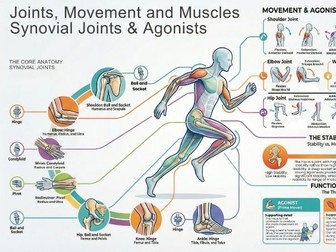
This revision pack provides a high-level deep dive into the musculoskeletal system, specifically designed to meet the advanced requirements of the 8386 specification. It transitions students from basic anatomy to complex movement analysis. This is built for AS Level Sport & Physical Education (8386) although the topic is relevant for all ssyllabuses. The “4-in-1” Learning Pack Includes: Premium Infographic: A high-resolution visual guide covering: Synovial Joint Classification: Hinge, Ball and Socket, Condyloid, and Pivot joints. The Stability-Mobility Axis: Analysis of how joint structure (e.g., Hip vs. Shoulder) dictates the relationship between range of motion and stability. Detailed Agonist Gallery: Visual mapping of muscle actions across the shoulder, elbow, wrist, radioulnar, hip, knee, and ankle joints. Revision Podcast: An engaging audio guide focusing on the functional roles of muscles perfect for “on-the-go” revision. Video Explainer: A concise visual breakdown of joint mechanics and the bones involved (Humerus, Scapula, Radius, Ulna, etc.). Exam-Style Questions: Targeted practice questions designed to mirror the Cambridge exam style, focusing on application to sporting examples. Core Topics Covered: Joint Actions: Flexion, Extension, Abduction, Adduction, Circumduction, Pronation, Supination, and Plantar/Dorsiflexion. Functional Muscle Roles: A clear breakdown of Agonists (Prime Movers), Antagonists, and Fixators (e.g., the role of the rotator cuff in a tennis drive). Anatomical Specificity: Identification of specific bones and muscles involved in complex sporting movements. Why Choose This ? Specification Specific: Built for the Cambridge AS PE 8386 syllabus. Multi-Modal Learning: Supports visual, auditory, and kinesthetic learners. Zero Prep: Professional, “plug-and-play” resources ready for the classroom.
IGCSE PE: Joints & Movement – Revision SuiteQuick View
ReviseDirect

IGCSE PE: Joints & Movement – Revision Suite

(0)
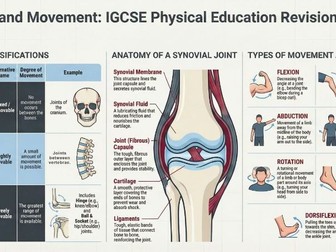
IGCSE PE: Joints & Movement – Revision Suite Smart. Fast. Exam-Ready. This is a “plug-and-play” suite for Section 2 of the IGCSE PE syllabus. Designed to master the mechanics of movement without the prep time. What’s in the Pack? Detailed Infographic: Clear visual guide to synovial joints (hinge, ball and socket) and types of movement (flexion, extension, adduction, abduction, rotation). Targeted Exam Practice: IGCSE-style questions focusing on articulating bones and identifying movement types in specific sporting examples. Model Answers: Full mark schemes included to teach students how to use technical terminology to hit every mark. Audio & Video Support: Includes an Explainer Video and a Revision Podcast (MP3). Ideal for flipped learning or independent student revision. Teacher Benefits Zero Prep: Ready to print or play the moment you download the folder. Syllabus Aligned: Fully mapped to current IGCSE requirements for Anatomy and Physiology. Classroom Tip: Use the podcast to help students “narrate” a sporting movement, like a tennis serve, to connect theory to real-world performance.
IGCSE / GCSE PE: Muscular System - Revision SuiteQuick View
ReviseDirect

IGCSE / GCSE PE: Muscular System - Revision Suite

(0)
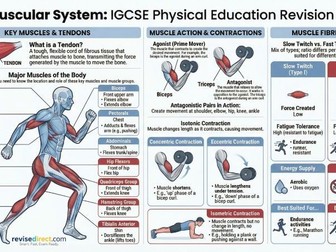
IGCSE PE: The Muscular System Suite – Exam Practice & Revision Smart. Fast. Exam-Ready. Created for Cambridge IGCSE Physical Education (0413) but fully aligned with all major GCSE PE syllabuses (AQA, Edexcel, OCR, WJEC/Eduqas) What’s in the Pack? Detailed Infographic: A high-impact visual map of the major superficial muscles and the mechanics of antagonistic pairs. Targeted Exam Practice: Questions specifically styled after IGCSE papers, focusing on muscle fiber types (Slow vs. Fast Twitch) and types of muscle contraction (Isotonic vs. Isometric). Model Answers: Full mark schemes included. Use these to show students exactly how to pick up “analyze” and “apply” marks in high-weighting questions. Audio & Video Support: Includes a “Mechanics of Movement” Explainer Video and a Muscular System Revision Podcast (MP3). Zero Prep: Everything is ready to print or play the moment you download the folder. Syllabus Aligned: Fully mapped to current IGCSE PE requirements to ensure your students are focusing on the content that actually appears in the exam. My Classroom Tip: I love using the Revision Podcast as a “flipped learning” starter. I have students listen to it before the lesson so we can jump straight into the exam-style application tasks. For more specialized resources, feel free to browse the rest of the Revisedirect shop.
IGCSE PE: The Skeleton – Revision SuiteQuick View
ReviseDirect

IGCSE PE: The Skeleton – Revision Suite

(0)
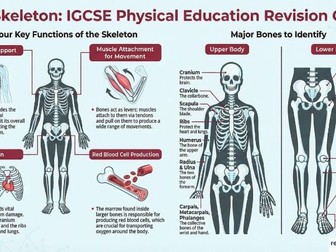
IGCSE PE: The Skeleton Suite – Exam Practice & Revision Smart. Fast. Exam-Ready. What’s in the Pack? Detailed Infographic: A clear visual map of the major bones and the four key skeletal functions. **Targeted Exam Practice: ** Questions specifically styled after IGCSE papers, focusing on synovial joints and bone production. Model Answers: Full mark schemes included. I use these to show students exactly where the “explain” marks are won. ** Audio & Video Support** : Includes an Explainer Video and a Revision Podcast (MP3). Zero Prep: Everything is ready to print or play the moment you download the folder. Syllabus Aligned: Fully mapped to current IGCSE requirements to ensure your students are studying the right content. My Classroom Tip: I often set the podcast as an “active recovery” task or homework. It’s a great way to get students revision-ready without them feeling like they are just staring at a textbook. For more specialized PE resources, feel free to browse the rest of the Revisedirect shop.