Rationalising the Denominator Worksheet - SurdsQuick View
JGoodens

Rationalising the Denominator Worksheet - Surds

(0)
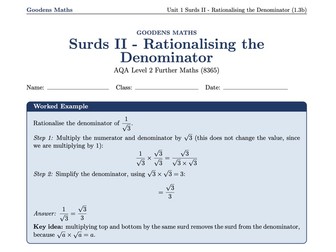
An AQA Level 2 Further Maths (8365) worksheet on rationalising the denominator, covering single-surd and binomial (conjugate) denominators, with full worked answers. Rationalising the denominator means rewriting a fraction so no surd is left on the bottom — a skill that comes up constantly in GCSE and A-level algebra and trigonometry. The worksheet opens with two worked examples: rationalising a single surd denominator by multiplying top and bottom by that same surd, then rationalising a binomial denominator (like 2 + √3) using its conjugate, which produces the difference of two squares and removes the surd completely. Three differentiated tiers follow: Fluency (single surd denominators), Reasoning (binomial denominators using the conjugate method), and Problem Solving (multi-step questions combining simplifying and rationalising, plus contextualised area and geometry problems that require rationalising as an intermediate step rather than the final answer). Full worked solutions are provided on the final pages, making this suitable for independent study, homework, or self-marking This is the second worksheet in the Surds sequence, following directly on from Surds I: Simplifying and Manipulating — students should be comfortable simplifying surds and using the difference of two squares before starting this one. Aimed at high-attaining Year 10/11 students taking the AQA Level 2 Certificate in Further Mathematics (8365) alongside GCSE, and at students bridging into A-level Maths, where rationalising denominators is assumed knowledge from the first topic on surds.\ Two PDF versions are included: a standard printable copy with name/class/date fields, and a name-free version for digital display. Last updated: 12th July 2026.
Surds - Simplifying and Manipulating WorksheetQuick View
JGoodens

Surds - Simplifying and Manipulating Worksheet

(0)
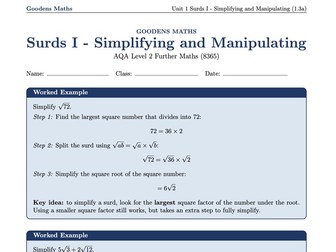
An AQA Level 2 Further Maths (8365) worksheet on simplifying and manipulating surds, covering surd rules, combining like surds, and expanding brackets, with full worked answers. A surd is a root (like √2 or √18) that can’t be simplified to a whole number — this worksheet builds the core skills for handling them algebraically. It opens with two worked examples: simplifying a surd by finding its largest square factor, and combining “like surds” by adding or subtracting coefficients once every term is fully simplified. From there it moves through three differentiated tiers: Fluency (simplifying surds fully), Reasoning (combining and multiplying surds, including questions where terms look unlike but simplify to the same root), and Problem Solving (expanding single and double brackets involving surds, plus two contextualised area/perimeter questions). The final problem-solving questions introduce the difference of two squares with surds — showing students why expressions like (√5 + 2)(√5 − 2) always cancel to a rational number, a result they’ll rely on again when rationalising denominators. Full worked solutions are included on the final pages, so this works for independent study, homework, or self-marking in class. This is the first in a two-part surds sequence (Surds I: simplifying and manipulating), aimed at high-attaining Year 10/11 students taking the AQA Level 2 Certificate in Further Mathematics (8365) alongside GCSE, and at students bridging into A-level Maths, where fluency with surds is assumed from the first week. Two PDF versions are included: a standard printable copy with name/class/date fields, and a name-free version for digital display. Last updated: 12th July 2026.
Number Toolkit & Product Rule for Counting WorksheetQuick View
JGoodens

Number Toolkit & Product Rule for Counting Worksheet

(0)
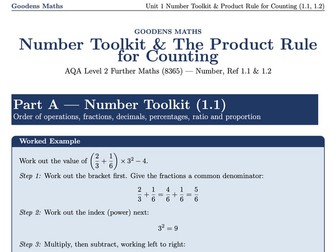
A two-part AQA Level 2 Further Maths (8365) worksheet covering the Number Toolkit (1.1) and the Product Rule for Counting (1.2), with full worked answers included. Part A revises the non-calculator toolkit that underpins the whole Further Maths course: order of operations (BIDMAS) applied to fractions and indices, reverse percentage problems, and ratio and proportion including direct proportion. Part B introduces the product rule for counting — the multiplicative method used to count independent choices, arrangements and codes — including restricted cases such as “must be odd” or “no repetition allowed,” which trip up most students on first meeting. Each topic opens with two fully worked examples before moving into three differentiated question sets: Fluency (straightforward practice), Reasoning (applied questions requiring explanation), and Problem Solving (multi-step, real-world contexts like sale prices, recipes and population growth). Full worked solutions are provided on the final pages, so the resource works equally well for independent study, homework, or self-marking in class. This worksheet suits high-attaining Year 10/11 students taking the AQA Level 2 Certificate in Further Mathematics (8365) alongside GCSE, and doubles as a bridging resource for students about to start A-level Maths, since the product rule for counting is a first step toward permutations and combinations. Two PDF versions are included: a standard printable copy with name/class/date fields, and a name-free version for digital display or projecting to the whole class without a header box. Last updated: 12th July 2026.