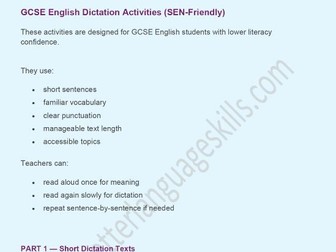
This resource should help students build greater confidence in identifying and becoming familiarized with some of the key terms required for GCSE English Language.
It also lays out a clear curriculum structure for teaching vocabulary during the course of the academic year.
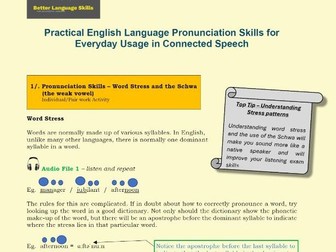
Practical tips and exercises with audio files to help improve your EFL students’ understanding of connected speech in English as well as their overall pronunciation skills. Includes the following;
Word stress and use of the Schwa
Sentence stress - Content & Structure words
Vowel & Dipthong sounds
Linking
Elision
Intrusion
Gist listening
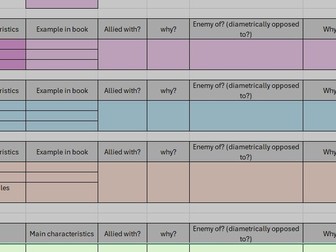
This spreadsheet provides a structure for students studying the French film, La Haine, to revise by filling in the necessary boxes largely centered around the characters, the main themes and the film director’s techniques. I hope this can be helpful to you.
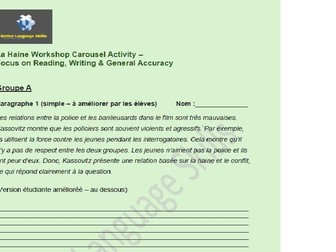
This group carousel resource should allow your students to refine their reading, writing, translation, error-correction and accuracy skills whilst focusing on La Haine. There is a supplementary activity students can do, which is to focus on writing (and improving) an introduction and conclusion to the body of an essay on La Haine. Good luck!
Why this works well for A-level French?
• Constant student-student interaction
• Exam-style skills: reformulation, opinions, justification
• Low-stress speaking (no audience)
• Competition without anxiety
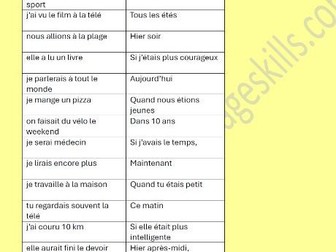
This practical resource covers the following tenses;
• Imperfect
• Passé Composé
• Pluperfect
• Future
• Conditional (si-Clauses)
• Present subjunctive
Instructions;
Cut out the cards (dominoes) and distribute face down to students in small groups.
Students select 4 cards each.
Once the 1st student plays his/her dominoe, the next students must then try to build on that by joining a dominoe and thus completing a sentence.
If a student cannot go, he/she should pick up a face down dominoe and misses a turn.
The winner is the student who can get get rid of his/her dominoes the fastest by ‘tagging’ them onto the face-up dominoes already put down by the group of the students.
Suggestion;
• Students could try to name the tense in each case and translate into English aloud on putting down his/her card.
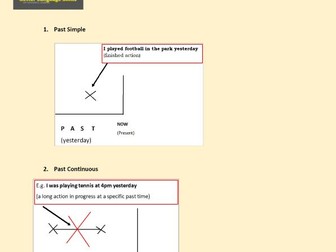
These visual graphs may help your students to better understand the nuances between the past tenses in English so that they become more familiarized and are able to use them with grater confidence.
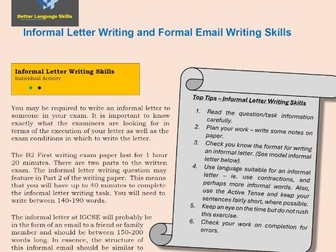
This resource should provide your students with some clarity about how to write an informal letter and a formal email in preparation for the IELTS, B2 First & IGCSE English Language exams.
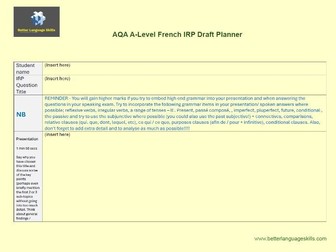
This resource should be useful in helping you plan and prepare your IRP in a clear and structured way and should provide you with the basis for a successful IRP. Good Luck!
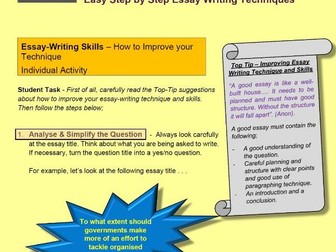
If you are nervous about having to write essays in English, this resource will give you a helping hand as to how effectively plan, draft and write out your essay into one coherent piece.
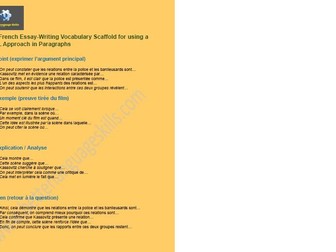
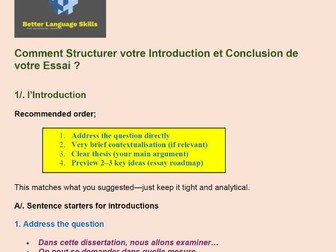
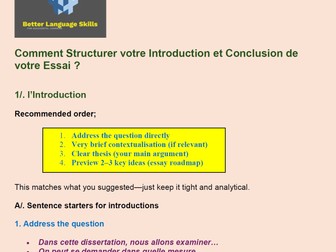
This resource may be helpful to anyone wishing to refine their essay-writing skills at French A-Level. Knowing how to start and finish an essay will give students confidence going forward and allow you to build the basis of a good essay, (something which A-Level French students can find tricky).
Learn how to develop successful essay writing skills for A-Level French with these practical resources which will allow you to;
plan succinctly
write effective introductions and conclusions with useful language tips.
write paragraphs using a PEEL structure
develop your level of analysis (in order to reach higher marks)
provide you with useful expressions involving high-tier vocabulary and grammar structures to obtain higher marks.
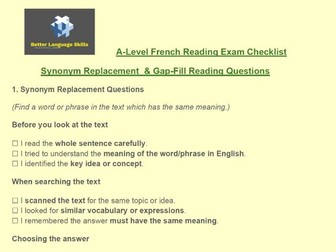
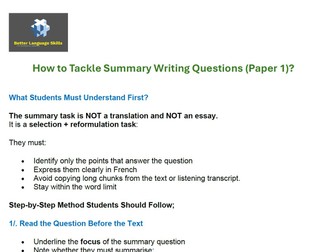
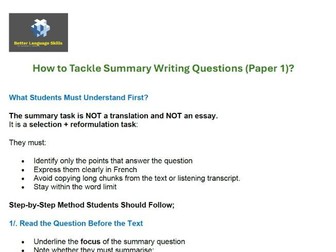
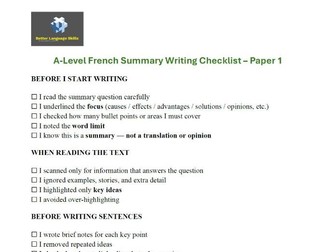
These practical resources should help you obtain a better understanding of the requirements needed to tackle summary writing exercises for AQA A-Level French, (which are often considered to be one of the more challenging aspects of the Paper 1 exam.
Some guidelines as to how to successfully improve on your summary writings for the Paper 1 French exam - which are often considered to be some of the most difficult questions.


 Quick View