VCE Psychology Unit 3 Memory Revision PackQuick View
TBSakari

VCE Psychology Unit 3 Memory Revision Pack

(0)
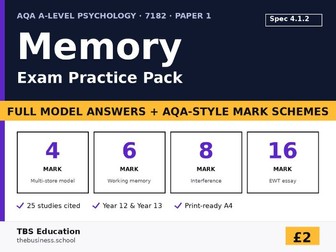
A 15-page exam revision pack for VCE Psychology Unit 3 Area of Study 2, fully aligned to the VCAA Study Design 2023-2027. Covers the Atkinson-Shiffrin multi-store model, all four types of long-term memory, the five named brain regions (hippocampus, amygdala, neocortex, basal ganglia, cerebellum), autobiographical reconstruction with Loftus’s 1974 leading-question study, and mnemonics including Songlines. What’s inside (15 pages): Knowledge Organiser 1: Atkinson-Shiffrin model - function, capacity, duration and encoding for sensory, STM and LTM, plus the key processes between stores and the most common student mistakes flagged in past examiners’ reports. Knowledge Organiser 2: Types of LTM - episodic, semantic, procedural and classically conditioned - with worked examples and the brain region most involved in each. Knowledge Organiser 3: The five named brain regions with location, role in memory and a quick-recall mapping table linking each region to the type of LTM it supports. Knowledge Organiser 4: Autobiographical reconstruction, Loftus’s ‘smashed/hit’ study (1974), the three named mnemonics (acronyms, acrostics, method of loci) and Songlines as an Aboriginal and Torres Strait Islander oral mnemonic system. Practice exam Section A: 15 multiple-choice questions in the four-option VCAA format. Practice exam Section B: 4 short-answer questions (2, 3, 4, 4 marks). Practice exam Section C: 1 ten-mark extended-response question with three required components and stimulus. Marking guide (teacher copy): MC key with examiner notes; short-answer marking with mark-by-mark allocations and common errors; extended-response component table. Why teachers like this pack: Every question references the relevant VCAA Key Knowledge dot point. Examples use real named studies (Atkinson & Shiffrin 1968; Miller 1956; Loftus 1974; case of patient H.M.). Mark schemes follow the structure of recent VCAA examiners’ reports - credit specific psychological reasoning, not generic statements. Clean, print-ready A4 layout. No clip art. Looks like a VCAA publication. Answer key prints separately so students see only the questions. How to use: Print pages 2-5 as a stand-alone revision booklet for students. Print pages 6-7 (questions only) for in-class assessment or homework. Keep pages 8-12 (marking guide) for staff use. Total: 38 marks across the practice exam.
AQA A-Level Business 25-Mark Essay ToolkitQuick View
TBSakari

AQA A-Level Business 25-Mark Essay Toolkit

(0)
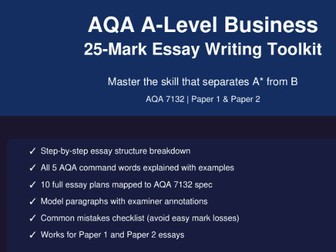
13 pages. 10 full essay plans. Model paragraphs with examiner annotations. All mapped to the AQA 7132 spec. The 25-mark essay is worth more marks than any other question on the AQA A-Level Business paper — and it’s the one students find hardest. Most students know the content but lose marks because they don’t know how to structure an argument, how to hit all four AOs in a single paragraph, or what examiners actually mean by “evaluate” vs “assess”. This toolkit fixes that. It’s 13 pages of practical, ready-to-use material that takes students from “I know the theory but can’t write it under pressure” to “I can plan and write a 25-mark essay in 40 minutes.” The 4-Part Essay Framework A clear, repeatable essay structure broken into four sections: Introduction, Arguments FOR, Arguments AGAINST, and Judgement. Each section shows exactly which AOs are being targeted (AO1 Knowledge, AO2 Application, AO3 Analysis, AO4 Evaluation) and how many marks are available per section. Students stop guessing what goes where and start writing with purpose. AQA Command Word Guide Students often write the same essay regardless of whether the question says “evaluate”, “assess”, “to what extent”, or “discuss”. This page breaks down what each command word actually requires in terms of structure and depth. For example: “To what extent” demands a clear position in the judgement with conditions — not just a vague “it depends”. The difference between a 15-mark and a 21-mark essay often comes down to this. 10 Detailed Essay Plans (AQA Spec Topics 3.1-3.8) Each essay plan gives students a full skeleton they can adapt: a clear question, two or three FOR arguments with real-business evidence, two or three AGAINST arguments, and a reasoned judgement. Every plan uses a named business so students see what genuine application (AO2) looks like — not generic “a business might…” filler.
AQA A-Level Business 3.5 Financial Decision Making — Complete Teaching Bundle (7 Resources)Quick View
TBSakari

AQA A-Level Business 3.5 Financial Decision Making — Complete Teaching Bundle (7 Resources)

(0)
A complete teaching bundle covering AQA A-Level Business Topic 3.5: Making Financial Decisions, mapped directly to the 2024 specification across all four subtopics (3.5.1–3.5.4). What’s included (7 resources): 4 × Lesson Slide Decks (PowerPoint, fully editable): Lesson 3.5.1 — Setting Financial Objectives (10 slides): Greggs case study — £1.8bn revenue, 10.4% operating margin, 145 new stores. Covers revenue, cost, and profit objectives with real financial data. Lesson 3.5.2 — Analysing Financial Performance (9 slides): Tesco vs Sainsbury’s ratio comparison — gross profit margin, operating margin, ROCE, gearing, current ratio using 2024 annual report figures. Lesson 3.5.3 — Sources of Finance (9 slides): BrewDog case study — £213m private equity deal, £90m Equity for Punks crowdfunding, £400m debt refinancing. Internal vs external, short vs long-term. Lesson 3.5.4 — Improving Cash Flow and Profits (10 slides): Ryanair case study — €13.4bn revenue, 14.3% net margin, 183.5m passengers. Cash flow forecasting, working capital management, profit improvement strategies. 1 × Worksheet Pack (PDF, 4 pages, printable): One worksheet per subtopic with real company case study context, short-answer questions (Section A), and a 12-mark extended response (Section B). Full AQA-style mark schemes included for every question (Knowledge 1–2, Application 2–4, Analysis 4–6, Evaluation 6–10). 1 × Exam Practice Pack (PDF, printable): Three 25-mark exam-style questions with detailed company extracts (Greggs, BrewDog, Gymshark vs JD Sports). Each question follows AQA’s 2+4+9+10 mark structure with full level descriptors and indicative content. Ideal for timed practice, homework, or mock preparation. 1 × Knowledge Organiser (PDF, landscape A4, printable): Single-page revision resource covering all four subtopics — key definitions, formulae (gross profit margin, operating margin, ROCE, gearing, current ratio, break-even), and real company data points. Colour-coded columns for quick reference during revision. All resources use real companies with real financial data — Greggs, Tesco, Sainsbury’s, BrewDog, Ryanair, Gymshark, JD Sports. No generic examples. Designed for AQA A-Level Business but also suitable for Edexcel/OCR with minor adaptation. Print-ready (grayscale-friendly, A4 layout).
AQA A-Level Business — Complete Knowledge Organiser (Topics 3.1–3.8) | 12 Pages | Print-FriendlyQuick View
TBSakari

AQA A-Level Business — Complete Knowledge Organiser (Topics 3.1–3.8) | 12 Pages | Print-Friendly

(0)
A complete 12-page knowledge organiser covering every topic in the AQA A-Level Business specification (3.1 through 3.8). Each page is a self-contained, single-topic summary designed for A4 printing in black and white — no colour printer needed. Topics covered in full: 3.1 What is business? — Mission, objectives, stakeholders, revenue/cost/profit calculations, supply and demand, PED and YED with worked examples, market structures 3.2 Managers, leadership and decision making — Management vs leadership, Tannenbaum-Schmidt and Blake Mouton models, decision trees with EMV calculations, stakeholder mapping 3.3 Decision making to improve marketing performance — STP, product life cycle with extension strategies, Boston Matrix, Fisher price sensitivity, digital marketing and e-commerce 3.4 Decision making to improve operational performance — Labour productivity formula, capacity utilisation calculations, lean production (JIT, Kaizen, cell), quality management (TQM, benchmarking) 3.5 Decision making to improve financial performance — Gross/operating/net profit margin formulas, ratio analysis (ROCE, current ratio, gearing), sources of finance comparison, breakeven with worked example 3.6 Decision making to improve human resource performance — Labour turnover and retention formulas, Herzberg two-factor theory, Maslow, employee engagement, flexible working 3.7 Analysing the strategic position of a business — SWOT, PESTLE, Porter’s Five Forces, Ansoff Matrix, Bartlett and Ghoshal framework, Elkington Triple Bottom Line 3.8 Choosing strategic direction and managing strategic change — Bowman’s Strategy Clock, mergers and takeovers, organic vs inorganic growth, Kotter and Schlesinger change management model, corporate culture (Handy) Every page includes key definitions in bold, formulas with calculation examples, named theorists and models with short explanations, and real-world business references (Apple, Tesco, Ryanair, JD Sports among others). How to use in your classroom: Print and laminate for classroom wall display — students see key terms daily Issue as a revision booklet at the start of Year 12 or Year 13 Use as a lesson starter: “find three key terms on this page you can’t define yet” Homework: students self-test using the organiser then mark their own answers Exam prep: students highlight areas they’re weakest on before mocks Designed specifically for the AQA 7132 specification (both AS and A-Level). All formulas match the exact wording AQA use in their mark schemes. 12 pages, A4, grayscale, print-ready. No preparation needed — download, print, hand out.
Six UK Business Failures — A-Level Business Case Study Pack with Worksheet, Mark Scheme & Teacher NoQuick View
TBSakari

Six UK Business Failures — A-Level Business Case Study Pack with Worksheet, Mark Scheme & Teacher No

(0)
A free 13-page A-Level Business case study pack — the only one focused entirely on recent UK business failures rather than success stories. Most A-Level case studies students see are about Apple, Costa or Greggs. This pack is the opposite. It puts six recent UK collapses on the desk: Carillion (2018), Thomas Cook (2019), BHS (2016), Patisserie Valerie (2019), Wilko (2023) and Debenhams (2020). WHAT’S INSIDE (13 pages, mostly black and white for the photocopier): • Six one-page case studies, each with: company background, key facts (revenue, debt, jobs lost, dates), why it failed (3 bullets), what students should remember (3 bullets), and Edexcel/AQA/OCR theme tags • A comparison matrix showing the three synoptic patterns examiners reward — dividend extraction (BHS + Wilko), external shocks meeting structural weakness (Thomas Cook + Debenhams), and “cash flow tells the truth” (Carillion + Patisserie Valerie) • Six exam-style questions ranging 12–25 marks — Edexcel evaluation, AQA analysis, OCR-style synoptic, AQA 25-mark • A printable Student Activity Sheet with one fillable box per case for active recall • Teacher Delivery Notes — likely student misconceptions, pause-and- discuss prompts, and stretch / SEND differentiation suggestions per case, plus three universal pitfalls to flag before students write • Full Levels 1–4 mark scheme for two of the 16-mark questions (Thomas Cook and Patisserie Valerie) • Specification mapping for Edexcel 9BS0, AQA 7132 and OCR H431 BEST USED FOR: Year 13 mock-exam preparation and synoptic 16-mark answer practice. Students who reach for these failures rather than the standard success stories tend to score one band higher because they are using evidence fewer of their peers will use. Print-ready, no sign-up, no email. Free for UK A-Level, BTEC and IGCSE Business teachers.
Greggs plc: A Case Study in Business Growth — A-Level Business Studies Worksheet + Mark SchemeQuick View
TBSakari

Greggs plc: A Case Study in Business Growth — A-Level Business Studies Worksheet + Mark Scheme

(0)
A ready-to-use, printer-friendly case study worksheet based on Greggs plc, covering business growth, financial performance, and strategic decision-making. Includes real financial data (2019–2023), 7 structured questions across short answer, data response, and extended response sections (54 marks total), plus a full AQA-style mark scheme with AO1–AO4 descriptors. Aligned to AQA, Edexcel, OCR and WJEC A-Level Business specifications. Just print and go — no prep needed.
Free Flexible A-Level Business Simulation  - demo licence includedQuick View
TBSakari

Free Flexible A-Level Business Simulation - demo licence included

(0)
Free live business simulation for A-Level Business teachers — full demo licence included inside (no signup, no email). TRY IT FIRST IN SOLO PRACTICE (3 minutes) Before running with your class, click “Solo Practice” on the welcome screen — no PIN, no licence needed. Play one phase yourself against four AI competitor firms. You’ll see exactly how it works in 3 minutes, then you’re ready to run a real session with your students. YOU CONTROL THE PACE The simulation works in any lesson length you have. Default suggestion is 60 minutes split across 3 phases (15 min each), but you decide: • 30-min lesson? Run shorter phases (~8 min each), advance with the Next Phase button when ready. • 60-min standard lesson? Use the default 15-min phases. • 90-min double lesson? Let phases run to ~25 min for deeper play. • 45-min revision drop-in? Run a single phase as a stand-alone activity. The countdown clock is just a guide. Your “Next Phase” button is the real control. Pause anytime for class discussion. WHAT’S INCLUDED IN THE 2-PAGE TEACHER QUICK START GUIDE • A working demo licence key — type it in and run a real session in your classroom • Step-by-step instructions: create a session, project the PIN, run the 3 phases, end the lesson • Role descriptions (CEO, CFO, CMO, CHRO, COO, Sales Director) • Scoring breakdown (out of 100 points) • 30-second class script and on-the-day checklist HOW IT WORKS Each student logs in on their own device, gets auto-assigned to a competing firm, and runs a live business across 3 phases (Incorporation, Crisis, Final Sprint). The teacher controls the pace, triggers market crisis events (Tax Hike, Recession, Supply Shock) and ESG dilemmas, pauses for discussion at any point, and downloads a class report at the end. Browser-only, no install, works on any device — phone, tablet, Chromebook or laptop. Aligned with AQA 7132, Edexcel 9BS0, OCR H431, and Pearson BTEC Level 3 specifications. Built in Finland. Engineered by Appifest, Sydney. UK GDPR compliant. ICO Registered: ZC133810. BESA applicant.
AQA GCSE Business Key Terms Flashcards — 168 Terms | Print, Cut & Use | All Topics CoveredQuick View
TBSakari

AQA GCSE Business Key Terms Flashcards — 168 Terms | Print, Cut & Use | All Topics Covered

(0)
A set of 168 key term flashcards covering the full AQA GCSE Business specification (both Paper 1 and Paper 2 topics). Each card has the term on one side and a clear, exam-ready definition on the other. Printed on A4 sheets with 6 cards per page — 28 pages total. Cut along the lines and you have a complete set of revision flashcards ready to use. All six GCSE Business topics are covered: Topic 1 — Business in the real world: Enterprise, risk, reward, opportunity cost, business plan, sole trader, partnership, Ltd, PLC, franchise, stakeholder, aims, objectives, revenue, cost, profit, break-even Topic 2 — Influences on business: Technology, ethical, environmental, economic climate, globalisation, exchange rates, legislation (consumer rights, employment law, health and safety), competitive environment, unemployment Topic 3 — Business operations: Procurement, quality control, quality assurance, customer service, supply chain, bar gate stock diagram, lean production, JIT, economies/diseconomies of scale Topic 4 — Human resources: Organisational structures, span of control, chain of command, delegation, communication, recruitment, selection, training (induction, on-the-job, off-the-job), motivation (Taylor, Maslow, Herzberg, Mayo) Topic 5 — Marketing: Market research (primary, secondary, qualitative, quantitative), market segmentation, marketing mix (4Ps), product life cycle, extension strategies, Boston Matrix, pricing strategies (penetration, skimming, competitive, cost-plus) Topic 6 — Finance: Cash flow forecast, income statement, balance sheet, gross profit, net profit, gross profit margin, net profit margin, ARR, sources of finance, break-even analysis Every definition is written in plain English that students can actually understand and memorise. No filler, no vague language — each definition is the kind of clear, specific answer that earns marks in an AQA exam. How to use in your classroom: Print a class set and let students cut them out — 10 minutes of focused activity Paired testing: one student reads the term, the other defines it Lesson starter: pick 5 random cards, students write definitions from memory Revision homework: students take a set home and self-test Sort activities: students group cards by topic or by “confident / not confident” Wall display: pin key terms around the room, rotate weekly Works for both Foundation and Higher tier students. Covers every key term that appears in AQA’s own specification glossary. 28 pages, A4, grayscale, print-ready. No laminator needed (though laminated sets last longer). Free resource — download, print, cut, use.