Pearson Edexcel iGCSE Chemistry 4XCH1 | Atomic Structure & Development of the Atom | Complete LessonQuick View
SAYB

Pearson Edexcel iGCSE Chemistry 4XCH1 | Atomic Structure & Development of the Atom | Complete Lesson

(0)
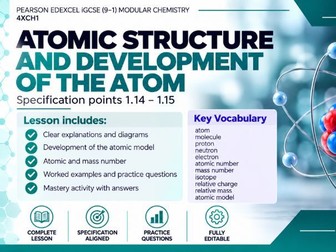
Complete ready-to-teach lesson for Pearson Edexcel International GCSE Chemistry (9–1) Modular 4XCH1, covering Atomic Structure and the Development of the Atomic Model (Specification Points 1.14–1.15). This fully editable 20-slide PowerPoint provides a structured lesson covering the fundamental ideas of atomic structure alongside how scientific understanding of the atom has developed as new experimental evidence has emerged. Students will learn to: define atom and molecule distinguish between atoms and molecules using chemical formulae describe the position, relative charge and relative mass of protons, neutrons and electrons describe how the atomic model developed over time understand the contributions of Dalton, Thomson, Rutherford and Bohr link experimental evidence, including Rutherford’s gold foil experiment, to changes in the atomic model define atomic number and mass number determine the numbers of protons, neutrons and electrons in atoms interpret standard atomic notation apply atomic structure knowledge to calculations and unfamiliar examples The lesson includes a clear visual timeline showing the progression from Dalton’s solid-sphere model through Thomson, Rutherford and Bohr to the modern atomic model, with emphasis on how new evidence led to improved scientific models. The resource includes: retrieval-based Do Now clear explanations of atoms and molecules visual molecular examples subatomic particle summary and comparison relative charge, relative mass and position of subatomic particles student checkpoint activities development of the atomic model timeline Rutherford gold foil experiment multiple-choice application and reasoning questions atomic number and mass number explanations worked examples proton, neutron and electron calculations structured independent practice Mastery of Key Skills activity complete answers for self-assessment final exit ticket The latter part of the lesson gives students substantial practice applying atomic and mass number relationships, including determining proton, neutron and electron numbers from nuclide notation. Suitable for: Pearson Edexcel International GCSE Chemistry (9–1) Modular specification 4XCH1 Atomic Structure | Development of the Atom | GCSE/iGCSE Chemistry First teaching | Consolidation | Revision | Intervention Resource type: Fully editable PowerPoint Slides: 20 Specification: 1.14–1.15 Answers included
Pearson Edexcel iGCSE Chemistry 4XCH1 | Isotopes & Relative Atomic Mass | Complete LessonQuick View
SAYB

Pearson Edexcel iGCSE Chemistry 4XCH1 | Isotopes & Relative Atomic Mass | Complete Lesson

(0)
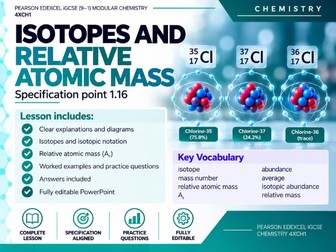
Complete ready-to-teach lesson for Pearson Edexcel International GCSE Chemistry (9–1) Modular 4XCH1, covering isotopes and relative atomic mass. This fully editable 16-slide PowerPoint develops students’ understanding of isotopes before progressing to the calculation and interpretation of relative atomic mass (Aᵣ). The lesson is carefully scaffolded from recalling atomic number, mass number, protons, neutrons and electrons to applying isotopic abundance data in increasingly challenging relative atomic mass calculations. Students first discover the similarities and differences between isotopes using chlorine before applying their understanding to unfamiliar examples. Students will learn to: define an isotope identify similarities and differences between isotopes of the same element determine numbers of protons, neutrons and electrons interpret isotope notation understand the meaning of relative atomic mass, Aᵣ understand isotopic abundance explain why relative atomic mass is often not a whole number calculate relative atomic mass from isotopic masses and percentage abundances interpret relative atomic mass in relation to the abundance of different isotopes The resource includes: retrieval-based Do Now discovery activity introducing isotopes isotope identification checkpoint atomic number and mass number practice clear explanation of relative atomic mass as a weighted mean relative atomic mass formula step-by-step worked example I Do / We Do / You Do calculation sequence prediction and reasoning questions multiple checkpoints throughout independent calculation practice worked answers for self-assessment final exit ticket The calculation section moves from a modelled chlorine example into scaffolded and independent problems, before students apply the method to examples including neon, silver, silicon and titanium. Suitable for: Pearson Edexcel International GCSE Chemistry (9–1) Modular specification 4XCH1 Isotopes | Relative Atomic Mass | Atomic Structure First teaching | Consolidation | Intervention | Revision Resource type: Fully editable PowerPoint Slides: 16 Answers included
NAFS Grade 9 Science | Crystalline & Amorphous Solids | Complete LessonQuick View
SAYB

NAFS Grade 9 Science | Crystalline & Amorphous Solids | Complete Lesson

(0)
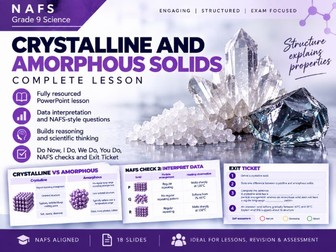
Complete ready-to-teach NAFS Grade 9 Science lesson on crystalline and amorphous solids, with a strong focus on scientific reasoning, data interpretation and application. This fully designed PowerPoint introduces students to the differences between crystalline and amorphous solids and develops their understanding of how particle arrangement affects the properties and heating behaviour of materials. Students progress from recalling the particle model to interpreting unfamiliar evidence and using particle arrangement and melting behaviour to classify materials. Students will learn to: Describe crystalline and amorphous solids Compare their particle arrangements Explain the difference between regular repeating and non-regular long-range structures Compare the heating behaviour of crystalline and amorphous materials Link particle structure to melting behaviour Use observations and data to classify unfamiliar solids Justify classifications using scientific evidence The resource includes: Do Now retrieval questions and answers Real-world examples including salt, quartz, glass, plastics, diamond and rubber Clear particle-model diagrams Crystalline vs amorphous comparison activities Heating and melting behaviour interpretation Checkpoint questions I Do, We Do and You Do structured practice Classification and evidence-based reasoning tasks NAFS-style multiple-choice questions NAFS data interpretation task Questions requiring students to explain relationships using evidence Exit ticket and student self-assessment The lesson places particular emphasis on moving beyond simple recall. Students are required to interpret information, identify evidence, classify unfamiliar materials and explain the relationship between microscopic particle arrangement and macroscopic properties. The later NAFS checks specifically include multiple-choice and data-interpretation questions. Suitable for: NAFS Grade 9 Science Grade 9 Chemistry / Physical Science Particle model and structure of matter Lesson teaching, consolidation, revision or NAFS preparation Resource type: 18-slide PowerPoint lesson
Saudi NAFS Grade 9 Science | Viscosity & Surface Tension | Complete LessonQuick View
SAYB

Saudi NAFS Grade 9 Science | Viscosity & Surface Tension | Complete Lesson

(0)
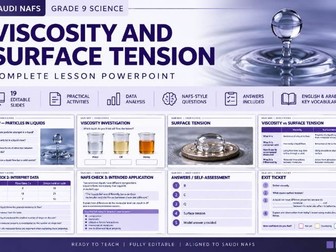
Complete ready-to-teach Grade 9 Science lesson designed to support Saudi NAFS preparation, covering viscosity, surface tension and the molecular properties of liquids. This fully editable PowerPoint provides a structured lesson on viscosity and surface tension, developing students from basic particle-model recall through to molecular-level explanations, data interpretation and NAFS-style application questions. Students will learn to: define viscosity and surface tension compare the viscosity of different liquids using observations and data explain viscosity in terms of molecular structure, movement and attractive forces explain surface tension using attractions between molecules at the surface of a liquid distinguish between viscosity and surface tension link the composition of a substance, molecular interactions and observable properties apply their understanding to unfamiliar data and scientific scenarios The resource includes: retrieval Do Now with answers viscosity prediction activity practical investigation comparing liquids clear explanations of viscosity and surface tension molecular-level diagrams and explanations data interpretation checkpoint surface tension demonstrations and applications I Do, We Do and You Do structured explanation practice comparison of viscosity and surface tension 3 dedicated NAFS Check activities multiple-choice questions data-analysis questions extended application and scientific reasoning model answers and self-assessment exit ticket English and Arabic key scientific vocabulary The lesson is designed to move students from recall and observation to explanation, data interpretation and application, with particular emphasis on explaining the properties of liquids using molecular ideas. Suitable for: Saudi NAFS preparation | Grade 9 Science | Chemistry | Properties of liquids | Revision | Intervention | Classroom teaching Resource: Fully editable PowerPoint Number of slides: 19
Pearson Edexcel iGCSE Chemistry 4XCH1 | Electrolysis & Half Equations | Complete LessonQuick View
SAYB

Pearson Edexcel iGCSE Chemistry 4XCH1 | Electrolysis & Half Equations | Complete Lesson

(0)
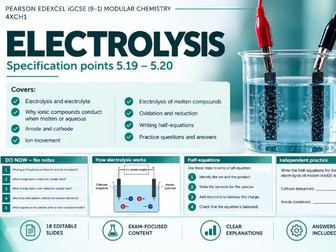
Complete ready-to-teach lesson for Pearson Edexcel International GCSE Chemistry (9–1) Modular 4XCH1, covering electrolysis, ion movement and half-equations. This fully editable PowerPoint provides a structured introduction to electrolysis, taking students from prior knowledge of ionic compounds through to predicting ion movement and writing balanced half-equations. Students will learn to: define electrolysis, electrolyte, anode, cathode, cation and anion explain why ionic compounds conduct electricity when molten or aqueous, but not when solid identify the anode and cathode predict which electrode positive and negative ions move towards explain the electrolysis of molten ionic compounds understand oxidation and reduction in terms of electron transfer write and balance half-equations apply their knowledge to unfamiliar ions and molten compounds The resource includes: retrieval Do Now with answers clear explanation of electrical conductivity in ionic substances visual particle-model explanations regular checkpoint questions labelled electrolysis cell cation and anion movement worked example using molten lead(II) bromide oxidation and reduction at the electrodes step-by-step method for writing half-equations scaffolded half-equation practice error-correction questions application and challenge questions differentiated independent practice answers for self-assessment exit ticket The lesson contains extensive opportunities for students to move from recall → explanation → application → independent exam-focused practice. The resource is designed specifically for Pearson Edexcel International GCSE Chemistry (9–1), Modular specification 4XCH1, with the introductory electrolysis content linked to specification points 5.19–5.20. Suitable for: Pearson Edexcel International GCSE Chemistry (9–1) | Modular 4XCH1 | GCSE/iGCSE Chemistry | Electrolysis | Classroom teaching | Revision | Intervention Resource type: Fully editable PowerPoint Slides: 18 Answers included
Pearson Edexcel iGCSE Chemistry 4XCH1 | Electrolysis at the Electrodes | Complete LessonQuick View
SAYB

Pearson Edexcel iGCSE Chemistry 4XCH1 | Electrolysis at the Electrodes | Complete Lesson

(0)
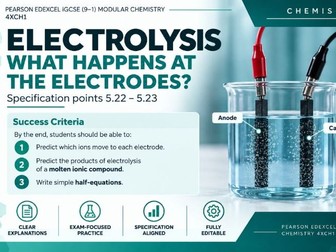
Complete ready-to-teach lesson for Pearson Edexcel International GCSE Chemistry (9–1) Modular 4XCH1, covering reactions and products at the electrodes during electrolysis. This fully editable PowerPoint develops students’ understanding of what happens at the anode and cathode, progressing from molten ionic compounds to predicting products in aqueous solutions and writing half-equations. Students will learn to: predict which ions move towards the anode and cathode predict the products formed during electrolysis of molten ionic compounds understand oxidation and reduction in terms of electron transfer write and balance half-equations distinguish between electrolysis of molten compounds and aqueous solutions predict products formed from aqueous electrolytes using inert electrodes explain when hydrogen is produced at the cathode apply electrode-product rules to different electrolytes The lesson uses worked examples including molten lead(II) bromide and magnesium chloride, before moving into half-equation practice and exam-style application. The resource includes: retrieval Do Now and answers clear diagrams showing ion movement and electrode reactions molten lead(II) bromide worked example oxidation and reduction at the electrodes step-by-step half-equation modelling regular checkpoint questions exam-style questions with answers clear rules for predicting products in aqueous electrolysis electrolysis of aqueous sodium chloride electrolysis of dilute sulfuric acid electrolysis of aqueous copper(II) sulfate observations, products and relevant half-equations summary flowchart comparing molten and aqueous electrolysis final exit ticket The aqueous section is particularly substantial: students see the experimental setups, expected observations, electrode products and half-equations for sodium chloride, sulfuric acid and copper(II) sulfate. Suitable for: Pearson Edexcel International GCSE Chemistry (9–1) | Modular 4XCH1 | Electrolysis | Electrode products | Half-equations | GCSE/iGCSE Chemistry | Revision | Intervention Resource type: Fully editable PowerPoint Slides: 19 Answers included
Pearson Edexcel iGCSE Chemistry 4XCH1 | Electrolysis of Aqueous Solutions | Complete LessonQuick View
SAYB

Pearson Edexcel iGCSE Chemistry 4XCH1 | Electrolysis of Aqueous Solutions | Complete Lesson

(0)
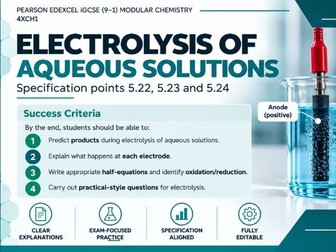
Complete ready-to-teach lesson for Pearson Edexcel International GCSE Chemistry (9–1) Modular 4XCH1, covering the electrolysis of aqueous solutions. This fully editable PowerPoint develops students’ understanding of aqueous electrolysis, including the additional ions present from water, competition between ions at the electrodes, predicting products and writing appropriate half-equations. Students will learn to: distinguish between molten and aqueous electrolysis identify the ions present in an aqueous electrolyte predict which ions move towards the anode and cathode use simple rules to predict the products formed at each electrode understand when a metal or hydrogen is produced at the cathode predict when halogens or oxygen are produced at the anode identify oxidation and reduction at the electrodes write appropriate half-equations apply their knowledge to unfamiliar electrolysis questions The lesson includes a clear comparison between molten and aqueous electrolysis and uses aqueous copper(II) sulfate to demonstrate how H⁺ and OH⁻ from water affect the ions available for discharge. The resource includes: retrieval questions with answers molten vs aqueous electrolysis comparison visual electrolysis diagrams ion movement and competing-ion activities clear cathode and anode product-prediction rules product-selection flowcharts oxidation and reduction links half-equation practice practical investigation using inert electrodes prediction, observation and product-testing tasks exam-style application using aqueous copper(II) sulfate answers for self-assessment final plenary and key vocabulary The product-prediction section provides students with a structured method for deciding what forms at both electrodes, while the practical section asks students to predict products, make observations, identify products and consider appropriate tests. Students then apply their understanding to aqueous copper(II) sulfate, including identifying electrode products, writing the cathode half-equation, identifying reduction and explaining electrical conductivity. Model answers are included. Suitable for: Pearson Edexcel International GCSE Chemistry (9–1) | Modular 4XCH1 | Electrolysis | Aqueous solutions | GCSE/iGCSE Chemistry | Classroom teaching | Revision | Intervention Resource type: Fully editable PowerPoint Slides: 11 Answers included
Pearson Edexcel iGCSE Chemistry 4XCH1 | Electrolysis of Aqueous Solutions Practical | Lesson + WorksQuick View
SAYB

Pearson Edexcel iGCSE Chemistry 4XCH1 | Electrolysis of Aqueous Solutions Practical | Lesson + Works

(0)
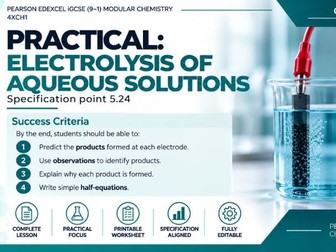
Complete electrolysis of aqueous solutions practical lesson and student worksheet for Pearson Edexcel International GCSE Chemistry (9–1) Modular 4XCH1, covering specification point 5.24. This ready-to-teach practical resource guides students through investigating the electrolysis of aqueous solutions using inert electrodes and identifying the products formed at each electrode. The resource combines a structured PowerPoint lesson with a dedicated practical worksheet, allowing students to predict products before the investigation, record observations during the practical and explain their results afterwards. Students investigate: sodium chloride solution, NaCl(aq) copper(II) sulfate solution, CuSO₄(aq) dilute sulfuric acid, H₂SO₄(aq) Students will learn to: predict the products formed at the cathode and anode apply the rules for aqueous electrolysis identify when a metal or hydrogen is produced at the cathode identify when a halogen or oxygen is produced at the anode use practical observations and chemical tests to identify products explain why particular ions are discharged link electrode reactions to oxidation and reduction complete appropriate half-equations apply their understanding to unfamiliar aqueous electrolytes The PowerPoint includes: retrieval questions and answers key rules for predicting electrode products worked example for aqueous sodium chloride pre-practical prediction activity full equipment list and step-by-step method practical and safety guidance post-practical checkpoint questions model answers summary of cathode and anode product rules independent application questions The practical slides provide the required apparatus and a clear method for investigating the three solutions, including collecting and testing products where appropriate. Also included: a printable practical worksheet structured into three sections: A — Before the practical: PREDICT Students identify the ions present and predict the products at each electrode. B — During the practical: OBSERVE Students record cathode and anode observations, test results and identify the products. C — After the practical: EXPLAIN Students explain their results, complete half-equations and apply oxidation and reduction concepts. Suitable for: Pearson Edexcel International GCSE Chemistry (9–1) | Modular 4XCH1 | Electrolysis | Aqueous solutions | Required practical skills | Classroom practical work | Revision Includes: PowerPoint lesson + printable PDF practical worksheet PowerPoint: 11 slides Specification: 4XCH1, point 5.24
Pearson Edexcel iGCSE Chemistry 4XCH1 | Energy & Changes of State | Complete LessonQuick View
SAYB

Pearson Edexcel iGCSE Chemistry 4XCH1 | Energy & Changes of State | Complete Lesson

(0)
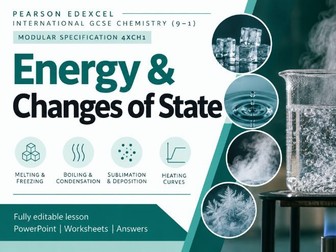
Complete ready-to-teach lesson for Pearson Edexcel International GCSE Chemistry (9–1) Modular 4XCH1, covering energy and changes of state. This fully editable PowerPoint lesson develops students’ understanding of changes of state, with a particular focus on explaining what happens to particles when substances are heated and cooled. The lesson is suitable for the Pearson Edexcel International GCSE Chemistry (9–1) Modular specification – 4XCH1 and can be used for first teaching, consolidation, intervention or revision. Students will learn to: • Describe melting, boiling, freezing, condensation, sublimation and deposition • Explain changes of state in terms of energy and particle movement • Explain the role of attractive forces between particles • Interpret heating curves • Explain why temperature remains constant during a change of state The lesson includes: • Clear learning objective and success criteria • Do Now / retrieval practice • Key scientific vocabulary • Structured explanations of changes of state • Particle-model explanations • Heating and cooling concepts • Heating curve interpretation • Regular checkpoint questions • Structured student activities • Independent practice • Exam-style application • Opportunities for self-assessment and correction • Answer/model response slides The resource has been designed with a clear learning sequence and regular opportunities to check student understanding before progressing. The PowerPoint is fully editable, allowing teachers to adapt the lesson, questions and timings for their own classes. Suitable for: Pearson Edexcel International GCSE Chemistry (9–1) Modular specification – 4XCH1 GCSE/iGCSE Chemistry Ages 14–16 Classroom teaching, revision, intervention or cover Topic: Energy and Changes of State Specification: Pearson Edexcel International GCSE Chemistry (9–1) Modular – 4XCH1 Resource type: Fully editable PowerPoint lesson
Edexcel iGCSE-Chemistry 4XCH1-States of Matter Complete LessonQuick View
SAYB

Edexcel iGCSE-Chemistry 4XCH1-States of Matter Complete Lesson

(0)
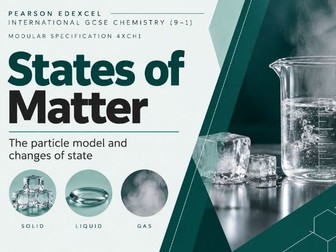
Complete ready-to-teach lesson for Pearson Edexcel International GCSE Chemistry (9–1) Modular 4XCH1, covering States of Matter and the particle model. This fully editable PowerPoint is designed for the Pearson Edexcel International GCSE Chemistry (9–1) Modular specification (4XCH1) and provides a structured lesson on States of Matter. Students develop their understanding of solids, liquids and gases through the particle model and learn to explain changes of state in terms of particle movement and energy. Learning objectives include: • Describe the arrangement, spacing and movement of particles in solids, liquids and gases • Explain the properties of the three states using the particle model • Explain changes of state in terms of energy and particle movement • Use appropriate scientific vocabulary when constructing explanations The lesson includes: • Clear learning objective and success criteria • Do Now / retrieval practice • Key vocabulary • Structured teacher explanation • Particle model diagrams • I Do / We Do / You Do activities • Checkpoint questions throughout the lesson • Independent practice • Exam-style questions • Opportunities for self-assessment and correction • Plenary / exit ticket activities • Answer and feedback slides The resource is designed with a clear teaching sequence and regular checks for understanding, making it suitable for both first teaching and consolidation. Suitable for: • Pearson Edexcel International GCSE Chemistry • 9–1 Modular specification – 4XCH1 • GCSE/iGCSE Chemistry • Ages 14–16 • Classroom teaching, revision, intervention or cover The PowerPoint is fully editable, so teachers can adapt activities, timings and content to suit their classes. Topic: States of Matter Specification: Pearson Edexcel International GCSE Chemistry (9–1) Modular – 4XCH1 Resource type: Editable PowerPoint lesson
Pearson Edexcel iGCSE Chemistry 4XCH1 | Dilution & Diffusion | Complete LessonQuick View
SAYB

Pearson Edexcel iGCSE Chemistry 4XCH1 | Dilution & Diffusion | Complete Lesson

(0)
Complete ready-to-teach lesson for Pearson Edexcel International GCSE Chemistry (9–1) Modular 4XCH1, covering dilution, diffusion and particle theory. This fully editable PowerPoint lesson is designed for the Pearson Edexcel International GCSE Chemistry (9–1) Modular specification – 4XCH1. The lesson develops students’ understanding of diffusion and dilution, moving from observations to particle-level explanations and exam-style application. Students are explicitly taught that diffusion is the net movement of particles from an area of high concentration to an area of low concentration, before applying this understanding to diffusion in gases and liquids. Dilution is then introduced as making a solution less concentrated by adding more solvent, with students developing an understanding that the solute particles have not disappeared but are spread throughout a larger volume. Students will learn to: Define diffusion and dilution accurately Explain diffusion using the particle model Describe diffusion from high to low concentration Apply particle theory to diffusion in liquids and gases Explain what happens to solute particles during dilution Explain why adding solvent decreases concentration Construct clear exam-style explanations using appropriate scientific vocabulary The resource includes: Do Now / retrieval activities Clear key definitions Diffusion in gases Diffusion in liquids Step-by-step particle explanations Dilution and concentration Visual particle models I Do / We Do structured modelling Sentence stems to support scientific explanations Independent application Exam-style questions Mark scheme / model answers Exit ticket assessment The lesson includes explicit modelling of how students can construct an exam response using terms such as solvent, solute particles, larger volume and lower concentration. The final exit ticket checks students’ ability to independently explain both dilution and diffusion using the particle model. Suitable for: Pearson Edexcel International GCSE Chemistry (9–1) Modular specification – 4XCH1 GCSE/iGCSE Chemistry Ages 14–16 First teaching, consolidation, intervention or revision Resource type: Fully editable PowerPoint lesson
Pearson Edexcel iGCSE Chemistry 4XCH1 | Solutions & Solubility | Complete LessonQuick View
SAYB

Pearson Edexcel iGCSE Chemistry 4XCH1 | Solutions & Solubility | Complete Lesson

(0)
Complete ready-to-teach lesson for Pearson Edexcel International GCSE Chemistry (9–1) Modular 4XCH1, covering solutions, solutes, solvents and saturated solutions. This fully editable PowerPoint lesson is designed for students studying the Pearson Edexcel International GCSE Chemistry (9–1) Modular specification – 4XCH1. The lesson introduces the key terminology required when studying solutions and develops students’ ability to apply these terms accurately to unfamiliar examples. Students will learn to: • Define the terms solute, solvent and solution • Identify the solute and solvent in different solutions • Understand the meaning of soluble and insoluble • Describe what is meant by a saturated solution • Apply key terminology to examples and exam-style questions • Construct accurate scientific explanations using appropriate chemistry vocabulary The lesson includes: • Do Now / retrieval activity • Clear learning objectives and success criteria • Key terminology and definitions • Visual examples of solute, solvent and solutions • Soluble vs insoluble substances • Saturated solutions • Structured questioning • Checkpoints for understanding • Student practice activities • Exam-style application questions • Mark scheme and model answers • Opportunities for independent practice and self-assessment The resource uses a clear teaching sequence to introduce terminology before students apply their understanding to questions and scientific explanations. Suitable for first teaching, consolidation, intervention, revision or cover. Specification: Pearson Edexcel International GCSE Chemistry (9–1) Modular – 4XCH1 Topic: Solutions and Solubility Age: 14–16 Resource: Fully editable PowerPoint
Pearson Edexcel iGCSE Chemistry 4XCH1 | Elements, Compounds & Mixtures | Complete LessonQuick View
SAYB

Pearson Edexcel iGCSE Chemistry 4XCH1 | Elements, Compounds & Mixtures | Complete Lesson

(0)
Complete ready-to-teach lesson for Pearson Edexcel International GCSE Chemistry (9–1) Modular 4XCH1, covering elements, compounds, mixtures and pure substances. This fully editable Chemistry lesson is designed for the Pearson Edexcel International GCSE Chemistry (9–1) Modular specification – 4XCH1. Students develop their understanding of how substances are classified as elements, compounds or mixtures, before applying this knowledge to particle diagrams, chemical names and formulae. The lesson also develops understanding of pure substances and how melting and boiling point data can be used to distinguish pure substances from mixtures. Students will learn to: • Define element, compound and mixture • Distinguish between elements, compounds and mixtures • Identify substances from particle diagrams • Classify substances using names and chemical formulae • Understand what is meant by a pure substance • Explain why a pure substance has a fixed melting and boiling point • Understand why mixtures can melt or boil over a range of temperatures • Apply their understanding to unfamiliar examples and exam-style questions The resource includes: • Clear learning objective and success criteria • Key scientific vocabulary • Retrieval / Do Now activities • Structured teaching of elements, compounds and mixtures • Particle diagram interpretation • Classification activities • Pure substance teaching • Melting and boiling point application • Checkpoint questions • Independent practice • Exam-style application • Answers / opportunities for self-assessment The lesson is designed to develop students from basic definitions to being able to classify unfamiliar substances and justify their answers using chemical evidence. Suitable for first teaching, consolidation, intervention, revision or cover. Specification: Pearson Edexcel International GCSE Chemistry (9–1) Modular – 4XCH1 Topic: Elements, Compounds and Mixtures Age: 14–16 Resource type: Fully editable PowerPoint lesson
Pearson Edexcel iGCSE Chemistry 4XCH1 | Solubility Practical & Solubility CurvesQuick View
SAYB

Pearson Edexcel iGCSE Chemistry 4XCH1 | Solubility Practical & Solubility Curves

(0)
Complete ready-to-teach practical lesson for Pearson Edexcel International GCSE Chemistry (9–1) Modular 4XCH1, investigating solubility and solubility curves. This practical-based Chemistry resource is designed for the Pearson Edexcel International GCSE Chemistry (9–1) Modular specification – 4XCH1. Students investigate the solubility of sodium chloride in water at a specific temperature, collect experimental data and use their results to calculate solubility. The lesson then develops students’ ability to interpret and use solubility curves. Students will learn to: • Understand solubility as the maximum mass of solute that will dissolve in a given amount of solvent at a particular temperature • Carry out a practical investigation to determine solubility • Identify when a solution has become saturated • Record experimental observations and results accurately • Calculate solubility in g per 100 g of water • Plot and interpret solubility data • Read values accurately from a solubility curve • Explain how solubility changes with temperature • Use solubility data to determine whether a given mass of solute will dissolve • Calculate the mass of crystals formed when a saturated solution cools The resource includes: • Clear learning objective and success criteria • Practical instructions • Equipment and chemicals list • Step-by-step experimental method • Student results table • Solubility calculation • Solubility data • Graph plotting activity • Solubility curve interpretation • Calculation practice • Structured questions • Practical application questions • Opportunities for independent work The practical worksheet guides students through the investigation from collecting experimental data to calculating solubility and applying their understanding to solubility curves. Suitable for first teaching, practical work, consolidation, intervention or revision. Specification: Pearson Edexcel International GCSE Chemistry (9–1) Modular – 4XCH1 Topic: Solubility and Solubility Curves Age: 14–16 Resource type: Practical lesson and student worksheet
Pearson Edexcel iGCSE Chemistry 4XCH1 | Chromatography & Rf Values | Complete LessonQuick View
SAYB

Pearson Edexcel iGCSE Chemistry 4XCH1 | Chromatography & Rf Values | Complete Lesson

(0)
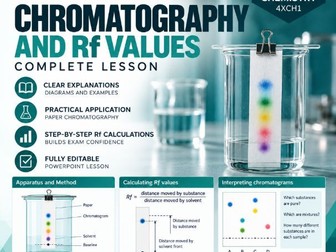
Complete ready-to-teach lesson for Pearson Edexcel International GCSE Chemistry (9–1) Modular 4XCH1, covering paper chromatography, interpreting chromatograms and calculating Rf values. This fully editable PowerPoint lesson is designed for the Pearson Edexcel International GCSE Chemistry (9–1) Modular specification – 4XCH1. The lesson develops students’ understanding of paper chromatography, moving from the basic experimental technique to interpreting chromatograms and completing Rf value calculations. Students are given opportunities to apply their understanding to mixtures, experimental observations and examination-style calculations. Students will learn to: • Describe how paper chromatography is carried out • Understand how a chromatogram provides information about the composition of a mixture • Identify pure substances and mixtures from chromatograms • Understand the role of the solvent • Explain why different substances travel different distances • Identify and use the solvent front and baseline correctly • Calculate Rf values • Use Rf values to help identify substances • Apply chromatography knowledge to unfamiliar examples • Investigate paper chromatography using inks or food colourings The resource includes: • Clear learning objective and success criteria • Do Now / retrieval activities • Key chromatography terminology • Step-by-step explanation of paper chromatography • Chromatogram interpretation • Pure substances vs mixtures • Solvent front and baseline • Rf equation • Worked Rf calculations • Student calculation practice • Checkpoint questions • Paper chromatography practical application • Independent practice • Exam-style questions • Answers / opportunities for self-assessment The lesson is structured to move students from understanding how chromatography works to interpreting experimental results and independently completing Rf calculations. Suitable for first teaching, practical work, consolidation, intervention, revision or cover. Specification: Pearson Edexcel International GCSE Chemistry (9–1) Modular – 4XCH1 Topic: Chromatography and Rf Values Age: 14–16 Resource type: Fully editable PowerPoint lesson
Pearson Edexcel iGCSE Chemistry 4XCH1 | Separating Techniques | Complete LessonQuick View
SAYB

Pearson Edexcel iGCSE Chemistry 4XCH1 | Separating Techniques | Complete Lesson

(0)
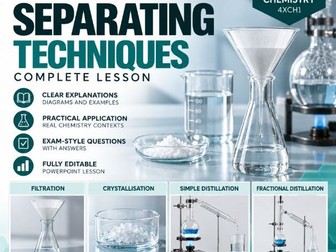
Complete ready-to-teach lesson for Pearson Edexcel International GCSE Chemistry (9–1) Modular 4XCH1, covering the key experimental techniques used to separate mixtures. This fully editable PowerPoint lesson is designed for the Pearson Edexcel International GCSE Chemistry (9–1) Modular specification – 4XCH1. Students develop their understanding of how different mixtures can be separated and, importantly, learn to select and explain the correct separation technique for a given mixture. The lesson covers filtration, crystallisation, simple distillation and fractional distillation, alongside the key terminology students need when answering examination questions. Students will learn to: • Describe how filtration is used to separate an insoluble solid from a liquid • Understand the terms filtrate and residue • Explain how crystallisation can be used to obtain a dissolved solid from a solution • Describe simple distillation and identify the distillate • Explain how fractional distillation separates mixtures of liquids • Select an appropriate separation technique for different mixtures • Use the terms mixture, solvent, solute, residue and distillate accurately • Apply their understanding to examination-style questions The resource includes: • Clear learning objective and success criteria • Retrieval / Do Now activities • Key vocabulary • Step-by-step explanations of separation techniques • Filtration • Crystallisation • Simple distillation • Fractional distillation • Scientific apparatus and experimental applications • Checkpoint questions • Structured student practice • Independent application • Exam-style questioning • Answers / opportunities for self-assessment The lesson is designed to move students from recognising each experimental technique to explaining how it works and selecting the correct technique for an unfamiliar mixture. Suitable for first teaching, consolidation, intervention, revision or cover. Specification: Pearson Edexcel International GCSE Chemistry (9–1) Modular – 4XCH1 Topic: Separating Techniques / Separation of Mixtures Age: 14–16 Resource type: Fully editable PowerPoint lesson
GCSE Chemistry Intervention & Revision Workbook | 60-Page Printable PDFQuick View
SAYB

GCSE Chemistry Intervention & Revision Workbook | 60-Page Printable PDF

(1)
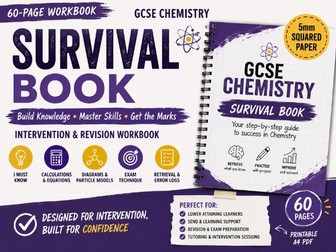
PLEASE NOTE: This resource is a 60-PAGE PRINTABLE PDF STUDENT WORKBOOK. It is not a PowerPoint presentation. A 60-page printable GCSE Chemistry intervention and revision workbook designed to help students build knowledge, practise key skills and become more independent. The GCSE Chemistry Survival Book is a structured, guided workbook for students who need additional support organising their chemistry knowledge, practising key skills and learning from mistakes. Rather than giving students another information-heavy revision guide, the workbook provides clear prompts and generous writing space so that students gradually build their own personalised chemistry revision resource. The workbook follows a simple learning cycle: Retrieve → Build → Practise → Prove It → Revisit What’s included: • 60 printable A4 pages • 5 mm squared working areas • I Must Know knowledge pages • Calculation Survival pages • Visualise It diagram and modelling pages • Vocabulary Survival pages • Retrieval 10 activities • 6-Mark Question Builders • Error Logs • Required Practical Survival page • Data and Graphs practice • Formula and Equation Bank • Exam Command Word Decoder • Intervention Progress Record • Weekly Chemistry Review • Final Mastery Check • Additional squared notes and practice pages Ideal for: • GCSE Chemistry intervention • Revision lessons • Students who lack confidence in Chemistry • Lower-attaining learners • SEND/SEN and learning-support settings • Tutoring • Lunchtime or after-school intervention • Exam preparation • Independent revision • Building student ownership of learning The structured layout helps students focus on the essential knowledge, vocabulary, calculations, diagrams, exam technique and misconceptions they need to improve. The 5 mm square-paper format provides additional structure for chemical calculations, equations, particle diagrams, graphs, apparatus drawings and other Chemistry working. Pages can be used in sequence as a complete workbook or printed individually for specific intervention sessions. Format: 60-page A4 printable PDF. Designed with a clean, low-distraction layout and suitable for colour or grayscale printing. This is an independent educational resource and is not endorsed by or affiliated with any examination board.