ANCIENT EGYPT GEOGRAPHY AND THE RIVER NILE – COMPLETE TEACHING RESOURCE BUNDLEQuick View
LightwayEdu

ANCIENT EGYPT GEOGRAPHY AND THE RIVER NILE – COMPLETE TEACHING RESOURCE BUNDLE

(0)
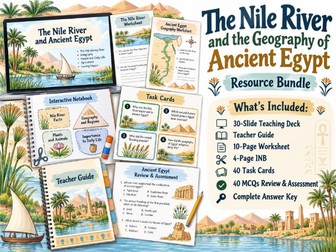
Explore how the River Nile and Egypt’s geography shaped the development of ancient Egyptian civilisation. This comprehensive teaching bundle combines illustrated lessons, printable worksheets, interactive notebook activities, historical images, task cards, digital classroom games and assessment materials. Suitable for KS3 History, ancient civilisations topics and introductory World History lessons. Click here to view PREVIEW of this bundle: WHAT’S INCLUDED 30-Slide Illustrated Teaching Presentation 30 Slide-by-Slide Teacher Notes Comprehensive Teacher Guide with Historical Background 10-Page Printable Worksheet Pack 4-Page Interactive Notebook Activities 40 Printable Task Cards (10 Pages) Interactive HTML Task Card Drawing Game 40 Multiple-Choice Questions Review and Assessment Pack HTML Slideshow of 40 Multiple-Choice Questions Collection of 20 Historical Images Complete Answer Key TEACHING PRESENTATION AND TEACHER SUPPORT The 30-slide presentation introduces the geography of ancient Egypt, focusing on the Nile Valley, Nile Delta, Upper and Lower Egypt, annual flooding, agricultural seasons, irrigation, deserts, cataracts, transportation and trade. Students investigate how Egypt’s natural environment influenced settlement patterns, food production, economic development and connections with neighbouring societies. The presentation includes quick-review activities and an exit ticket. The accompanying slide-by-slide notes provide historical explanations, discussion questions, teaching guidance and suggested transitions. The comprehensive Teacher Guide includes classroom implementation strategies and extended historical background information to support lesson planning and delivery. WORKSHEETS AND INTERACTIVE NOTEBOOK The 10-page worksheet pack features a variety of activities, including reading comprehension, vocabulary, matching, sequencing, multiple-choice questions, cause-and-effect exercises, historical reasoning and written responses. The four-page interactive notebook includes black-and-white cut-and-paste activities with shapes inspired by the lesson. Students complete individual notes before cutting them out and adding them to their notebooks. No folding or complicated assembly is required. Both resources are suitable for independent work, classroom practice, homework and revision. TASK CARDS AND DIGITAL DRAWING GAME The collection includes 40 illustrated task cards arranged across 10 printable pages. Students complete geographical challenges, historical scenarios, problem-solving activities and evidence-based questions exploring the relationship between the Nile and ancient Egyptian civilisation. An additional HTML Task Card Drawing Game offers an interactive alternative for classroom projection and group activities. REVIEW AND ASSESSMENT The assessment pack includes 40 multiple-choice questions covering the main geographical and historical concepts taught throughout the lesson. COMPLETE ANSWER KEY
Cuneiform Writing Lesson | Ancient Mesopotamia Slides, Worksheets & ActivitiesQuick View
LightwayEdu

Cuneiform Writing Lesson | Ancient Mesopotamia Slides, Worksheets & Activities

(0)
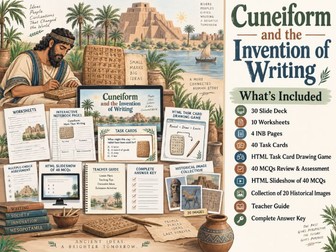
A complete Ancient Mesopotamia lesson resource exploring how record-keeping developed from clay tokens and pictographs into cuneiform and how writing changed government, trade, law, literature and historical memory. You can see the PREVIEW of this lesson bunlde by the link below: https://drive.google.com/file/d/1suev1Wo54QPIdr0iv1D1xmjpzuF2MtuF/view?usp=sharing TOPICS COVERED Clay tokens and bullae Pictographs and proto-cuneiform Wedge-shaped cuneiform Clay tablets and reed styluses Signs for sounds and syllables Scribes and scribal education Accounting and storage Temple administration Government, taxation and labour Trade, contracts, debts and receipts Writing and law Mesopotamian literature The Epic of Gilgamesh Libraries and archives Cuneiform and different languages Clay tablets as historical evidence Observation and inference Strengths and limitations of written evidence Why writing changed civilisation WHAT’S INCLUDED 30-slide instructional slide deck Teacher Notes for all 30 slides 10 printable A4 worksheets 4 Interactive Notebook pages 40 printable task cards across 10 A4 pages HTML Task Card Drawing Game 40-question multiple-choice Review and Assessment Pack HTML slideshow version of the 40 MCQ Review and Assessment Collection of 20 Historical Images with captions and lesson-use suggestions Detailed Teacher Guide with teaching plan and historical background information Complete Answer Key for worksheets, INB activities, task cards and assessment SKILLS Chronology Cause and effect Vocabulary Reading comprehension Historical reasoning Primary source analysis Observation and inference Evaluating evidence Recognising source limitations Written explanation CLASSROOM USE Suitable for whole-class teaching, independent work, learning stations, interactive notebooks, task card review, homework, revision, cover lessons and assessment. The HTML activities can be projected for whole-class practice, while the historical image collection provides additional visual material for discussion and source analysis. The printable resources use white backgrounds and light colour decoration for classroom and printer-friendly use. TEACHER SUPPORT The Teacher Guide includes learning objectives, vocabulary, suggested lesson organisation, differentiation, misconceptions, assessment guidance and a detailed background article. Teacher Notes are also included for all 30 slides, making the presentation ready to teach. Open-ended activities include suggested responses in the Complete Answer Key. A flexible, ready-to-use resource for teaching the origins, development, uses and historical importance of cuneiform in Ancient Mesopotamia.
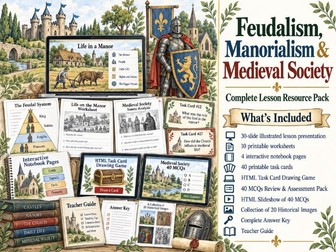
Feudalism, Manorialism & Medieval Society — Complete Lesson ResourcesQuick View
LightwayEdu

Feudalism, Manorialism & Medieval Society — Complete Lesson Resources

(0)
A complete lesson resource pack covering feudalism, manorialism, lords and vassals, knights, peasants and serfs, manor life, the medieval Church, the Three Orders, farming, local power and social change. Click here to see PREVIEW of this lesson product: https://drive.google.com/file/d/18kCc9LRdbacEW4aMNZDGxPWsCs6Vhvc_/view?usp=sharing WHAT IS INCLUDED 30-slide illustrated lesson presentation 10 printable worksheets with vocabulary, reading, sorting, compare and contrast, cause and effect, short response and review activities 4 Interactive Notebook pages with cut-and-paste notes — no folding or complicated assembly required 40 printable Task Cards HTML Task Card Drawing Game for classroom display and review 40-question multiple-choice Review and Assessment Pack HTML Slideshow version of the 40 MCQs Collection of 20 Historical Images to support teaching and discussion Complete Answer Key for Worksheets, INB, Task Cards and Review Questions Teacher Guide with teaching suggestions and detailed background information TOPICS COVERED Feudalism Manorialism Lords and Vassals Fiefs Knights and Castles Manors and Demesne Serfs and Free Peasants Medieval Farming The Church The Three Orders Nobles, Clergy and Peasants Towns, Trade and Change Over Time SUITABLE FOR Medieval Europe World History European History Whole-class teaching Independent practice Homework Revision Assessment Cover lessons The resource combines printable and digital materials to support teaching, practice, review and assessment within one complete lesson pack.
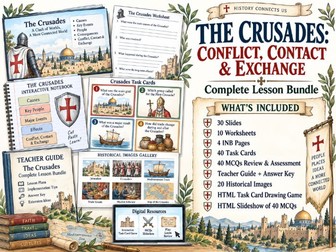
Crusades: Conflict, Contact & Exchange | Full Lesson | Slides, INB, WSQuick View
LightwayEdu

Crusades: Conflict, Contact & Exchange | Full Lesson | Slides, INB, WS

(0)
A complete Crusades lesson resource exploring religious motivations, political and economic interests, major crusading movements, conflict, cross-cultural contact, trade, exchange and long-term consequences. Suitable for KS3 Medieval History and comparable secondary history courses. Click this link to see PREVIEW of this lesson bundle: https://drive.google.com/file/d/1gnSq8dePYpC-B0enwEAoHsk6cbWefY9b/view?usp=sharing WHAT IS INCLUDED 30-slide lesson deck 10 printable worksheets 4 Interactive Notebook pages with simple write, cut and stick activities 40 printable task cards HTML Task Card Drawing Game 40-question multiple-choice Review and Assessment Pack HTML Slideshow version of the 40 MCQs Collection of 20 Historical Images Complete Answer Key for worksheets, INB activities, task cards and assessment Teacher Guide with teaching suggestions and detailed background information TOPICS COVERED Jerusalem and the Holy Land, Pope Urban II, the First Crusade, religious motivations, political ambitions, economic interests, crusader states, military orders, Muslim resistance, Saladin, Hattin, the Third Crusade, Richard I, the Fourth Crusade, Constantinople, Acre, Christian, Muslim and Jewish experiences, siege warfare, Mediterranean trade, cultural contact and long-term consequences. SKILLS Chronology, cause and consequence, comparison, historical explanation, multiple perspectives, reading comprehension, evidence-based reasoning and evaluation of long-term impact. CLASSROOM USE Suitable for direct teaching, independent work, homework, revision, interactive notebooks, group activities, task-card stations, whole-class digital review and assessment. The lesson is built around the key idea that the Crusades involved not only conflict, but also contact and exchange between societies across the medieval Mediterranean.
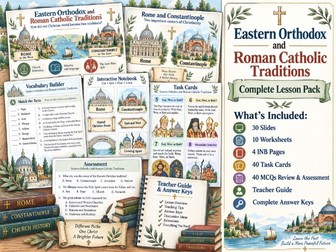
Eastern Orthodox and Roman Catholic | Great Schism 1054 | Secondary History LessonQuick View
LightwayEdu

Eastern Orthodox and Roman Catholic | Great Schism 1054 | Secondary History Lesson

(0)
A complete history lesson exploring how Christianity developed differently in the Eastern and Western worlds and how these differences contributed to the Great Schism of 1054. Students examine Rome and Constantinople, the Pope and Patriarchs, church–state relations, Latin and Greek traditions, icons and sacred art, the filioque controversy, political rivalry, and the long-term effects of the East–West split. Click here to see PREVIEW of this lesson bundle: https://drive.google.com/file/d/1FWux6dsuSRQqDdNOngqMn0w3L0P6IVxg/view?usp=sharing WHAT’S INCLUDED 30-slide lesson presentation 10 printable worksheets with vocabulary, reading comprehension, comparison, cause and effect, timeline work, sacred art analysis, classification, error correction, short response and review activities 4 Interactive Notebook pages with simple cut-and-paste notes – no folding or complicated assembly 40 task cards covering recall, vocabulary, historical scenarios, cause and effect, comparison, evidence and historical reasoning 40-question multiple-choice Review and Assessment with balanced A–D answers Complete answer keys for worksheets, INB pages, task cards and assessment Teacher Guide with lesson organisation guidance and detailed historical A Collection of 20 historical images to support this lesson HTML Task Cards Drawing Game - Just click and play to challenge your student HTML Slideshow of 40 MCQs Review and Assessment, just click and project it to practice with your students.background information KEY TOPICS Rome and Constantinople Pope and Patriarch Eastern and Western Christianity Latin and Greek traditions Church and state Icons and Iconoclasm Sacred art Papal authority Filioque controversy Great Schism of 1054 Roman Catholic tradition Eastern Orthodox tradition Long-term effects SKILLS Compare and contrast Cause and effect Chronology Vocabulary Reading comprehension Historical evidence Continuity and change Short written responses Historical argument SUITABLE FOR World History Medieval History Byzantine Empire studies Medieval Europe History of Christianity Classwork Independent practice Revision Homework Cover lessons Assessment preparation The lesson presents the two Christian traditions respectfully and historically, emphasising that the Great Schism developed over centuries through a combination of political, cultural, theological and leadership differences.
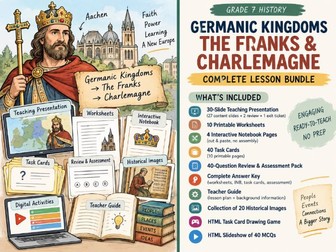
Germanic Kingdoms, the Franks & Charlemagne | Medieval Europe History LessonQuick View
LightwayEdu

Germanic Kingdoms, the Franks & Charlemagne | Medieval Europe History Lesson

(0)
A complete Medieval Europe lesson exploring the transformation of Western Europe after Roman political authority weakened, the rise of the Franks, Clovis, the Carolingian dynasty, and the reign and legacy of Charlemagne. Students examine how the Franks combined conquest, government, Christianity, alliances, and learning to rebuild political order in Western Europe. Click this link to see the PREVIEW https://drive.google.com/file/d/1Uf6CnmVrOqBHAHRF4oK7u9tzNXbMoGdT/view?usp=sharing TOPICS COVERED The fragmentation of Western Rome, Germanic kingdoms, the Franks, Clovis and his conversion, Merovingians, Charles Martel, Pepin the Short, Carolingians, the papacy, Charlemagne, the Lombards, Saxon Wars, counts, missi dominici, capitularies, imperial government, the coronation of 800, Aachen, the Palatine Chapel, the Carolingian Renaissance, and Charlemagne’s legacy. WHAT IS INCLUDED 30-slide illustrated teaching presentation 10 printable A4 worksheets 4 Interactive Notebook pages with cut-and-paste topic-shaped notes 40 task cards presented across 10 printable pages 40-question multiple-choice Review and Assessment Pack Complete Answer Key for worksheets, INB activities, task cards, and assessment Teacher Guide with lesson organisation and detailed historical background information Collection of 20 Historical Images for visual analysis and lesson support HTML Task Card Drawing Game for classroom review HTML Slideshow of the 40 MCQs Review and Assessment Pack SKILLS Cause and effect, chronology, continuity and change, comparison, historical evidence, political power, religious relationships, inference, and short written responses. CLASSROOM USE Suitable for Medieval Europe, World History, European History, independent work, classroom stations, homework, revision, assessment preparation, homeschool lessons, and substitute teaching. RESOURCE STYLE Printable materials use white backgrounds and light colour decoration. Interactive Notebook activities require no complicated folding or assembly. The presentation and digital resources use clear, large text designed for classroom display. TEACHING FOCUS The lesson presents Charlemagne within the wider development of post-Roman Western Europe rather than as a simple ruler biography. Students investigate how military expansion, local administration, cooperation with the Church, education, and surviving Roman traditions helped create a new medieval political order.
Sumer: The First Mesopotamian City-States Lesson | Slides, Worksheet, INB, GuideQuick View
LightwayEdu

Sumer: The First Mesopotamian City-States Lesson | Slides, Worksheet, INB, Guide

(0)
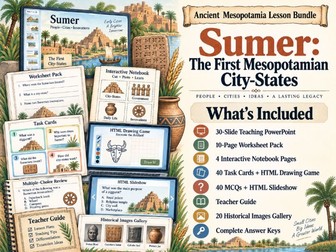
A complete Middle School History lesson bundle exploring the rise of Sumerian city-states, including Uruk and Ur, irrigation, food surplus, specialization, government, temples, labor, trade, social hierarchy, daily life, and archaeological evidence. Students learn how farming villages developed into complex urban societies and how historians use artifacts such as the Standard of Ur to study the ancient past. Click this link to see the PREVIEW of this bundle: https://drive.google.com/file/d/1G3TfdVOyzYl_p4VlLQ7C2N0VIlN8RdC1/view?usp=sharing WHAT’S INCLUDED 30-slide teaching PowerPoint 10-page worksheet pack 4 Interactive Notebook pages 40 printable task cards HTML Task Cards Drawing Game 40-question Review & Assessment Pack HTML Review & Assessment Slideshow Teacher Guide 20 Historical Images Gallery PowerPoint Complete answer keys TOPICS COVERED Sumer Ancient Mesopotamia Uruk and Ur City-states Irrigation Agricultural surplus Specialization Government and administration Temples and public works Social hierarchy Merchants and trade Daily life Archaeology Standard of Ur Evidence and inference CLASSROOM USE Use the slide deck for direct instruction, worksheets and INB pages for practice, task cards for stations or review, and the HTML activities for interactive whole-class practice. The printable 40-MCQ assessment can be used as a quiz or end-of-lesson review, while the HTML slideshow version works well for projected classroom practice. The Historical Images Gallery provides additional archaeological and visual sources for discussion and enrichment. SUITABLE FOR Middle School History Ancient Civilizations Ancient Mesopotamia Sumer World History Whole-class teaching Independent practice Stations Review Assessment Homeschool learning A flexible print-and-digital lesson bundle designed to help students understand how the first Sumerian city-states developed and why the rise of cities was such an important turning point in human history.
Sargon and the Akkadian Empire Lesson | Slides, Worksheets, INB, GuideQuick View
LightwayEdu

Sargon and the Akkadian Empire Lesson | Slides, Worksheets, INB, Guide

(0)
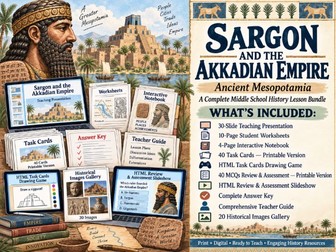
A complete Middle School History lesson exploring how Sargon of Akkad transformed a region of rival Mesopotamian city-states into one of the earliest territorial empires. Students examine conquest, imperial government, tribute, governors, cuneiform, cultural continuity, Enheduanna, Naram-Sin, trade, propaganda, decline, and Sargon’s historical legacy. Click the link below to see PREVIEW of this lesson bundle https://drive.google.com/file/d/1SJ53NihwvUCI4ldDm8v-H0X2z3wXJ-U9/view?usp=sharing WHAT’S INCLUDED 30-slide teaching presentation 10-page student worksheet pack 4-page Interactive Notebook 40 Task Cards – printable version HTML Task Cards Drawing Game 40 MCQs Review and Assessment Pack – printable version HTML Review and Assessment Slideshow Complete Answer Key Comprehensive Teacher Guide 20 Historical Images Gallery KEY SKILLS Cause and effect Continuity and change Comparison Source analysis Historical perspective Evidence vs. legend Claim and evidence writing GREAT FOR Ancient Mesopotamia Ancient Civilizations World History Whole-class teaching Independent practice Stations Review Assessment Homeschool PRINT + DIGITAL The resource includes both printable materials and interactive HTML activities for classroom projection and whole-class review.
Origins and Spread of Christianity Lesson | Secondary HistoryQuick View
LightwayEdu

Origins and Spread of Christianity Lesson | Secondary History

(0)
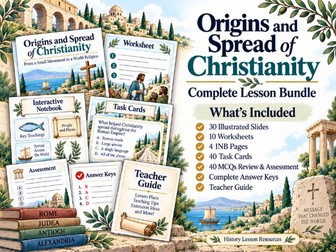
A complete classroom-ready lesson covering the origins, development, and spread of Christianity across the Roman world. Copy this link and paste to your browser to preview the product bundle: https://drive.google.com/file/d/1cB6xeiPkbYraur2PF8OrjutUX_YZ0GjL/view?usp=sharing Students explore Roman Judea, the Jewish background of early Christianity, Jesus and his teachings, early Christian communities, Paul and missionary activity, Roman roads and cities, persecution, Constantine, the Edict of Milan, the Council of Nicaea, Theodosius I, and the reasons Christianity spread so widely. WHAT’S INCLUDED 30 illustrated lesson slides 10 printable worksheets 4 interactive notebook pages 40 task cards 40-question multiple-choice review and assessment Complete answer keys Teacher Guide with lesson organization and detailed background information KEY TOPICS Roman Judea Jesus of Nazareth Parables and teachings Early Christian communities Paul of Tarsus Roman roads and sea routes Cities and communication Persecution and martyrs Constantine and the Edict of Milan Council of Nicaea Theodosius I Why Christianity spread SKILLS PRACTICED Reading comprehension Vocabulary Cause and effect Chronology Historical context Comparison Short written response Historical reasoning PERFECT FOR Ancient Rome units, Early Christianity lessons, World History, classroom stations, independent practice, review, assessment, homework, or substitute lessons. The materials are designed with clear text, hand-drawn illustrations, and print-friendly layouts for easy classroom use.
15 Breaks & Flexible Classroom | Editable Daily Classroom templates slidesQuick View
LightwayEdu

15 Breaks & Flexible Classroom | Editable Daily Classroom templates slides

(0)
Breaks & Flexible Classroom Slides | Editable Daily Classroom Slides Keep transitions, breaks, and flexible classroom moments organized with this set of 15 editable classroom slides. Designed for everyday projection, these slides help students quickly understand what to do during brain breaks, catch-up time, quiet reading, teacher conferences, study hall, and other in-between moments. With large text, bright high-contrast colors, and clear visual directions, the slides are easy for students to follow from anywhere in the classroom. What’s Included 15 classroom slides: Brain Break Movement Break Stretch Break Quiet Break Water Break Snack Time Reset & Refocus Catch-Up Time Missing Work Time Free Choice Choice Time Quiet Reading Study Hall Teacher Check-In Flexible Time Great for Daily classroom routines Brain and movement breaks Independent work time Early finishers Missing-work catch-up Small-group instruction Student conferences Quiet reading Study hall Schedule changes Flexible classroom time Teacher-Friendly Design The slides include spacious areas for adding your own: Activities Assignments Time limits Student choices Priorities Instructions Next steps Simply choose the slide you need, add your information, and project it for students. Perfect for elementary and middle school classrooms looking for a simple visual system to keep flexible parts of the school day calm, clear, and organized.
Classroom Transition Slides | 15 Editable TemplatesQuick View
LightwayEdu

Classroom Transition Slides | 15 Editable Templates

(0)
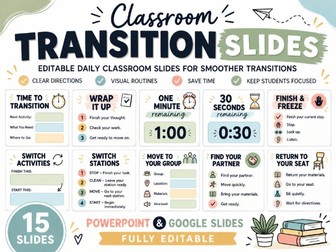
Make classroom transitions smoother, faster, and easier to manage with this set of 15 bright, editable transition slides designed for everyday classroom use. These slides help students quickly understand what to do when it is time to wrap up, switch activities, move to groups, clean up, return to seats, and refocus for the next task. Simply project the slide you need and let the visual routine guide your class. What’s Included Time to Transition Wrap It Up One Minute Remaining 30 Seconds Remaining Finish & Freeze Switch Activities Switch Stations Move to Your Group Find Your Partner Return to Your Seat Materials Away Clean Up Time Reset & Refocus Back to Learning Ready for What’s Next? Perfect For Daily classroom routines Classroom management Centers and station rotations Partner and group work Independent work transitions Clean-up routines Brain break transitions End-of-activity reminders Elementary and middle school classrooms Why Teachers Will Love It These slides give students clear visual directions without repeated verbal reminders. Large text, simple icons, high-contrast colors, and easy-to-follow steps make them highly visible on classroom projectors. Several slides also include blank editable spaces for teachers to add the next activity, materials, group information, voice level, or other classroom directions. Use them throughout the school year as part of your daily classroom slide routine. Includes 15 classroom transition slides in a bright, clean, teacher-friendly design.
Centers, Stations & Rotations Classroom Slides | 35 Editable TemplatesQuick View
LightwayEdu

Centers, Stations & Rotations Classroom Slides | 35 Editable Templates

(0)
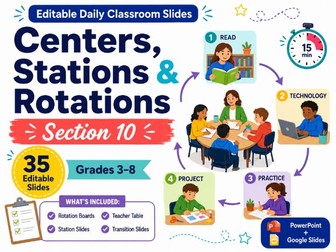
Organize classroom centers, stations, and rotations with this set of 35 editable Centers, Stations & Rotations classroom slides. This resource gives teachers a complete visual system for introducing centers, displaying station directions, assigning groups, showing rotation schedules, managing transitions, and keeping students on track throughout station-based activities. Simply add your own group names, station names, tasks, materials, times, or directions and display the slides during class. What’s Included Centers Today Station Time Today’s Rotations How Centers Work Center Expectations Before You Begin Ready to Rotate? Station 1–6 instruction slides Generic Station Instructions 2-Group Rotation Boards 3-Group Rotation Boards 4-Group Rotation Boards 5-Group Rotation Boards 6-Group Rotation Boards Flexible Rotation Board Rotation Path Teacher Table Independent Work Partner Station Technology Station Reading Station Practice Station Rotation Time Switch Stations 1 Minute Remaining Centers Complete Perfect For Learning centers Classroom stations Small-group rotations Intervention groups Workshop-style lessons Reading and math centers Review stations Test-prep rotations Project-based learning Grades 3–8 Multiple rotation-board layouts make it easy to manage classes with 2, 3, 4, 5, or 6 groups, while individual station slides give students clear directions without repeated teacher reminders. The bright, high-contrast design is easy to read from across the classroom, and all teacher-customizable areas are intentionally left open for your own editable text. Use the slides for one lesson, one unit, or as part of your everyday classroom routine. Set up your groups, project the slides, and let students see exactly where to go, what to do, and when to rotate.
Partner & Group Work classroom Slides | 15 Editable Visual TemplateQuick View
LightwayEdu

Partner & Group Work classroom Slides | 15 Editable Visual Template

(0)
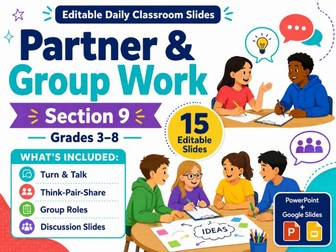
Make partner work, group discussions, and collaborative activities easier to manage with this set of 15 editable Partner & Group Work classroom slides. Designed for daily classroom use, these slides give students clear visual directions for partner tasks, Think-Pair-Share, group roles, discussions, collaboration, and class sharing. Simply add your own task, question, student names, time, or directions and project the slide during class. What’s Included Partner Work Find a Partner Turn & Talk Think-Pair-Share Partner Practice Partner Work Expectations Group Work Team Time Group Work Expectations Group Roles Choose Your Role Group Discussion Compare Your Thinking Collaborate & Create Share With the Class Perfect For Partner activities Small-group learning Classroom discussions Cooperative learning Review activities Project work Daily classroom routines Grades 3–8 The clean, colorful, high-contrast design is easy to read on a classroom projector while keeping student directions organized and visible. Editable areas are intentionally left open so you can customize each slide for any subject, activity, or class. Use these slides again and again throughout the school year to make collaborative learning more structured, independent, and classroom-friendly.
Classroom Directions Slides | 20 Editable TemplatesQuick View
LightwayEdu

Classroom Directions Slides | 20 Editable Templates

(0)
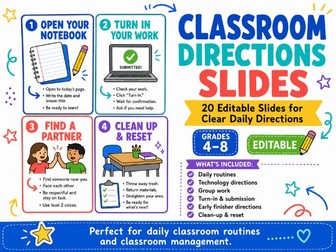
#Make everyday classroom directions clear and easy to follow with this set of 20 editable Classroom Directions Slides. Designed for upper primary and middle school classrooms, these ready-to-display slides provide visual instructions for common routines including getting materials ready, using Chromebooks, submitting work, working with a partner, checking work and cleaning up. Simply add your own information to the blank editable areas and display the appropriate slide whenever you need it. What’s Included 20 classroom direction slides covering: Please Take Out… You Will Need Get Ready to Learn Open Your Notebook Open Your Book Chromebook Time Log In Pick Up Your Materials Turn In Your Work Submit Your Work Follow These Directions Your Task Work Quietly Eyes on the Board Listen Carefully Find a Partner Move to Your Group Check Your Work When You Finish Clean Up & Reset Great For Daily classroom routines Classroom management Morning and lesson transitions Independent work Partner and group work Technology instructions Assignment submission Early finisher directions End-of-activity clean-up Supply and material reminders Designed for Easy Classroom Display The slides feature: Large, easy-to-read text Bright, high-contrast layouts Clear visual cues Simple hand-drawn classroom illustrations Blank editable areas for your own instructions Consistent layouts students can quickly recognise Teachers can customise details such as assignment names, materials, page numbers, websites, group information, timings and activity instructions. Suitable for Grades 4–8 / upper primary to lower secondary and adaptable across subjects. A practical visual classroom management resource for helping students understand what to do, what they need and what comes next without repeated verbal reminders.
Classroom Management Slides | 20 editable templatesQuick View
LightwayEdu

Classroom Management Slides | 20 editable templates

(0)
Make classroom expectations clear, visual, and easy to reinforce throughout the day with this Editable Classroom Management Slides set. This resource includes 20 high-contrast classroom slides designed to help teachers manage voice levels, independent work, partner and group work, technology use, assessments, student focus, and classroom readiness. Simply project the slide you need and customize the editable areas to match your own classroom routines. Perfect for upper elementary and middle school classrooms, these slides are clean, modern, easy to read from across the room, and designed for everyday use. WHAT’S INCLUDED Today’s Expectations The 3 R’s Voice Levels 0–4 Current Voice Level Independent Work Expectations Partner Work Expectations Group Work Expectations Technology Expectations Assessment Time Stay on Task Reset & Refocus Need Help? What Should I Be Doing? Class Check Ready to Learn? GREAT FOR classroom management daily routines independent work partner and group activities technology time assessments and quizzes transitions behavior reminders student self-management projected classroom expectations EDITABLE & REUSABLE Editable areas are intentionally left open so you can add your own: directions expectations voice-level descriptions activity information reminders classroom-specific routines Use the slides again and again throughout the school year. DESIGN STYLE bright white backgrounds colorful high-contrast layouts large, easy-to-read text simple hand-drawn classroom illustrations modern, cheerful design suitable for Grades 4–8 These slides are designed to help students quickly answer the questions: What should I be doing? How should I be working? What is expected right now? Project a slide, customize it for your classroom, and keep expectations visible without repeating the same directions over and over.
The First Israelites Lesson Bundle | Belief, Exodus, Ten Commandments | Slides, INB, WorksheetQuick View
LightwayEdu

The First Israelites Lesson Bundle | Belief, Exodus, Ten Commandments | Slides, INB, Worksheet

(0)
The First Israelites – Complete Grade 6 World History Lesson Bundle Teach the First Israelites, the origins of Judaism, Moses and the Exodus, the Ten Commandments, and early Israelite life in Canaan with a complete, visually supported Grade 6 World History lesson bundle. This resource moves students from Canaan and early Israelite identity through Abraham, the covenant, Jacob and the Twelve Tribes, migration to Egypt, Moses, the Exodus, the Torah, Joshua, Deborah, the judges, and the Phoenicians. Students also practice an important history skill by learning to distinguish between biblical tradition and historical interpretation. The bundle now also includes a PowerPoint gallery of 20 historical images with captions, giving teachers an additional visual source for discussion, background building, lesson hooks, review, and historical observation activities. What’s Included 27-Slide Lesson Presentation 24 content slides 3 review and practice slides clear, large classroom-friendly text hand-drawn historical illustrations visual timelines, comparisons, cause-and-effect explanations, and key concept summaries 20 Historical Images PowerPoint Gallery 20 carefully selected historical and archaeological images captions included ready for classroom projection useful for visual analysis, discussion, warm-ups, enrichment, and review an easy way to supplement the illustrated lesson slides with authentic historical visuals 10-Page Printable Worksheet Pack vocabulary in context reading comprehension Abraham, Jacob, and the covenant migration from Canaan to Egypt Moses and the Exodus Torah and the Ten Commandments Joshua, the judges, and Deborah Phoenician trade and the alphabet historical source thinking comprehensive final review 4-Page Interactive Notebook Note Tickers Origins & Beliefs Abraham, Covenant & Twelve Tribes Moses, Exodus & Israelite Law Torah, Leaders & Regional Connections students fill in → cut out → glue into notebooks Answer Keys complete worksheet answer key complete INB note-ticker answer key sample responses for open-ended questions Detailed Teacher Guide suggested pacing and lesson organization learning objectives vocabulary support discussion questions differentiation ideas assessment suggestions common misconceptions teacher background reading on the Israelites, biblical traditions, archaeology, monotheism, the Exodus, Torah, Canaan, the judges, and Phoenician influence Topics Covered Canaan • Israelites • Monotheism • Judaism • Hebrew Bible • Abraham • Covenant • Jacob • Twelve Tribes • Egypt • Moses • Exodus • Passover • Mount Sinai • Torah • Ten Commandments • Joshua • Jericho • Judges • Deborah • Phoenicians • Mediterranean Trade • Alphabet
Editable Learning Objectives Classroom Slides – 15 Daily Teaching TemplatesQuick View
LightwayEdu

Editable Learning Objectives Classroom Slides – 15 Daily Teaching Templates

(0)
A practical set of 15 editable classroom slides for displaying learning objectives, learning intentions, success criteria, essential questions and lesson goals. Designed for everyday classroom use, these slides help students see clearly what they are learning, why it matters and what success looks like. Included Learning Objective slides Learning Target templates “I Can” statements Success Criteria Essential Questions Know – Understand – Do Learn – Practice – Apply Goal and Steps to Success Student self-assessment Learning dashboard templates The main content areas are left blank so teachers can quickly add their own objectives, questions and success criteria. Suitable for: Upper Primary Secondary / Middle School Any subject area Lesson introductions Daily classroom routines Whole-class display Format: 15 slides, 16:9 widescreen Style: bright, clear and easy to read on classroom screens A simple visual resource for making lesson expectations clear and keeping students focused on their learning.
Editable Bell Ringer & Do Now Slides | 20 Classroom Warm-UpsQuick View
LightwayEdu

Editable Bell Ringer & Do Now Slides | 20 Classroom Warm-Ups

(0)
Start lessons quickly and keep classroom routines consistent with this set of 20 editable Bell Ringer and Do Now slides. Designed for Grades 4–8, these versatile templates can be used across subjects for morning work, lesson starters, retrieval practice, quick reviews, discussion prompts, vocabulary activities and formative assessment. Simply add your own question, prompt, vocabulary word, image or activity and display the slide at the start of class. What’s Included 20 editable slide templates, including: Bell Ringer Do Now Warm-Up Quick Start Question of the Day Daily Challenge Quick Check Look & Think Turn & Talk Make a Prediction Quick Review Retrieval Practice Find the Mistake Which One Doesn’t Belong? Agree or Disagree? Sentence Starters Vocabulary Warm-Up 3-Minute Brain Starter and more Perfect For Lesson starters Morning work Bell work Daily review Retrieval practice Discussion activities Vocabulary practice Quick formative assessment Transition activities Substitute lessons The slides feature a clean, colourful and high-contrast design with large readable headings, making them suitable for classroom projection and digital use. All lesson-specific content areas are intentionally left open so teachers can easily customise the slides for different subjects, topics and classes. Suitable for upper primary and lower secondary classrooms.
Instruction & Activity Classroom Slides | 30 editable templatesQuick View
LightwayEdu

Instruction & Activity Classroom Slides | 30 editable templates

(0)
These ready-to-use slides are designed to help teachers display lesson directions, practice tasks, reading activities, writing prompts, research instructions, work expectations and more. Simply add your own content and project the slides during class. What’s Included 30 editable slides covering: Mini Lesson Let’s Learn Today’s Focus Watch & Listen Key Idea Take Notes Vocabulary Focus Guided Practice Independent Practice Work Time Reading Time Read & Respond Close Reading Writing Time Quick Write Research Time Digital Activity Hands-On Activity Check Your Work What’s Next? and more Suitable For Upper primary Middle school Whole-class teaching Guided practice Independent work Reading and writing lessons Research activities Digital learning Classroom routines Daily lesson organisation Easy to Edit The slides include spacious editable areas where teachers can add their own: instructions questions lesson content prompts materials time limits reminders activity steps The bright, high-contrast layouts are designed to be easy for students to read when displayed on a classroom screen or projector. A practical reusable resource for keeping lessons organised, reducing repeated verbal instructions and giving students clear visual guidance throughout the lesson.
How Does a Historian Work? | Grade 6 World History Lesson BundleQuick View
LightwayEdu

How Does a Historian Work? | Grade 6 World History Lesson Bundle

(0)
Teach students how historians investigate, evaluate, and interpret the past with this complete, ready-to-use Grade 6 World History lesson bundle. Students move beyond simply learning historical facts and practice the skills historians actually use: asking questions, examining evidence, identifying primary and secondary sources, evaluating reliability and bias, making inferences, comparing interpretations, and drawing evidence-based conclusions. What’s Included 27-Slide Presentation 24 content slides 3 built-in practice slides large, classroom-friendly text hand-drawn illustrations and clean visual explanations 10-Page A4 Worksheet Pack key vocabulary primary vs. secondary sources source analysis evidence and inference reliability and bias point of view Domesday Book source study historical interpretations artifact repatriation debate cumulative review & exit ticket suitable for print or digital annotation 4-Page Interactive Notebook Pack Primary vs. Secondary Sources foldable Source Detective foldable Evidence → Inference → Conclusion foldable Historical Interpretations foldable black-and-white, print-friendly design cut, fold, glue, and write activities Teacher Guide lesson organization and teaching suggestions learning objectives and key vocabulary differentiation and formative assessment ideas detailed teacher background reading on historical inquiry, source evaluation, bias, inference, historical interpretation, Genghis Khan, and artifact repatriation Key Concepts Covered Evidence • Historical Sources • Primary Sources • Secondary Sources • Reliability • Context • Point of View • Bias • Inference • Conclusion • Historical Interpretation • Artifacts Perfect For Grade 6 World History • Beginning-of-Year History Skills • Historical Thinking • Social Studies Skills • Primary & Secondary Sources • Homeschool • Classroom Instruction This lesson works especially well as part of an introductory “Tools of History” unit and gives students the foundational skills they will use throughout the rest of their World History course.
What Is History? – Grade 6 World History Lesson BundleQuick View
LightwayEdu

What Is History? – Grade 6 World History Lesson Bundle

(0)
Introduce students to the tools, vocabulary, and thinking skills historians use to study the past with this complete Grade 6 World History lesson bundle. This resource works well as an opening lesson for an Ancient Civilizations or World History course. What’s Included 24-Slide Lesson Deck 21 content slides 3 review and practice slides 10-Page Printable Worksheet Pack vocabulary and key concepts cause and effect measuring historical time prehistory vs. history calendars and historical dating B.C./A.D./B.C.E./C.E. timeline skills archaeology and artifacts paleontology and anthropology lesson review 4 Interactive Notebook Pages Past–Present–Future foldable Prehistory vs. History foldable Archaeology–Paleontology–Anthropology tabs Think Like a Historian foldable Teacher Guide suggested lesson organization and teaching strategies objectives, vocabulary, differentiation, and assessment ideas detailed background information for teachers Students Will Learn Students explore: what history is and why it matters how historians investigate cause and effect decades, centuries, millennia, and historical eras the difference between prehistory and history how calendars and timelines organize the past B.C., A.D., B.C.E., and C.E. archaeology, artifacts, fossils, paleontology, and anthropology how discoveries such as Lucy help us understand early humans how evidence is used to make conclusions about the past The worksheets feature light, printer-friendly designs that work well in both color and black-and-white printing, while the INB pages are specifically designed for easy black-and-white classroom printing. Perfect for: Grade 6 World History, Ancient Civilizations, beginning-of-year history instruction, interactive notebooks, independent practice, review, homework, and sub plans.