Mixed-Ability Class SEN Overview: Free Flexible Snapshot for All LearnersQuick View
beinlab

Mixed-Ability Class SEN Overview: Free Flexible Snapshot for All Learners

(0)
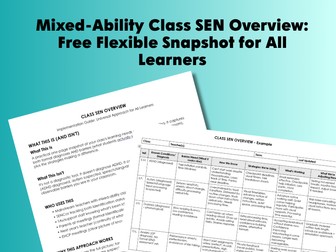
One simple landscape snapshot for your whole mixed-ability class. Capture any student with any barrier: ADHD, anxiety, dyslexia, autism, slow processing, speech/language, behaviour, low confidence – anything. Know their diagnosis status (or lack of), what barriers they face, what strategies you’re using, and what’s working. No need for separate sheets per condition – this one flexible page works for diagnosed, suspected, or just-needs-differentiation students. 7-column landscape template, 5 worked examples showing mixed needs in one class, editable Word .docx, UK secondary (Year 7–11). FREE.
Behaviour vs Need Decision TreeQuick View
beinlab

Behaviour vs Need Decision Tree

(0)
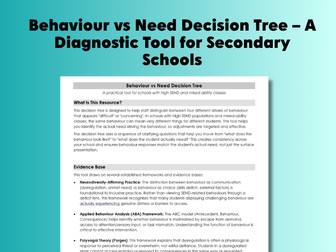
Is your school struggling to distinguish between behaviour driven by dysregulation, skills deficit, access barriers, and actual defiance? This decision tree is designed for secondary schools with high SEND and mixed-ability classes. It helps staff move from “what does the behaviour look like?” to “what does the student actually need?” in three minutes. What’s included: • Laminate-ready A4/A3 decision tree flowchart • Staff quick-reference card (summary of diagnostic questions) • Full guidance including evidence base (neurodiversity-affirming practice, ABA, polyvagal theory, UDL) • Step-by-step implementation guide • Ready to print, train staff on, and use immediately Why this matters: In schools with high SEND populations, the same behaviour means different things for different students. Dysregulation looks like defiance until you understand the student is overwhelmed, not being difficult. This tool ensures your behaviour responses are targeted at the actual need, not just the surface behaviour. Who should download this: Secondary school SENDCos, inclusion leads, behaviour leads, senior staff responsible for SEND or behaviour strategy. Works at whole-school or departmental level. Practical, evidence-based, and immediately usable. No video training or ongoing facilitation required.