A two-page A3 landscape wallchart for the 2026 FIFA World Cup, designed for classroom display or individual pupil use. Page one covers all 12 group stages with every fixture, date, and venue included – pupils fill in results as the tournament progresses or predict scores before matches kick off. A final standings table sits below each group for tracking team positions. Page two features the full knockout bracket from the Round of 32 through to the Final, with a champion box for pupils to name their predicted winner. Works equally well as a live score tracker updated match by match, a prediction challenge at the start of the tournament, or a display piece to keep the class engaged throughout. No preparation required – print both pages on A3 landscape, hand out, and go. Suitable for upper primary and early secondary.
This Burns Night literacy pack is designed for Second Level (P5-P7) and develops analytical reading, Scots language awareness and extended writing skills, all centred on the poetry and life of Robert Burns. It is fully aligned to Curriculum for Excellence Experiences and Outcomes and Second Level Literacy and English Benchmarks, and is suitable for use through P5-P7, including as assessed writing in P7.
The pack features a reading comprehension activity based on Address to a Haggis, with selected stanzas presented alongside a modern English gloss and a set of literal, inferential, evaluative and language analysis questions. A Scots language analysis activity asks pupils to complete a glossary exploring word choice and effect, then write analytical paragraphs on why Burns chose to write in Scots. A biography of Robert Burns is followed by retrieval, inferential and evaluative questions and an extended fact-or-opinion task requiring written justification. The narrative writing task asks pupils to write a third-person account of Burns at the plough discovering the mouse’s nest, with a planning frame, word bank and peer assessment prompt. An information report writing frame guides pupils through an independently written piece on Burns as a Scottish icon, with success criteria built in.
A teacher notes page lists all relevant Experiences and Outcomes - LIT 2-16a, ENG 2-17a, LIT 2-18a, ENG 2-19a, LIT 2-20a, LIT 2-22a, ENG 2-22a, LIT 2-26a and ENG 2-31a - alongside benchmark statements and suggested timings for each activity.
All pages are print-ready and designed to reproduce clearly in black and white. The pack is 13 pages including the cover and teacher notes.
This Burns Night literacy pack is designed for First Level (P2-P4) and covers reading comprehension, Scots vocabulary, biography work and writing tasks, all built around the poetry and life of Robert Burns. It is fully aligned to Curriculum for Excellence Experiences and Outcomes and First Level Literacy and English Benchmarks.
The pack features a reading comprehension activity based on To a Mouse, with selected stanzas presented alongside a modern English gloss and a set of literal, inferential and evaluative questions. A Scots vocabulary activity asks pupils to match words to meanings, complete gap-fill sentences and use Scots language in their own writing. A short biography of Robert Burns is followed by comprehension questions and a fact-or-opinion task. The descriptive writing activity invites pupils to write from the perspective of the mouse, with a structured planning scaffold, sentence starters and a word bank. An information report writing frame guides pupils through a structured piece on Burns and Burns Night using given headings and starters.
A teacher notes page lists all relevant Experiences and Outcomes - LIT 1-16a, ENG 1-17a, LIT 1-18a, ENG 1-19a, LIT 1-20a, LIT 1-22a, ENG 1-22a and LIT 1-26a - alongside the corresponding benchmark statements and suggested timings for each activity.
All pages are print-ready and designed to reproduce clearly in black and white. The pack is 12 pages including the cover and teacher notes.
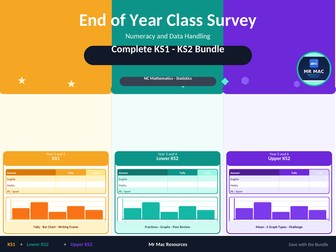
This bundle brings together all three versions of the End of Year Class Survey - Numeracy and Data Handling resource, covering KS1 through to Upper KS2. It is ideal for teachers of mixed-age or split classes, subject leads wanting a consistent whole-school end-of-year activity, or schools looking to provide differentiated versions of the same task across multiple year groups.
All three resources follow the same end-of-year survey theme and can be run simultaneously across different classes, with each version offering appropriate content, scaffolding and challenge for its stage. The resources are fully aligned to the National Curriculum for Mathematics - Statistics.
KS1 - pupils survey classmates using four pre-set questions, record tally marks, and construct a guided bar chart with a scaffolded writing frame. Suitable for Year 1 and Year 2.
Lower KS2 - pupils design two of their own questions alongside two pre-set ones, record data including fractions and percentages, choose and construct their own graph type, and complete a peer review activity. Suitable for Year 3 and Year 4.
Upper KS2 - pupils design their own questions, record data including the mean, use two different graph types with written justification, and complete higher-order statistical analysis prompts including a challenge activity on data reliability and misleading data. Suitable for Year 5 and Year 6.
No preparation required beyond printing. Purchasing the bundle saves against buying all three resources separately.
This bundle contains both the First Level (P2-P4) and Second Level (P5-P7) Burns Night literacy packs offering complete coverage of the Burns Night learning across the primary school. Both packs are fully aligned to Curriculum for Excellence Experiences and Outcomes and the relevant Literacy and English benchmarks for each level.
The First Level pack is built around To a Mouse and includes a levelled reading comprehension, a Scots vocabulary activity, a Burns biography with questions, a descriptive writing task with scaffold and a structured information report frame. The Second Level pack is built around Address to a Haggis and includes an analytical reading comprehension with language analysis questions, a Scots language study activity, a biography with fact-or-opinion and evaluative tasks, an extended narrative writing task and an independently written information report frame.
Both packs include a teacher notes page with Full Experiences and Outcomes references, benchmark codes and suggested timings. All pages are print-ready and designed to reproduce clearly in black and white.
Purchasing this bundle saves against buying the two packs individually.
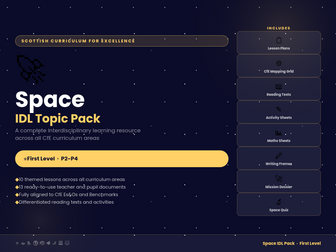
This complete Space interdisciplinary learning pack covers all ten themes of a cross-curricular space topic for First Level (P2-P4), fully aligned to the Scottish Curriculum for Excellence. All Experiences and Outcomes and Benchmarks are mapped across Literacy and English, Numeracy and Mathematics, Sciences, Social Studies, Technologies, Health and Wellbeing, Expressive Arts, and Religious and Moral Education.
The pack contains thirteen documents. Teacher resources include a detailed CfE mapping grid showing all relevant Es&Os and Benchmarks, and ten fully written lesson plans covering every theme from the introductory engagement lesson through to the final showcase and assessment. Each lesson plan includes learning intentions, success criteria, beginning, middle and end activities, differentiation guidance for both support and extension, assessment opportunities, and a list of required resources.
Pupil-facing resources include two original non-fiction reading texts, each available in an Accessible and a Challenging version with accompanying comprehension questions at literal, inferential and evaluative levels. Activity sheets cover Themes 1 to 3 (including a discussion mat, planet ordering activity, planet research sheet, sun and moon observation diary, astronaut profile sheet and space timeline), Theme 5 writing frames (narrative planning frame, story scaffold, information report frame and space word bank), Theme 6 maths activity sheets (large numbers, time in space, measurement and word problem cards), and Themes 7 to 9 (design brief, design drawing sheet, evaluation sheet, space art guide, Mission Control drama cards, astronaut nutrition activity and big questions discussion cards).
Also included are a Space Mission Dossier - a fifteen-page pupil booklet used throughout the topic to record learning across all ten themes - a ten-question multiple choice space quiz with teacher answer key, a set of twenty-four vocabulary display cards, five astronaut profile cards featuring Yuri Gagarin, Valentina Tereshkova, Neil Armstrong, Mae Jemison and Tim Peake, a self-assessment I Can strips sheet, and a Mission Accomplished badge sheet.
All resources are ready to print and use without additional preparation.
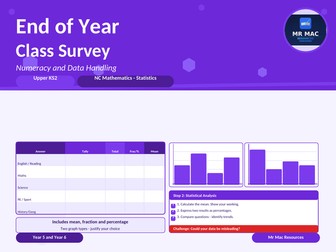
This two-page resource asks pupils to design and carry out their own end-of-year class survey, then apply a full range of statistical skills to analyse and present their findings. Two questions are provided as starting points, while pupils design two of their own with careful attention to question wording and data reliability.
The tally recording table includes columns for total, fraction or percentage, and the mean - pushing pupils to apply and connect multiple areas of number work. On the analysis page, pupils must use two different graph types and justify why each is appropriate. Four statistical analysis prompts require pupils to calculate the mean with shown working, compare results using percentages, identify trends, and make evidence-based predictions. A Challenge box asks pupils to consider whether their data could be misleading and how they would improve the reliability of their survey - directly targeting the Year 5 and 6 statistics curriculum.
The resource is aligned to the National Curriculum for Mathematics - Statistics at Upper Key Stage 2.
Page 1 - Survey sheet with two pre-set questions and two pupil-designed questions, including total, fraction or percentage, and mean columns. Page 2 - Two blank graph templates requiring different graph types with justification, four statistical analysis prompts including calculation of the mean, and a challenge activity on data reliability.
No preparation required beyond printing. Suitable for Year 5 and Year 6.
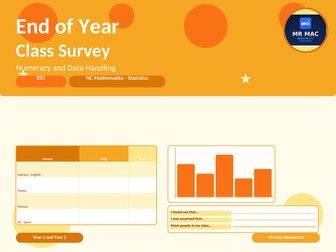
This ready-to-use two-page resource gives pupils a structured and engaging end-of-year maths activity that can be completed in a single afternoon session. Pupils survey their classmates using four pre-written end-of-year themed questions, record their results using tally marks, and then display and analyse their data using a guided bar chart template and scaffolded writing frame.
All answer options are provided for pupils, making this fully accessible for KS1 learners. Sentence starters support the written analysis section, and a reflection activity encourages pupils to evaluate their own survey process.
The resource is aligned to the National Curriculum for Mathematics - Statistics at Key Stage 1. Pupils collect and record data in tally charts, construct a bar chart, and answer questions about their results.
Page 1 - Survey sheet with four themed questions and tally recording tables. Page 2 - Bar chart template with pre-numbered axes, guided writing frame with sentence starters, and a paired reflection activity.
No preparation required beyond printing. Suitable for Year 1 and Year 2.
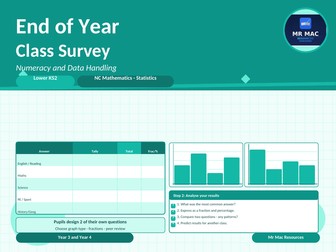
This two-page resource challenges pupils to design, carry out and analyse their own end-of-year class survey - a meaningful and engaging activity that develops real statistical thinking. Two questions are provided as starting points, while pupils design two of their own, choosing appropriate answer options and considering how to gather useful data.
The tally recording table includes a fraction and percentage column, pushing pupils to apply number skills in context. On the analysis page, pupils choose their graph type and justify their choice, construct their graphs using blank axes, and respond to four higher-order analysis prompts. A peer review section encourages collaborative written feedback.
The resource is aligned to the National Curriculum for Mathematics - Statistics at Lower Key Stage 2. Pupils collect, record and interpret data, construct appropriate graphs, and draw conclusions from their findings.
Page 1 - Survey sheet with two pre-set questions and two pupil-designed questions, including a fraction and percentage column. Page 2 - Two blank graph templates with choice of graph type, four structured analysis prompts, and a peer review activity.
No preparation required beyond printing. Suitable for Year 3 and Year 4.
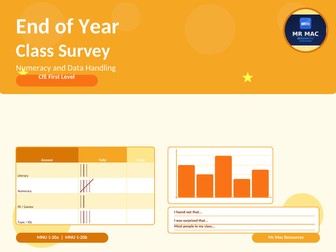
This ready-to-use two-page resource gives pupils a structured and engaging end-of-year numeracy activity that can be completed in a single afternoon session. Pupils survey their classmates using four pre-written end-of-year themed questions, record their results using tally marks, and then display and analyse their data using a guided bar graph template and scaffolded writing frame.
All answers are provided for pupils, making this fully accessible for First Level learners. Sentence starters support the written analysis section, and a reflection activity encourages pupils to evaluate their own survey process.
The resource is fully aligned to CfE First Level Numeracy and Mathematics - MNU 1-20a and MNU 1-20b.
Page 1 - Survey sheet with four themed questions and tally recording tables. Page 2 - Bar graph template with pre-numbered axes, guided writing frame with sentence starters, and a paired reflection activity.
No preparation required beyond printing. Suitable for P2-P4 or any composite class working at First Level.
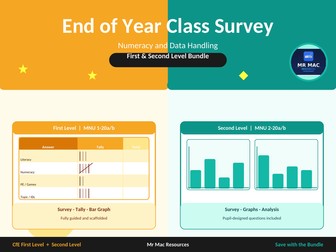
This bundle contains both the First Level and Second Level versions of the End of Year Class Survey - Numeracy and Data Handling resource, making it ideal for teachers of composite classes or schools wanting to offer a consistent end-of-year activity across stages.
Both resources follow the same end-of-year survey theme and can be run simultaneously in the same classroom, with each level offering appropriately differentiated content, scaffolding and challenge. First Level pupils work with pre-set questions, guided tally tables and a structured bar graph template. Second Level pupils design their own questions, choose their graph type, and engage with higher-order analysis tasks including fractions, percentages and peer review.
Purchasing the bundle saves against buying both resources separately.
First Level - aligned to MNU 1-20a and MNU 1-20b. Second Level - aligned to MNU 2-20a, MNU 2-20b and LIT 2-26a. Suitable for P2-P7.
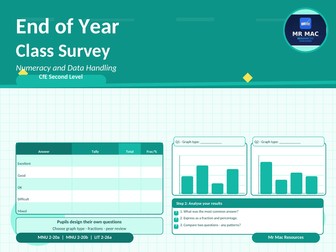
This two-page resource challenges pupils to design, carry out and analyse their own end-of-year class survey - a meaningful and engaging activity that develops real statistical thinking. Two questions are provided as starting points, while pupils design two of their own, choosing appropriate answer options and considering how to gather useful data.
The tally recording table includes a fraction and percentage column, pushing pupils to apply number skills in context. On the analysis page, pupils choose their graph type and justify their choice, construct their graphs using blank axes, and respond to four higher-order analysis prompts using mathematical language. A peer review section encourages collaborative feedback.
The resource is aligned to CfE Second Level Numeracy and Mathematics - MNU 2-20a and MNU 2-20b - and supports aspects of Literacy and English LIT 2-26a through the written analysis tasks.
Page 1 - Survey sheet with two pre-set questions and two pupil-designed questions, including a fraction and percentage column. Page 2 - Two blank graph templates with choice of graph type, four structured analysis prompts, and a peer review activity.
No preparation required beyond printing. Suitable for P5-P7 or any composite class working at Second Level.
This resource contains two end of year art task sheets aligned to the Scottish Curriculum for Excellence - one for First Level and one for Second Level. Each sheet is designed to be printed as a double-sided A4 and completed alongside artwork done on a separate piece of paper, meaning the only resources children need are pencils, pens and paper.
The First Level sheet includes four tasks covering drawing from memory, identifying and describing the visual elements, exploring colour theory including primary and secondary colours, and responding to the work of an artist or designer. A peer feedback bonus task and a star self-assessment are also included.
The Second Level sheet includes tasks on planning an end of year artwork with a focus on depth and mark-making, analysing the completed artwork using art vocabulary, and a structured artist or designer study. Children are asked to describe how they used the visual elements, explain their media choices, discuss what works well and what could be improved, and give a personal response to an artist’s work. A five-criteria star self-assessment rounds off the sheet.
Both sheets are fully aligned to the Expressive Arts Experiences and Outcomes and Benchmarks - EXA 1-02a to EXA 1-07a at First Level and EXA 2-02a to EXA 2-07a at Second Level. The resource is suitable for use at the end of P4-P5 for First Level and P6-P7 for Second Level.
This resource contains two end of year art task sheets aligned to the National Curriculum for England - one for Key Stage 1 and one for Key Stage 2. Each sheet is designed to be printed as a double-sided A4 and completed alongside artwork done on a separate piece of paper, meaning the only resources children need are pencils, pens and paper.
The Key Stage 1 sheet includes four tasks covering drawing from memory, identifying and using the elements of art including line, shape, form, colour, tone, pattern, texture and space, exploring colour mixing including primary and secondary colours, and responding to the work of an artist or designer. A peer feedback bonus task and a star self-assessment are also included.
The Key Stage 2 sheet includes tasks on planning an end of year artwork with a focus on depth, mark-making and technique, analysing the completed artwork using art vocabulary, and a structured artist or designer study. Pupils are asked to describe how they used the elements of art, explain their technique choices, discuss what works well and what could be improved, and give a personal response to an artist’s work. A five-criteria star self-assessment rounds off the sheet.
Both sheets are fully aligned to the Art and Design National Curriculum for England. The Key Stage 1 sheet is suitable for Years 1 and 2 and the Key Stage 2 sheet is suitable for Years 3 to 6, with the depth of response expected naturally increasing with age.
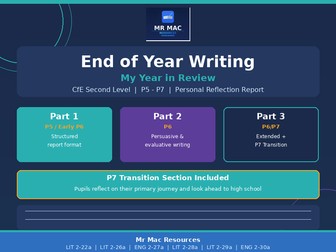
A differentiated end of year writing pack for CfE Second Level, covering P5 to P7. Pupils reflect on their school year and look ahead with ambition and purpose through a personal reflection report - a rich non-fiction writing task designed for use in June.
The pack contains three fully differentiated parts, each with a planning frame and a writing task. Part 1 focuses on organising information logically under headings with appropriate vocabulary and tone, suitable for P5 and early P6. Part 2 challenges pupils to move beyond recounting and begin to engage and influence the reader using persuasive and evaluative techniques, suitable for P6. Part 3 is the most extended and independent task, combining personal reflection, persuasion and ambitious language - suitable for confident P6 and P7 writers.
Part 3 includes a dedicated P7 transition section, inviting pupils to reflect on their whole primary school journey and look ahead to high school with honesty and excitement. Pupils consider what they are looking forward to, what challenges they may face and what goals they have for secondary school.
All three parts are included in one PDF, making it easy to print the right version for each group. Teacher notes with CfE references are included.
CfE references - LIT 2-22a - LIT 2-24a - LIT 2-25a - LIT 2-26a - ENG 2-27a - LIT 2-28a - LIT 2-29a - ENG 2-30a
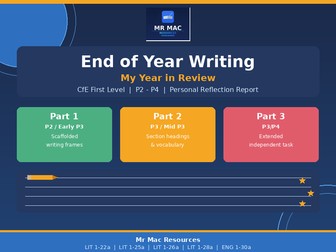
A differentiated end of year writing pack for CfE First Level, covering P2 to P4. Pupils reflect on their school year and look ahead to next year through a personal reflection report - a motivating and purposeful non-fiction writing task for June.
The pack contains three fully differentiated parts, each with a planning frame and a writing task. Part 1 is heavily scaffolded with sentence starters and guided frames, suitable for P2 and early P3. Part 2 reduces the scaffolding and introduces section headings for pupils to organise their own ideas, suitable for P3. Part 3 is the most extended and independent task, with an open planning frame, a vocabulary bank and a self-assessment checklist, suitable for confident P3 and P4 writers.
All three parts are included in one PDF, making it easy to print the right version for each group. Teacher notes with CfE references are included.
CfE references - LIT 1-20a - LIT 1-22a - LIT 1-25a - LIT 1-26a - LIT 1-28a - LIT 1-29a - ENG 1-30a
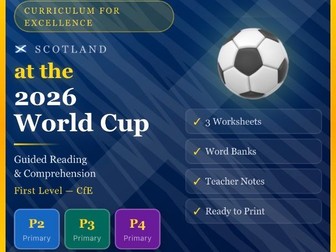
Scotland at the 2026 World Cup | Guided Reading & Comprehension | CfE First Level | P2, P3 & P4
Capitalise on World Cup fever with this fully differentiated guided reading and comprehension resource for CfE First Level! Three complete, ready-to-use pupil worksheets — one each for Primary 2, Primary 3 and Primary 4 — all built around the real, exciting story of Scotland’s dramatic qualification for the 2026 FIFA World Cup.
What’s included:
P2 worksheet — a simplified shared reading text with five recall and personal response questions, a word bank and a drawing activity
P3 worksheet — a fuller reading text, a vocabulary task, and six comprehension questions progressing from retrieval to basic inference
P4 worksheet — a more challenging text with two differentiated question sections (Finding Information and Thinking it Through), a vocabulary challenge and deeper inference questions
Every worksheet includes:
A colourful, engaging layout designed to appeal to primary pupils
A relevant key facts box to support reading
A word bank to develop vocabulary
A self-assessment traffic light at the bottom
Name and date fields ready to print and go.
Curriculum links:
Literacy and English — Reading for information; understanding, analysing and evaluating texts; vocabulary development; personal response to reading.
About the texts:
All reading passages are based on real events — Scotland’s qualification campaign, their stunning 4–2 win over Denmark at Hampden Park in November 2025, key players including Scott McTominay and Andy Robertson, and their group stage draw against Haiti, Brazil and Morocco. Texts have been carefully written and levelled for each year group, with vocabulary and sentence complexity increasing from P2 to P4.
Why teachers love this resource:
Fully differentiated — no adapting needed, just print the right sheet
Real-world context that motivates and engages pupils
Saves hours of planning and preparation
Ideal for guided reading sessions, independent work or homework
Compatible with any school using the Curriculum for Excellence
Introduce your KS1 pupils to non-fiction writing with this fully differentiated information report resource. Two complete lesson plans with pupil worksheets - one each for Year 1 and Year 2 - using England’s 2026 FIFA World Cup campaign as a motivating real-world context for factual writing.
What’s included:
Year 1 lesson - a simple stimulus report read aloud together, sentence starters, a word bank and a non-fiction features identification activity
Year 2 lesson - a fuller stimulus text, a non-fiction features analysis table, a five-section planning grid and extended writing space
Every lesson includes:
A clear Learning Intention and Success Criteria
Teacher notes with discussion prompts and plenary suggestions
A non-fiction stimulus text written and levelled for each year group
A word bank of topic-specific vocabulary
A non-fiction features identification activity
A planning grid and writing space
A self-assessment section
Curriculum links - English: writing for a range of purposes; non-fiction text features; present tense; factual writing; vocabulary; text organisation.
Builds from basic fact sentences at Year 1 to a structured multi-paragraph report at Year 2. Pairs well with the KS1 Narrative Writing pack for a complete World Cup writing unit. Compatible with any school following the National Curriculum in England.
This complete Space interdisciplinary learning pack covers all ten themes of a cross-curricular space topic for Second Level (P5-P7), fully aligned to the Scottish Curriculum for Excellence. All Experiences and Outcomes and Benchmarks are mapped across Literacy and English, Numeracy and Mathematics, Sciences, Social Studies, Technologies, Health and Wellbeing, Expressive Arts, and Religious and Moral Education.
The pack contains thirteen documents. Teacher resources include a detailed CfE mapping grid and ten fully written lesson plans for every theme. Each lesson plan includes learning intentions, success criteria, differentiated activities with support and extension guidance, assessment opportunities, and required resources.
Pupil-facing resources include two original non-fiction reading texts - an information text on the solar system and a dual biography of space pioneers Valentina Tereshkova and Mae Jemison - each available in an Accessible and a Challenging version. Challenging versions include a language analysis question section addressing the writer’s craft. Activity sheets cover Themes 1 to 3 (fact, opinion and debatable activity, solar system research project, planet data table, source evaluation using the CRAAP framework, space pioneer comparison sheet and annotated timeline), Theme 5 writing frames (persuasive argument planning frame, information report structure guide and peer editing framework), Theme 6 maths sheets (large numbers and rounding, weight on other planets with data handling, multi-step time problems and planetary data handling), and Themes 7 to 9 (Mars habitat design brief, annotated design template, evaluation framework, press conference drama scenario and character profiles, space art guide with artist’s reflection, a space mission meal plan and origins of the universe discussion activity, and a reasoned argument task on the question of extraterrestrial life).
Also included are a Space Mission Dossier - a fifteen-page pupil booklet for recording analytical reflection across all ten themes - a ten-question multiple choice quiz with teacher answer key, a twenty-four card vocabulary display set, five astronaut profile cards, a self-assessment I Can strips sheet, and a Mission Accomplished badge sheet.
All resources are ready to print and use without additional preparation.
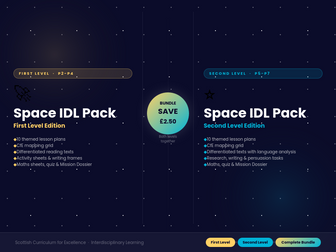
This bundle contains the complete Space interdisciplinary learning pack for both First Level (P2-P4) and Second Level (P5-P7), fully aligned to the Scottish Curriculum for Excellence across all eight curriculum areas. Purchasing both packs together saves £2.50 compared to buying them individually.
The bundle contains twenty-six documents in total - thirteen per level. Both packs share the same ten-theme structure, covering Launching Into Space, Our Solar System, Space Explorers, Reading the Universe, Writing in Space, Space Maths, Design a Space Mission, Space Art and Drama, Big Questions, and Mission Complete. Content is fully differentiated between levels, with First Level resources built around scaffolded activities, sentence starters and drawing tasks, and Second Level resources built around independent research, analytical writing, source evaluation and extended reasoning.
Each pack includes a CfE mapping grid, ten lesson plans, differentiated reading texts with comprehension questions, themed activity sheets across all curriculum areas, writing frames, maths activity sheets, a fifteen-page Space Mission Dossier for pupils to use throughout the topic, a multiple choice quiz with teacher answer key, twenty-four vocabulary display cards, five astronaut profile cards, self-assessment I Can strips, and a Mission Accomplished badge sheet.
This bundle is ideal for schools with mixed Primary 2-7 classes, for stage teams planning the same topic across two year groups, or for teachers moving between stages who want a consistent set of resources that grows with their pupils.
All resources are ready to print and use without additional preparation.
Scotland at the 2026 World Cup | Narrative Writing Lessons | CfE First Level | P2, P3 & P4
Harness World Cup excitement to inspire your writers! This fully differentiated narrative writing resource for CfE First Level contains three complete lesson plans with pupil worksheets — one each for Primary 2, Primary 3 and Primary 4 — all built around Jamie, a young Scotland fan watching Scotland’s historic 4–2 win over Denmark at Hampden Park.
What’s included:
• P2 lesson — shared stimulus reading, sentence starters, a word bank and a drawing activity to scaffold early writers
• P3 lesson — fuller stimulus text, a five-stage planning grid, vocabulary support and extended writing space
• P4 lesson — complete stimulus text with a Writer’s Toolkit analysis activity, two-section planning grid and extended writing space
Every lesson includes:
• A clear Learning Intention and Success Criteria
• Differentiated teacher notes with discussion prompts and plenary ideas
• A narrative stimulus text written and levelled specifically for each year group
• A word bank tailored to the level
• Planning grid with structured prompts
• A self-assessment section
Curriculum links:
Literacy and English — Writing for a range of purposes and audiences; narrative structure; descriptive language; vocabulary development; sentence-level work.
Why teachers love this resource:
Fully planned — Learning Intention, Success Criteria, teacher notes, stimulus and pupil task all in one document
Topical, real-world context that gives reluctant writers something to say
Progresses from supported sentence writing at P2 to independent narrative craft at P4
Print and go — no preparation needed
Compatible with any school using the Curriculum for Excellence


 Quick View