Complete Middle School Biology BundleQuick View
orotheory

Complete Middle School Biology Bundle

9 Resources
Teach the core concepts of biology with this comprehensive Biology Lesson Bundle. This collection of engaging, ready-to-teach lessons and printable activities is designed to make biology meaningful, interactive, and easy to understand. Perfect for middle school science classrooms, this bundle includes complete lessons covering cells, microscopes, biological organization, reproduction, ecosystems, and energy transfer. Each lesson features colorful visuals, inquiry-based learning, interactive activities, guided practice, and assessments that help students develop scientific knowledge and critical thinking skills. This Bundle Includes Cell City Exploring Cells Science Lesson Cell City Microscope Activity Sheet Comparing Plant and Animal Cells Compound Microscope Parts and Functions Levels of Biological Organization Meiosis and Fertilization Complete Lesson Sexual and Asexual Reproduction Complete Lesson Trophic Levels and Energy Transfer Lesson Bundle Understanding Mitosis Interactive Lesson Unicellular and Multicellular Lesson Topics Covered Cells Cell Organelles Plant and Animal Cells Compound Microscope Scientific Investigation Biological Organization Unicellular Organisms Multicellular Organisms Mitosis Meiosis Sexual Reproduction Asexual Reproduction Ecosystems Trophic Levels Energy Transfer Food Chains Food Pyramids Biology Life Science
Levels of Biological Organization: Cells to Biosphere |Complete Science LessonQuick View
orotheory

Levels of Biological Organization: Cells to Biosphere |Complete Science Lesson

(0)
Save hours of lesson planning with this complete, ready-to-teach Science lesson on the Levels of Biological Organization. Students discover how living things are organized from the cell to the biosphere, exploring how cells form tissues, tissues form organs, organs work together in organ systems, and organisms interact within populations, communities, ecosystems, and the biosphere. Includes: ✔ Ready-to-use presentation ✔ Learning objectives & success criteria ✔ Hook activities ✔ Guided discussions ✔ Interactive learning activities ✔ Student worksheets ✔ Reflection ✔ Exit ticket ✔ Assessment Students will identify, describe, compare, and arrange the nine levels of biological organization while explaining how each level is connected to the next. Perfect for Grade 7 Science, Life Science, Biology, STEM, middle school classrooms, and homeschool.
Sexual & Asexual Reproduction| Complete Science LessonQuick View
orotheory

Sexual & Asexual Reproduction| Complete Science Lesson

(0)
Save hours of lesson planning with this complete, ready-to-teach Science lesson on Sexual and Asexual Reproduction. Students explore the different types of reproduction, compare sexual and asexual reproduction, and examine real-life examples in plants, animals, and microorganisms through engaging visuals and activities. Includes: ✔ Ready-to-use presentation ✔ Learning objectives ✔ Interactive activities ✔ Guided discussions ✔ Real-life examples ✔ Student worksheets ✔ Reflection ✔ Exit ticket ✔ Assessment Students will differentiate sexual and asexual reproduction, identify their types, compare offspring and parents, and explain how reproduction ensures the continuity of life. Perfect for Grade 7 Science, middle school biology, STEM, and homeschool. Tagged Topics Science Education Biology Reproduction Cell Biology Middle School Science STEM Education Classroom Activities Science Classroom Teacher Resources Homeschool
Meiosis and Fertilization Complete LessonQuick View
orotheory

Meiosis and Fertilization Complete Lesson

(0)
A complete, visually engaging 42-slide PowerPoint lesson on Meiosis and Fertilization designed for Grade 7 Science. This resource explains how genetic information is passed from parents to offspring using colorful infographics, accurate biological diagrams, animations-ready layouts, assessment slides, and student-friendly explanations. This resource includes: Learning Objectives Review Activity Think About It (Engage) Definition of Meiosis Importance of Meiosis Chromosome Numbers Where Meiosis Occurs Complete Phases of Meiosis I Interphase Prophase I Metaphase I Anaphase I Telophase I Cytokinesis I Complete Phases of Meiosis II Introduction to Meiosis II Prophase II Metaphase II Anaphase II Telophase II Cytokinesis II Products of Meiosis Why Cells Are Genetically Different Gametes Fertilization How Traits Are Passed Why Children Do Not Look Exactly Like Their Parents Application Activity Activity Cards and Answer Key Exit Ticket Assessment (8 questions) Reflection Activity Closing Slide
Trophic Levels & Energy Transfer Lesson BundleQuick View
orotheory

Trophic Levels & Energy Transfer Lesson Bundle

(0)
Teach ecosystem energy flow with this engaging 2-Lesson Science Bundle! This ready-to-teach resource helps students understand how energy moves through food chains, trophic levels, and food pyramids using colorful visuals, inquiry-based learning, interactive activities, guided practice, and assessments. Designed for middle school science classrooms, this bundle builds students’ understanding from identifying trophic levels to explaining why energy decreases as it moves through an ecosystem. This Bundle Includes Lesson 1: Trophic Levels Interactive PowerPoint Presentation Learning Objectives Success Criteria Hook Activity Producers, Consumers, and Decomposers Food Chains Food Web Connections Primary, Secondary, Tertiary Consumers Apex Predators Trophic Level Identification Activities Guided Practice Independent Practice Assessment Exit Ticket Lesson Summary Lesson 2: Transfer of Energy in Ecosystems Interactive PowerPoint Presentation Learning Objectives Success Criteria Hook Activity Energy Flow in Ecosystems Food Pyramid Energy Transfer Between Trophic Levels The 10% Rule Pyramid of Energy Energy Loss at Each Level Interactive Class Activities Guided Practice Independent Practice Assessment Exit Ticket Lesson Summary Students Will Learn To Describe trophic levels in an ecosystem. Identify producers, consumers, and decomposers. Explain how energy enters an ecosystem. Trace the flow of energy through food chains and food pyramids. Explain why less energy is available at higher trophic levels. Interpret food pyramids. Apply ecosystem concepts to real-life situations.
Physical Science Complete Lesson BundleQuick View
orotheory

Physical Science Complete Lesson Bundle

9 Resources
Teach the essential concepts of Physical Science with this comprehensive, ready-to-teach lesson bundle. This collection of engaging presentations covers the foundations of matter, scientific investigations, measurements, laboratory safety, solutions, solubility, acids and bases, and particle theory through inquiry-based learning, colorful visuals, interactive activities, and assessments. Designed for middle school science classrooms, every lesson is carefully structured to promote scientific thinking, hands-on learning, and real-world application while saving teachers valuable preparation time. This Bundle Includes Science: The Scientific Models Scientific Investigation Complete Lesson Making Accurate Measurements and Organizing Data Science Equipment and Laboratory Safety Particle Model of Matter Complete Lesson How Heat Affects Particles and Phase Changes Solutions: Solvents, Solutes and Concentration Factors Affecting Solubility Acids, Bases and Salts Using Litmus Indicators Students Will Learn To Use scientific models to explain invisible phenomena. Plan and conduct scientific investigations. Measure accurately using standard scientific units. Organize, interpret, and analyze scientific data. Identify and safely use laboratory equipment. Explain the particle model of matter. Describe how heat affects particles and changes of state. Differentiate solutes, solvents, and solutions. Calculate solution concentration. Explain factors affecting solubility. Identify acids, bases, and salts using indicators. Apply scientific knowledge to real-world situations. Topics Covered Scientific Models Scientific Investigation Laboratory Safety Science Equipment Measurement Data Collection Particle Model of Matter States of Matter Heat Transfer Phase Changes Solutions Solutes Solvents Concentration Solubility Acids Bases Salts Litmus Indicators Physical Science
Understanding Mitosis Interactive LessonQuick View
orotheory

Understanding Mitosis Interactive Lesson

(0)
Help students understand mitosis and cell division through this engaging, interactive science lesson designed for middle school learners. This ready-to-teach PowerPoint uses colorful visuals, inquiry-based activities, real-life examples, and guided practice to help students discover how cells grow, repair damaged tissues, and produce new cells. Students explore the stages of mitosis, compare mitosis and meiosis, connect cell division to everyday life, and demonstrate understanding through interactive activities, quizzes, and an exit ticket. What’s Included? 44 Interactive PowerPoint Slides Learning Objectives Success Criteria Engaging Lesson Starter Activity Follow-Up Discussion Questions Introduction to Cell Division Why Cells Divide Cell Division in Everyday Life Types of Cell Division Mitosis vs. Meiosis Comparison Cell Cycle Overview Stages of Mitosis Interphase Prophase Metaphase Anaphase Telophase Cytokinesis Mitosis in Action Activities Picture Analysis Tasks Mitosis Flowchart Summary Multiple-Choice Assessment Lesson Summary Exit Ticket Final Review Learning Objectives Students will be able to: Explain why cells divide. Describe mitosis as the process of cell division for growth and repair. Identify the stages of mitosis in the correct order. Compare mitosis and meiosis. Explain how mitosis helps organisms grow and repair damaged tissues. Apply knowledge of mitosis to real-life situations. Why Teachers Love This Resource Ready-to-Teach Highly Visual and Engaging Interactive Learning Activities Student-Friendly Explanations Inquiry-Based Learning Critical Thinking Opportunities Assessment Included No Preparation Required Topics Covered Cell Division Mitosis Meiosis Cell Cycle Interphase Prophase Metaphase Anaphase Telophase Cytokinesis Growth Tissue Repair Cell Reproduction Biology Life Science Middle School Science
Comparing Plant and Animal CellsQuick View
orotheory

Comparing Plant and Animal Cells

(0)
Help students explore the fascinating world of plant and animal cells through this engaging and interactive science lesson. This ready-to-use PowerPoint presentation introduces the major organelles found in plant and animal cells, explains their functions, and helps students compare similarities and differences using colorful visuals, inquiry-based activities, comparison charts, higher-order thinking questions, and assessment tasks. What’s Included? 33 Interactive PowerPoint Slides Learning Objectives Success Criteria Engaging Lesson Starter Activity Introduction to Cells Cell Review Major Cell Organelles Nucleus Cytoplasm Mitochondria Ribosomes Endoplasmic Reticulum Golgi Apparatus Vacuole Chloroplast Lysosome Plant Cell Diagram Animal Cell Diagram Similarities and Differences Venn Diagram Activity Cell Challenge Questions Exit Ticket Reflection Activity Lesson Summary Learning Objectives Students will be able to: Identify the major organelles found in plant and animal cells. Describe the functions of each organelle. Differentiate plant and animal cells based on their organelles. Compare similarities and differences using diagrams and activities. Apply knowledge of cell organelles to real-life situations. Why Teachers Love This Resource Ready-to-Teach Highly Visual and Engaging Interactive Activities Student-Friendly Explanations Inquiry-Based Learning Critical Thinking Questions Assessment Included No Preparation Required Topics Covered Plant Cells Animal Cells Cell Organelles Nucleus Cytoplasm Cell Membrane Mitochondria Ribosomes Endoplasmic Reticulum Golgi Apparatus Vacuole Chloroplast Lysosome Cell Comparison Biology Life Science
Unicellular and Multicellular LessonQuick View
orotheory

Unicellular and Multicellular Lesson

(0)
Help students discover how living things are made of one cell or many cells through this engaging and interactive Grade 7 Science lesson. This ready-to-use PowerPoint introduces students to cells as the basic unit of life before exploring the differences between unicellular and multicellular organisms. Through prediction activities, comparisons, sorting challenges, real-world examples, and assessments, students build a strong understanding of how living organisms are classified according to the number of cells they contain. What’s Included? 38 Interactive PowerPoint Slides Learning Objectives Success Criteria Engaging Prediction Activity Vocabulary Development What Is a Cell? Life Processes Why Cells Are Important Unicellular Organisms Multicellular Organisms Characteristics of Each Group Examples of Organisms Compare and Contrast Charts Interactive Classification Activity Sorting Challenge Real-Life Connections True or False Assessment Lesson Summary Exit Ticket Answer Keys Learning Objectives Students will be able to: Define unicellular and multicellular organisms. Differentiate unicellular and multicellular organisms. Classify organisms according to the number of cells. Explain why all living things are made of cells. Apply scientific reasoning to classify unfamiliar organisms. Why Teachers Love This Resource Ready-to-Teach Highly Visual and Engaging Interactive Activities Student-Friendly Explanations Inquiry-Based Learning Real-Life Examples Assessment Included Answer Keys Included No Preparation Required Topics Covered Cells Cell Theory Living Things Unicellular Organisms Multicellular Organisms Bacteria Amoeba Paramecium Yeast Plants Animals Fungi Classification Scientific Observation Biology Life Science
Cell City Exploring Cells Science LessonQuick View
orotheory

Cell City Exploring Cells Science Lesson

(0)
Teach cell structure in a fun, memorable, and engaging way with this Cell City science lesson! Students discover how cells work by comparing each cell part to an important building or worker in a city, making difficult biological concepts easy to understand and remember. This ready-to-use PowerPoint presentation combines inquiry-based learning, colorful visuals, interactive activities, real-world analogies, application tasks, and assessments to help students master the structure and function of cells. What’s Included? 45 Interactive PowerPoint Slides Learning Goals and Success Criteria Engaging Lesson Starter Think–Pair–Share Activity Introduction to Cells Why We Need a Microscope Cell City Analogy The Three Main Parts of a Cell Cell Membrane Nucleus Cytoplasm Cell Organelles Overview Chloroplast Ribosomes Endoplasmic Reticulum Golgi Apparatus Mitochondria Lysosomes Peroxisomes Cell City Labeling Activity Cell City Missions Application and Generalization Activities Learning Goals Check Lesson Summary Exit Ticket Assessment Reflection Activity Learning Objectives Students will be able to: Explain what a cell is. Identify the three main parts of a cell. Describe the functions of major cell organelles. Compare cell organelles using the Cell City analogy. Explain how organelles work together to keep cells alive. Apply knowledge of cell structures to solve real-life and scenario-based problems. Why Teachers Love This Resource Ready-to-Teach Highly Visual and Engaging Inquiry-Based Learning Interactive Student Activities Easy-to-Understand Cell City Analogy Encourages Critical Thinking Includes Assessment and Reflection No Preparation Required Perfect for Middle School Biology Topics Covered Cells Cell Structure Cell Membrane Cytoplasm Nucleus Cell Organelles Chloroplast Ribosomes Endoplasmic Reticulum Golgi Apparatus Mitochondria Lysosomes Peroxisomes Plant Cells Scientific Observation Biology Life Science
Science Equipment and Laboratory SafetyQuick View
orotheory

Science Equipment and Laboratory Safety

(0)
Help students become responsible young scientists with this engaging and interactive lesson on science equipment and laboratory safety. This ready-to-use PowerPoint lesson introduces common laboratory tools, their functions, proper handling techniques, and essential safety practices. Students learn through interactive challenges, equipment identification activities, real-life scenarios, safety investigations, and assessment tasks that promote critical thinking and responsible laboratory behavior. What’s Included? • 44 Interactive PowerPoint Slides • Learning Competencies and Objectives • Spot the Safety Mistakes Activity • Science Equipment Identification Lesson • Microscope Functions and Uses • Beaker Functions and Uses • Graduated Cylinder Functions and Uses • Test Tube Functions and Uses • Test Tube Rack Functions and Uses • Pipette Functions and Uses • Erlenmeyer Flask Functions and Uses • Laboratory Thermometer Functions and Uses • Alcohol Lamp Functions and Uses • Triple Beam Balance Functions and Uses • Hand Lens Functions and Uses • Test Tube Holder Functions and Uses • Safety Goggles Functions and Uses • Equipment Review Activities • Quick Check Assessment • Laboratory Safety Rules • Proper Equipment Handling Guide • Do or Don’t Interactive Activities • Real-Life Safety Scenarios • Apply It Activities with Answers • Exit Ticket Assessment • Lesson Summary and Reflection Learning Objectives Students will be able to: • Identify common science equipment and laboratory tools • Describe the function of each piece of equipment • Demonstrate proper handling of science equipment • Explain the importance of laboratory safety rules • Apply safety procedures in laboratory situations • Recognize safe and unsafe laboratory practices • Develop responsible laboratory habits Why Teachers Love This Resource • Complete Ready-to-Teach Lesson • Highly Visual and Engaging • Interactive Safety Activities • Real-Life Laboratory Scenarios • Student-Friendly Explanations • Includes Answer Keys • Assessment Included • Supports Inquiry-Based Learning • No Preparation Required • Perfect for Beginning Laboratory Skills Topics Covered • Science Equipment • Laboratory Tools • Microscope • Beaker • Graduated Cylinder • Test Tube • Pipette • Erlenmeyer Flask • Triple Beam Balance • Laboratory Thermometer • Safety Goggles • Laboratory Safety • Proper Equipment Handling • Scientific Investigation • Science Process Skills
Compound Microscope Parts & FunctionsQuick View
orotheory

Compound Microscope Parts & Functions

(0)
Help students master the parts, functions, and proper handling of a compound microscope with this engaging and interactive science lesson. Designed for middle school science, this resource uses colorful visuals, guided instruction, hands-on activities, and real-world scenarios to build confidence in microscope use while reinforcing essential laboratory skills. This ready-to-teach resource includes everything needed for a complete lesson—from introducing microscope parts to correctly carrying, focusing, observing, cleaning, and storing the microscope. What’s Included 66 Interactive PowerPoint Slides Learning Objectives Success Criteria Engaging Lesson Starter History of the Microscope Parts of a Compound Microscope Mechanical, Magnifying, and Illuminating Parts Functions of Each Microscope Part Microscope Magnification Coarse and Fine Adjustment Comparison Guided Practice Activities Mystery Part Identification Game Proper Microscope Handling Step-by-Step Microscope Procedures Real-Life Scenario Activities Lesson Summary Exit Tickets Student-Friendly Visuals Learning Objectives Students will be able to: Identify the parts of a compound microscope. Explain the function of each microscope part. Classify microscope parts according to their roles. Demonstrate proper microscope handling and use. Apply correct microscope safety procedures. Why Teachers Love This Resource Ready-to-Teach Highly Visual Interactive Activities Student-Friendly Explanations Inquiry-Based Learning No Preparation Required Supports Laboratory Skills Assessment Included Topics Covered Compound Microscope Microscope Parts Microscope Functions Mechanical Parts Magnifying Parts Illuminating Parts Microscope Magnification Proper Microscope Handling Laboratory Safety Scientific Investigation Observation Skills Science Laboratory Equipment Keywords (include at the bottom) Compound Microscope, Microscope Parts, Microscope Functions, Laboratory Equipment, Microscope Lesson, Science Lesson, Middle School Science, Biology, STEM, Lab Safety, Laboratory Skills, Scientific Investigation, Observation Skills, Interactive PowerPoint, Grade 7 Science, Secondary Science, Teacher Resources, Science Activities, Classroom Presentation
Acids, Bases and Salts Using Litmus Indicators | Complete Grade 7 Science LessonQuick View
orotheory

Acids, Bases and Salts Using Litmus Indicators | Complete Grade 7 Science Lesson

(0)
Engage your Grade 7 students with this colorful and interactive lesson on acids, bases, and salts using litmus paper. This ready-to-use PowerPoint helps learners identify common household and school solutions, understand how litmus indicators work, and classify substances as acids, bases, or salts through engaging activities and real-life examples. Perfect for Grade 7 Science, this lesson follows an inquiry-based approach that encourages observation, critical thinking, discussion, and scientific reasoning. What’s Included? 27 Full-Color PowerPoint Slides Learning Objectives and Success Criteria Engaging Lesson Starter Activity Inquiry-Based Discussion Activities Introduction to Acids, Bases, and Salts Litmus Paper Investigation Real-Life Household and School Examples Comparison Charts and Visual Summaries Generalization Activity Mystery Science Lab Challenge Application and Reflection Activities 5-Question Exit Ticket Assessment Learning Goal Checklist Lesson Wrap-Up and Closure Slides Topics Covered Acids Bases Salts Litmus Indicators Blue Litmus Paper Red Litmus Paper Classification of Solutions Everyday Examples of Acids, Bases, and Salts Scientific Observation and Investigation Learning Outcomes By the end of the lesson, students will be able to: Define acids, bases, and salts. Use litmus paper to identify different solutions. Classify common household and school solutions as acids, bases, or salts. Observe how acids, bases, and salts react with litmus indicators. Explain why acids, bases, and salts are important in everyday life. Bring chemistry to life with this fun lemonade-themed lesson that helps students confidently identify acids, bases, and salts while developing scientific thinking skills.
Factors Affecting Solubility Science LessonQuick View
orotheory

Factors Affecting Solubility Science Lesson

(0)
Teach students how different factors affect the dissolving process with this engaging and interactive Grade 7 Science lesson on solubility. This ready-to-use PowerPoint presentation helps students investigate how temperature, stirring, particle size, amount of solvent, amount of solute, and the nature of the solute and solvent influence how substances dissolve. Through inquiry-based activities, real-life problem-solving scenarios, guided discussions, and assessment tasks, students develop a deeper understanding of solubility and its practical applications. What’s Included? • 29 Interactive PowerPoint Slides • Learning Objectives and Success Criteria • Solubility Detectives Mystery Activity • Inquiry-Based Investigations • Temperature and Solubility • Stirring and Solubility • Particle Size and Solubility • Amount of Solvent and Solubility • Amount of Solute and Solubility • Nature of the Solute and Solvent • Real-Life Problem Solving Activities • Guided Discussion Questions • Case Study Investigations • Exit Ticket Assessment • Reflection Activities • Lesson Summary and Review Learning Objectives Students will be able to: • Define solubility • Identify factors affecting solubility • Explain how each factor influences dissolving • Compare different dissolving conditions • Analyze real-life situations involving solubility • Apply scientific reasoning to solve everyday problems • Use evidence to support scientific explanations Why Teachers Love This Resource • Ready-to-Teach • Highly Visual and Engaging • Inquiry-Based Learning Approach • Student-Centered Activities • Real-Life Applications • Critical Thinking Opportunities • Assessment Included • No Preparation Required Topics Covered • Solubility • Temperature • Stirring • Particle Size • Amount of Solvent • Amount of Solute • Nature of the Solute and Solvent • Dissolving • Solutions • Scientific Investigation • Problem Solving • Science Process Skills
Solutions Solvents Solutes & ConcentrationQuick View
orotheory

Solutions Solvents Solutes & Concentration

(0)
This ready-to-use lesson helps students understand how solutions are formed, identify solutes and solvents, compare different types of solutions, and calculate concentration using simple formulas and guided examples. Through colorful visuals, interactive discussions, worked examples, and assessment activities, students develop a strong foundation in solution chemistry. What’s Included? • 22 Interactive PowerPoint Slides • Learning Objectives and Success Criteria • Engaging Lesson Starter Activity • Introduction to Solutions • Solute and Solvent Concepts • Different Phases of Solutes and Solvents • Solvent vs Solute Comparison • Solution Identification Activities • Concentration Concepts • Step-by-Step Concentration Calculations • Guided Practice Activities • Independent Practice Exercises • Assessment Worksheets • Lesson Review and Summary Learning Objectives Students will be able to: • Define solution, solute, and solvent • Identify solutes and solvents in everyday examples • Compare the roles of solutes and solvents • Explain how solutions are formed • Describe concentration in simple terms • Calculate concentration using a formula • Apply concepts to real-life situations Why Teachers Love This Resource • Ready-to-Teach • Highly Visual and Engaging • Student-Friendly Explanations • Interactive Activities Included • Guided and Independent Practice • Supports Inquiry-Based Learning • No Preparation Required • Assessment Included Topics Covered • Solutions • Solute • Solvent • Concentration • Dissolving • Mixtures • Solution Chemistry • Scientific Thinking • Data Interpretation • Problem Solving
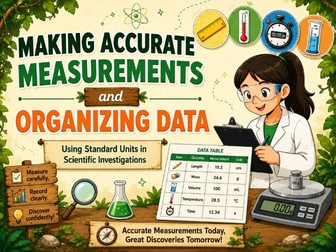
Making Accurate Measurements and Organizing Data LessonQuick View
orotheory

Making Accurate Measurements and Organizing Data Lesson

(0)
Help students develop essential scientific skills through this engaging and interactive lesson on measurement and data collection. Students learn how scientists use measuring tools, standard units, and organized data to conduct reliable investigations and draw evidence-based conclusions. File Type: PowerPoint Presentation Grade 7 Science, Measurement, Scientific Investigation, Measuring Tools, Standard Units, Data Collection, Accuracy and Precision, STEM, Science Lesson, PowerPoint, Science Process Skills, Scientific Inquiry, Data Analysis, Laboratory Skills
How Heat Affects Particles and Phase Changes LessonQuick View
orotheory

How Heat Affects Particles and Phase Changes Lesson

(0)
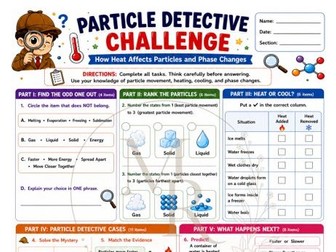
Help students understand how heat affects particle movement and how these changes lead to phase changes of matter. This engaging, detective-themed lesson uses interactive activities, visual explanations, real-life examples, and mystery scenarios to help learners explore the relationship between heat, particle behavior, and changes of state. Students investigate how heating and cooling affect particle movement, compare solids, liquids, and gases, and explain melting, freezing, evaporation, condensation, sublimation, and deposition using the Particle Model of Matter. The lesson concludes with problem-solving challenges that encourage scientific reasoning and discussion. What’s Included: 30-slide PowerPoint lesson Learning objectives Interactive pre-assessment activity Heating and cooling of particles Particle movement and energy changes Phase changes of matter Melting, freezing, evaporation, condensation, sublimation, and deposition Mystery scenario challenges Discussion and reflection activities Lesson summary and review Learning Objectives: Describe how heat affects particle movement. Compare the effects of heating and cooling on matter. Explain phase changes using the Particle Model of Matter. Analyze real-life examples of changes of state. Apply scientific reasoning to particle behavior and energy changes. Perfect For: Grade 7 Science Particle Model of Matter States of Matter Phase Changes Chemistry Lessons Middle School Science STEM Education Inquiry-Based Learning
Particle Model of Matter Complete LessonQuick View
orotheory

Particle Model of Matter Complete Lesson

(0)
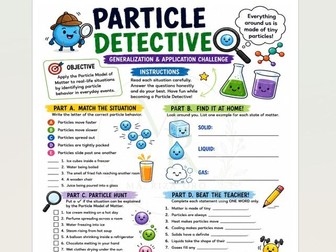
Bring the invisible world of particles to life with this engaging and visually rich Science lesson on the Particle Model of Matter. Through real-life examples, interactive discussions, colorful diagrams, and inquiry-based activities, students learn how particles explain the behavior and properties of matter. The lesson begins with a fun Mystery Scent Challenge that encourages students to think like scientists before exploring the Particle Model of Matter, the five key rules of the model, particle behavior, forces of attraction, and the differences among solids, liquids, and gases. Students discover how particle movement and arrangement explain changes in matter and everyday phenomena. What’s Included: 20-slide PowerPoint lesson Mystery Scent Challenge engagement activity Learning objectives Introduction to the Particle Model of Matter The 5 Rules of the Particle Model Structure and behavior of particles Forces of attraction Solids, liquids, and gases Particle diagrams and visual explanations Summary and review slide Reflection questions and discussion prompts Learning Objectives: Describe the Particle Model of Matter. Explain that matter is made of tiny particles that are constantly moving. Compare the arrangement and movement of particles in solids, liquids, and gases. Explain how forces of attraction affect particle behavior. Describe how temperature affects particle movement. Use the Particle Model to explain the properties of matter and changes of state. Perfect For: Grade 7 Science Particle Theory of Matter States of Matter Chemistry Lessons Middle School Science Inquiry-Based Learning STEM Education Classroom Presentations Science Review Lessons
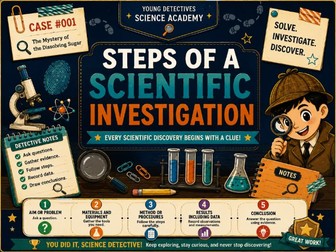
Scientific Investigation Complete Lesson | Inquiry-Based ScienceQuick View
orotheory

Scientific Investigation Complete Lesson | Inquiry-Based Science

(0)
Transform students into science detectives as they learn the five steps of a scientific investigation through interactive activities, practice tasks, and assessment challenges. Add What’s Included Teachers love knowing exactly what they’re getting. What’s Included: Lesson introduction Learning objectives Interactive pre-assessment activity Step-by-step instruction on scientific investigation Guided practice Investigation scenario Science Detective Test Answer key Closing reflection activity Add Keywords Include: Scientific Investigation Scientific Method Inquiry-Based Learning Science Lesson Middle School Science Grade 7 Science STEM Investigation Skills Critical Thinking Assessment
Science: The Scientific ModelsQuick View
orotheory

Science: The Scientific Models

(0)
Help students explore how scientists study things that cannot be directly observed with this engaging and interactive lesson presentation! This ready-to-use resource introduces scientific models and their role in understanding invisible, distant, complex, and microscopic phenomena. What’s Included? ✔ 20 visually engaging presentation slides ✔ Interactive “Can You Draw It?” mystery activity ✔ Introduction to scientific models ✔ Importance and uses of models in science ✔ Physical Models ✔ Conceptual Models ✔ Computer Models ✔ Mathematical Models ✔ Real-world scientific examples ✔ Interactive “Model Masters Challenge” (5 examples) ✔ Review and assessment activities ✔ Conclusion and reinforcement slide Learning Objectives Students will be able to: • Define a scientific model • Explain why scientists use models • Differentiate the four major types of scientific models • Identify scientific models from real-world examples