Low-Demand Meltdown & Shutdown De-Escalation GuideQuick View
DysPhilterFounder

Low-Demand Meltdown & Shutdown De-Escalation Guide

(0)
A 4-step meltdown and shutdown de-escalation guide for Autistic, ADHD and PDA children — non-punitive, low-arousal crisis response, no restraint. Answers the exact questions people search for in the moment: What to do in a meltdown, autistic shutdown help, and PDA meltdown response. A four-step, low arousal, non-punitive guide covering: Crisis response Co-regulation & Behaviour support Usable as a tutor crisis plan, pod facilitator guide, foster carer crisis response tool, as well as a parent’s quick-reference. No restraint, no consequences, no forced debrief. A short, practical guide for the moment a young person hits a genuine meltdown or shutdown at home, mid-tutoring-session, or in a small EOTAS/EHE pod. Reframes the moment not “challenging behaviour” to manage, but a nervous system in overload needing help finding safety. No apps, no login. Print and keep close by. **The four immediate steps ** **Drop all communication demands **Give absolute spatial freedom **Offer one low-pressure statement **Clear the environment Co-regulation guidance for coming back from a shutdown. What to do afterwards No consequences, no forced debrief, quietly note the pattern that led up to it. Who this is for: -Parents/carers of autistic, ADHD, or PDA young people -Tutors and key workers -EHE/EOTAS pod facilitators -Foster/kinship carers Licence: This resource may be printed and used freely for personal, family, and one-to-one professional support purposes. Not for resale or redistribution as a standalone product. © Rosalind Millett / DysPhilter™ 2026
DysPhilter™ My Sensory & Safety Profile — Living PassportQuick View
DysPhilterFounder

DysPhilter™ My Sensory & Safety Profile — Living Passport

(0)
A living sensory and safety profile for autistic, ADHD and PDA young people — a one-page profile alternative to clinical risk assessments, no scores. A five-page, write-in-your-own-words alternative often searched for as a communication passport, key worker handover document, or care plan alternative. Covers communication comforts, sensory world (sound, sight, touch, taste, smell, body awareness, interoception), executive functioning and predictability anchors, plus a full co-regulation and safety plan for meltdown support and shutdown support. Built for autistic, ADHD, PDA-friendly, alexithymia, and situational mutism presentations. Useful for new school transitions, new tutor handovers, self-advocacy, and alongside an EHCP — not as a replacement for one. A printable, fillable profile that belongs to the young person using it — not the professionals around them. Replaces the clinical “risk assessment” model entirely. No apps. No login. No scores. Print and fill in at your own pace — no deadline, no “finished” version. **Section 1 ** My Communication Comforts: how they prefer to connect, what to do (and never do) when overwhelmed. **Section 2 ** My Sensory World: a write-in card for each sense. **Section 3 ** Executive Functioning & Predictability Anchors: what keeps them grounded, how to introduce change without triggering a crisis. **Section 4 ** My Co-Regulation & Safety Plan: early warning signs, what a meltdown/shutdown looks like for them, clear MUST DO / MUST NEVER DO list. Who this is for Parents/carers of neurodistinct or traumatised young people Young people building self-advocacy documents Tutors and key workers needing a clear handover Anyone moving between settings. Licence This resource may be printed and used freely for personal, family, and one-to-one professional support purposes. Not for resale or redistribution as a standalone product. © Rosalind Millett / DysPhilter™ 2026
DysPhilter™ Parent-Carer Toolkit — Low-Demand Home GuideQuick View
DysPhilterFounder

DysPhilter™ Parent-Carer Toolkit — Low-Demand Home Guide

(0)
A low-demand parenting toolkit for autistic, ADHD and PDA children — declarative language, sensory safe spaces and carer co-regulation strategies. Written for parents searching for low demand parenting strategies, PDA (Pervasive Drive for Autonomy) support, and demand avoidance parenting advice. Covers the Red/Yellow/Green Basket method for sorting daily expectations, a full declarative language conversion table, building a genuine sensory safe space at home, and carer support strategies for meltdown and shutdown moments. Trauma-informed throughout — for foster carers, kinship carers, and any family supporting recovery from burnout or trauma, not just diagnosed autistic or ADHD children. This 3-page guide gives parents and carers permission to drop the pressure at home — and practical tools to do it. Written for families whose young person may be masking all day, only to hit exhaustion at the front door. No apps, no login. 1. Radical Permission to Drop the Demand Cliff: the Red/Yellow/Green Basket method for sorting daily expectations. 2. Transitioning to Declarative Language at Home: direct commands vs declarative alternatives, with reasoning. 3. Designing a Home Sensory Audit & Safe Spaces: building a genuine low-arousal haven at home. 4. Carer Co-Regulation & De-Escalation Strategies: checking your own energy, a simple “do nothing” protocol. Who this is for: -Parents/carers of autistic, ADHD, PDA, or neurodistinct children -Families supporting recovery from trauma or burnout -EHE and EOTAS families -Foster/kinship carers. Licence: This resource may be printed and used freely for personal and family use. Not for resale or redistribution as a standalone product. © Rosalind Millett / DysPhilter™ 2026
DysPhilter™ Sensory Check-In Kit — EHE, EOTAS & Small PodsQuick View
DysPhilterFounder

DysPhilter™ Sensory Check-In Kit — EHE, EOTAS & Small Pods

(0)
Printable sensory check-in kit for EHE, EOTAS and SEN home education. Tick-box evidence logs for Local Authority annual reviews. No apps, No scores. Built for parents delivering elective home education (EHE), families on Local Authority EOTAS packages, and small alternative provision pods of two to eight children. Includes- **A learner-facing Touch-Track Mat **A facilitator Session Evidence Log **A Pre-Session Check-In **A plain-language “How-to-Use” guide covering the legal basis for EOTAS and EHE under the Education Act 1996. Answers searches for EOTAS evidence for Local Authority annual reviews, EHCP evidence tracking, funding audit support, home education worksheets, one-to-one tutoring tools, alternative provision session logs, private therapy tracker, sensory processing disorder (SPD) comfort layout, PDA-friendly and autistic spectrum resources, low arousal approach, non-academic tracking, sensory break tools, emotional regulation for neurodistinct learners, and individual learning plan evidence. This pack gives parents, tutors, and alternative-provision facilitators four immediately usable tools — File 1 My Daily Touch-Track Mat: a learner-facing check-in sheet completed before each session, surfacing physical tension and sensory state early. **File 2 ** Session Evidence Log: tick-box observations rather than scored ratings, building a dated evidence trail for EOTAS annual reviews and LA funding conversations. **File 3 ** How to Use This Pack: plain-language legal context for EOTAS and EHE (Education Act 1996 s.7 and s.19). **File 4 ** Pre-Session Check-In: a short, low-demand check-in used before the main Touch-Track Mat. Who this is for: -Parents providing EHE -Families on LA EOTAS packages -Specialist tutors and therapists -Small co-operative learning pods (2–8 children) -Anyone supporting a neurodistinct learner outside mainstream school Licence This resource may be printed and used freely for personal, EHE, and non-commercial alternative provision purposes. Not for resale or redistribution as a standalone product. © Rosalind Millett / DysPhilter™ 2026
DysPhilter™ The Low-Demand Support Bundle (3 Resources)Quick View
DysPhilterFounder

DysPhilter™ The Low-Demand Support Bundle (3 Resources)

(0)
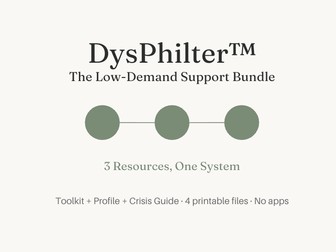
The complete toolkit for low-demand parenting support, PDA and drive for autonomy support bundle - Sensory safety profile Parent-carer toolkit Meltdown de-escalation guide for autistic, ADHD, PDA families. Plus a short bundle guide explaining the order most families find useful. **All bundled below the cost of buying all three separately. ** Relevant across autism, ADHD, SEN and SEMH settings, home education and EOTAS provisions, and foster care. Trauma-informed throughout, for families who want the complete system in one purchase. These three resources were designed to work together, bundled at a lower combined price. **Included: ** -Parent-Carer Co-Production Toolkit (the everyday work of building a low-demand home) -My Sensory and Safety Profile (belongs to the young person) -Low-Demand Meltdown & Shutdown De-Escalation Guide (the four steps for the moment itself, linking back to the Profile). Plus a short bundle guide explaining the order most families find useful. No apps, no login, no scores. Why buy the bundle: The Crisis Guide explicitly points back to the Profile to log patterns after a meltdown - they’re a loop, not three unrelated documents. Licence This resource may be printed and used freely for personal, family, and one-to-one professional support purposes. Not for resale or redistribution as a standalone product. © Rosalind Millett / DysPhilter™ 2026